The Story of Heyford: Heyford’s Midwife V1C1

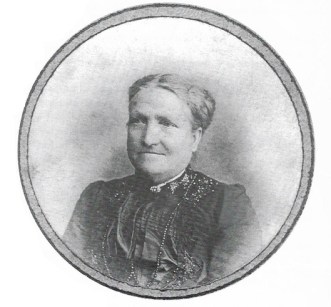
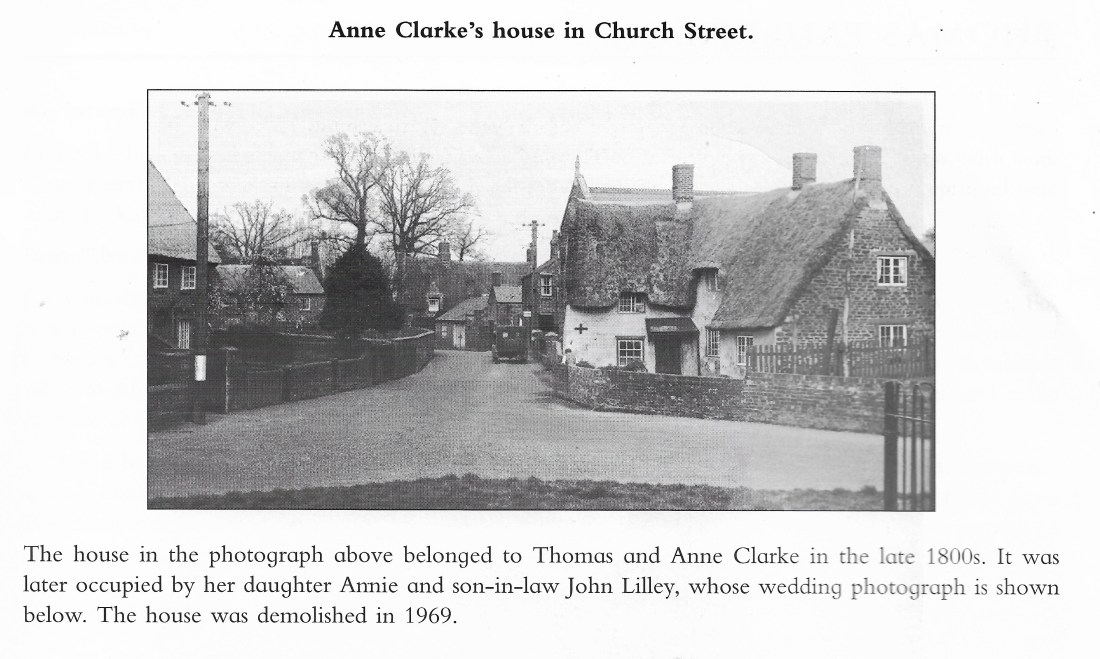
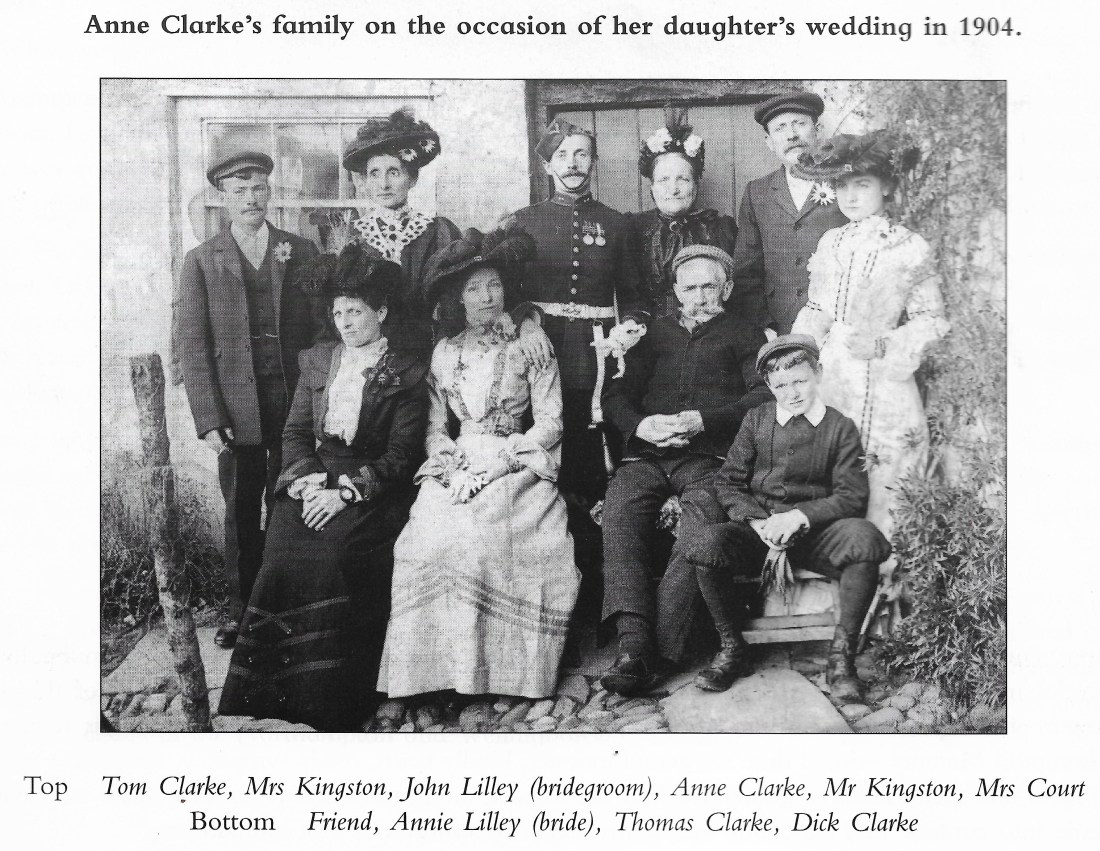
Anne ClarkeMrs Anne Clarke was a midwife in Heyford for forty years. Born around 1846, Miss Bateman as she then was took a nurses training course at St Thomas’ Hospital in London. She was sent to Heyford to recover from housemaid’s knee, where she met and married Thomas Clarke. He was a village man who worked at the old brickyard in Furnace Lane. They bought a little thatched cottage that used to stand on the corner of Church Street, opposite the little village green, and had nine children. Mrs Clarke later took an interest in midwifery and became the village midwife for forty years, and it is said that she was reluctant to give up even then.

Outside her house Mrs Clarke kept a long pole which was used to tap her bedroom window should she be needed in the night. She attended all confinements on her own and visited her patients daily for two weeks. One story suggests that she had two confinements at the same time, one at Upper Heyford and one at Upper Stowe, and a pony and trap had to rush her from one home to the other. She made one delivery on a boat on the canal. The next morning the boat had gone. She had to give evidence in court as the baby had not been registered. They later traced the family up north.

Mrs Clarke is remembered as always wearing a hat and shawl, carrying a black bag and a supply of candles and sheets, as some families lacked these necessities. She could be seen every day at noon with her little white jug fetching her half pint of stout (at a cost of 2d) from the pub ‘to keep her going’. Her charge for a confinement was 7/6d which could be paid in instalments of 9d at a time. As families were larger and closer then, it is possible that these instalments were a regular allowance in the family budget for a while.

She had a brother in America who regularly sent her a dollar note which was a great deal of money in those days. On her old age pension of 10/-she managed to fatten up a pig for the winter, pay 1/- for a bag of coal, and still manage her half pint a day!

Anne Clarke was a widow for a number of years and died during the 1939-45 war at the age of 95. Several of her descendants still live in Heyford and no doubt have heard many a tale of their grandmother or great-grandmother.

Shirley Collins

House

AnneClarke_Family.jpg

Photos lent by: Mick Lilley

~~

Extract from “The Story of Heyford” – Local book series published in the late 1990’s

Volume 1 of 4 | Chapter 1 of 13 | Pages 2 & 3

TheStoryOfHeyford_NetherHeyford_Footer

Heyford’s Historical Heritage  |  How the books were created

Index  |  Covers

The Story of Heyford: Book series – Heyford’s Historical Heritage (Foreword)

It is mostly the towns and cities that have their histories recorded, but many Northamptonshire villages have published their records in various ways. Heyford too has a rich historical heritage, and this series of booklets is one way in which we can record some of our local past, both for our own interest, and for the benefit of our descendants.

Heyford was mentioned in the Domesday Survey as `Heiforde – 2 hides and 1 virgate of land’. The mill was also specifically mentioned, ‘rendering 16s’. But even before then the area had been occupied. The Romans were here as was evidenced by the remains of a roman building found in Horestone Field in 1699. Stone axes and flint scrapers have been found, suggesting that earlier peoples also settled in the area. The word `Heyford’ takes its name from either the old English word ‘heg’ meaning hedge or `haeg/hage’ meaning hay. Hence Heyford means either ‘the ford by the hedge’ or ‘the ford over which hay is carried’. The proximity to the river and the fertile land around it means that this has always been a good place for a settlement.

The Church was built in the early 1200s and the first rector was Ralph in 1216. In 1601 it acquired its first two bells. Nonconformists have been here too. During the 1700s there were Quakers living in the village. Then in the early 1800s the Methodist and Baptist chapels were built, both flourishing well into the twentieth century.

The village has been most fortunate in having had a school since 1674. It was endowed by William Bliss of London, a native of Heyford, and has ensured that for more than 300 years the children of Heyford have had the opportunity of a good basic education.

The digging of the canal in the 1790s and the opening of the railway in the 1830s brought new trade to the area. Towards the end of the 1800s the two furnaces were in operation, followed later by the brickworks. This meant that the Furnace Lane area between the canal and railway was a hive of industry. Trade in lime, coal, bricks and iron ore created a flourishing business community.

There have been many meeting places where the business and social life of the village has been conducted. Activities in the Manor House, the Rectory, the Jubilee Hall, the Old Sun and Foresters Arms, the Church and Chapel Rooms, the School Hall and the Village Hall have all played their part in shaping the evolution of our village.

The Green is another important focal point. It has played a central role in the village for as long as anyone can tell. It is very much a public place and has been used for fairs, fetes, sports days, football, cricket, and many other village events. It therefore breathes life into the village and is justifiably called `Heyford’s lung’.

During the 1960s the village changed its character enormously. It became transformed from a rural agricultural community with a stable, but ageing population, into a modern thriving community with good communications and many new faces. It still remains a wonderful place to live, with a rich heritage of which we can all be proud, and which it is our responsibility to preserve for future generations.

~~

Extract from “The Story of Heyford” – Local book series published in the late 1990’s

TheStoryOfHeyford_NetherHeyford_Footer

Heyford’s Historical Heritage  |  How the books were created

Index  |  Covers

The Story of Heyford: Book series – Cover photos

The Story of Heyford

The cover photograph, taken by Brian Clements in the 1990’s, shows a view of Church Street taken from the top of the church tower.


~~

Extract from “The Story of Heyford” – Local book series published in the late 1990’s

TheStoryOfHeyford_NetherHeyford_Footer

Heyford’s Historical Heritage  |  How the books were created

Index  |  Covers

The Story of Heyford: Book series – How the books were created (Afterword)

‘The Story of Heyford’ was a series of 4 books published by the Nether Heyford village community as a result of the research work completed during 1996-1997

The Heyford Local History Group

These booklets were born out of a small group of local people meeting together with the aim of recording Heyford’s past. The group became known as the `Heyford Local History Group.’

The first meeting was held at the house of Eiluned Morgan in Church Street in the Spring of 1996. During a series of informal meetings we discussed how we could collect information, photographs and stories, how we could involve other people, and in what form the information could be recorded.

The people involved in these early meetings were Eiluned Morgan, Ken Garrett, Shirley Collins, John Smith, Pam Clements, Stephen Ferneyhough and Steve Young.

Our original aim was to publish a paperback style book with photographs, probably by the end of 1998. We held two open meetings in the school hall, one in October 1996 and one in February 1997. At these meetings we had various information and photographs on display.  At the second meeting Barry Highfield gave a short talk about Mrs Court’s shop and we showed a video of old Heyford photographs. About forty people came to each of these meetings. We served tea and coffee, we made new contacts, we collected more stories, and both occasions were good social events.

By this time however it had become clear that the funds necessary and the time commitment needed to publish a full scale book were beyond our means. All of us in the group were working full time and had various other commitments. So the idea of a series of smaller scale booklets came about and what you see here is the result. There will be several booklets in the series, but with no formal structure. We have worked on the principle that it is better to write down the information as we find it, publish it and then move our efforts on to the next subject. We can always add to it in a later issue as more information becomes available.

By the people, of the people and for the people

Many local villagers have contributed to these booklets by giving information, lending photographs, offering documents, telling stories and exchanging memories. Their names will appear with particular stories as you read through them. It is truly a history prepared by, written about, and published for the people of Heyford.

However we would like to make several particular acknowledgements in relation to the preparation and publishing of these booklets. All the people mentioned below live in the village. Use of school facilities for our open meetings: Alan Watson, headmaster;  Scanning and preparation of photographs: Tim Beard of Manor Park; Typesetting and origination: Bill Nial and Key Composition; Printing:  David Farmer and Heyford Press;  Financial support: The Prattler

Accuracy

Whilst every effort has been made to report these stories accurately, please understand that much of the information has come from memory, recollection and hand-written notes. These booklets have been written to capture the ‘spirit’ of the village rather than to catalogue a series of facts, flames, names and dates. We do hope that you enjoy reading them.

Stephen Ferneyhough, Editor

~~

Extract from “The Story of Heyford” – Local book series published in the late 1990’s

TheStoryOfHeyford_NetherHeyford_Footer

Heyford’s Historical Heritage  |  How the books were created

Index  |  Covers

The Story of Heyford (Extra): Memories of Nether Heyford – Joan Collins

The memories of Joan Collins, and life at Wharf Farm, Nether Heyford

I was born in Bugbrooke and moved to Nether Heyford when l married Reg, nearly 70 years ago. Reg was born in Nether Heyford, and as well as being a farmer, he worked on the Parish Council for nearly 30 years, and also became a District Councillor. One of the main features of the village is the very large village green, said by some to be the largest in England. This Green was purchased, together with other land, and a Schoolhouse, using money left to the village in the will of William Bliss in 1674, for that purpose. He had been brought up in Heyford, before becoming a London wine merchant.

Trustees of the Charity that was set up to administer the proceeds used the rental income from the land to pay for a schoolmaster and for the upkeep of the school. This is why the school is known as the ‘Bliss Charity Aided School’. The trustees of this charity, along with another one set up using a legacy in the will of Edmund Arnold (died 1689) may use part of the income from the charities to help “the poor children of poor persons of the town of Nether Heyford” to help with their apprenticeships, for tools, etc. The gift of the green to the village was made with the conditions “that there should not be a spade put into it, and that it should not be fenced in”. This is taken to mean that there should be no building or allotments on it. The area of the green extends to the Memorial Green and the piece of land behind the butchers and patisserie.

At the side of the main green there is an area that is known as ‘The Pound”, which also belongs to the Green. This is called The Pound because in days gone by, the cattle that were allowed to roam and graze the green at daytime, were rounded up at night and closed in the pound.

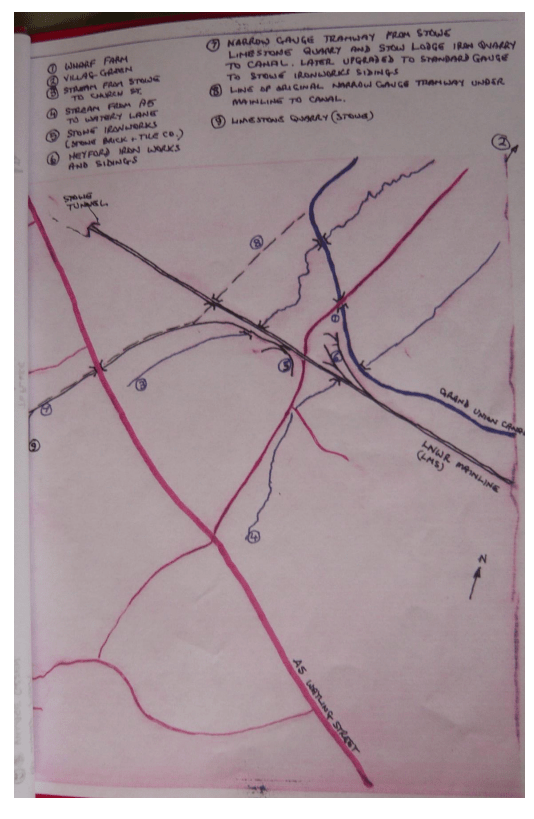
The estate known as “Rolfe Crescent’ used to be open fields owned by Mr John Radbume Adams. A stream, which rises near to the A5 on the easterly side of Furnace Lane, and goes into a culvert under the railway and the canal before emerging into the field. used to flow across the land of Mr. Adams before running behind the houses alongside the green. This stream then ran uncovered across the village Green and under the road into Watery Lane and on to the river. That is where the name Watery Lane came from.

Watercress used to grow along this stream. Similarly, the estate of Brookside was named due to its proximity to the same stream, or brook. Mr Wakefield Whitton owned land here, so when another small estate was built there, it was naturally named ‘Wakefield Way’.

Water also ran down from Stowe in a full stream, again under the railway and then under the canal, and on down the rear of the houses on the westerly side of Furnace Lane. It used to flow under the Weedon Road and down Church Street into the Manor, and on to the river. I suppose this is why our village is called “Hayford” as water used to run over the road before it was routed through a culvert there.

Manor Park was an estate belonging to the owners of the Manor, but a road used to run from Manor Walk, passing by the Manor House. across the fields to the coach bridge and on to Heyford Mill. Farmers would drive their horses and carts laden with corn along this lane to the mill. More recently, the fields at the rear of the Manor House were all built on, providing the homes in which some of you now live.

Middle Street, behind Mr. Denny’s house, used to be all open fields, but is now the site of Parsons Close, and other houses on that side of the road were all built on farm land belonging to the Manor, in the 1970′s, a bit before those in Manor Park. There was a footpath from the end of Middle Street that crossed the field to the river bridge leading to Upper Heyford. On the opposite side of Middle Street was a farm just below the “Olde Sun” where houses are now built.

Up Furnace Lane towards the A5, near the railway bridge, were ironstone Furnaces. One was on the land between Wharf Farm, Furnace Lane and the railway (LNWR, then LMS) line, and was known as Heyford Ironworks. operating in 1857. The other was diagonally across the railway where the Wickes site is. This one was known as Stowe Ironworks and was operating in 1866. Iron-ore was brought in by boat or rail from Stowe and other villages around.

The iron-ore excavated at Stowe Lodge was brought by a tram railway to feed the ironworks at these sites.

In its original form it was a narrow-gauge tramway which ran under the Watling Street (A5) near to the turning to Church Stowe, and then over a couple of fields to cross under the main LNW railway at a point about 1/4 mile west of the Furnace Lane bridge. it then went across one more field to be loaded into barges at the Grand Junction Canal. This tram-line was working pre-1863 and was one of the earliest and longest of the ironstone quarry lines at that time. The narrow gauge tramway was upgraded to a standard gauge line and elevated to link up with the mainline beside the Stowe Ironworks, probably before 1870. Iron ore could now be brought directly to the Stowe Ironworks, and be shunted across the main line into the Heyford Ironwork sidings. Therefore iron ore supplied directly from the Stowe quarries and other local quarries, was smelted into “Pig iron ingots’ and loaded originally onto horse and carts or canal boats to be taken away for further processing.

Through the railway bridge. the Stowe Ironworks site on the right changed hands several times. at one time being the home of the brickyard known as “The Stowe Tile and Brick Works’, where some of the finest bricks in England were made. At one time it may have been ‘The Lion Works” because an application was made to run “a tramway under the railway bridge into the Lion Companys Works’ (Feb. 1855). Apparently, the applicant didn’t wait for approval because there was “Indictment by the Queen” to be heard at the Northampton Summer Assizes of 1855 against John Judkins ‘for the nuisance on a highway in Nether Heyford – for laying iron tramrails on the highway, with an endorsement that the nuisance be abated’!

At this time the canal was one of the main means of transport, busy carrying iron ore and bricks, with the boats being pulled along by horses.

The building next to the canal bridge near Wharf Farm, which we used to use for cow sheds, has now been converted into a house. However, it was originally used for stabling these horses, and as the adjacent land is where the loading and unloading took place, the area was called “Heyford Wharf’.

There were many Public Houses in Nether Heyford, eight in all. There was one at the canal bridge, opposite the old stables, which was called ‘The Bricklayers Arms‘ and the house that I live in at Wharf Farm was another pub, known as ‘The Boat‘.

There were gravel pits in Heyford, at the back of Wakefield Way and Brookside Close, which were shown on some maps to contain Roman remains.

Returning to the village green, there is a now a Village Hall on the south side. There once was an Ox hovel where this hall is now, which belonged to Mr. Adams of Whitehall. This was demolished and our Village Hall was built using the voluntary labour of village people, and it was completed in May 1960. We are all proud of our hall and the lovely green, and the village as a whole. The green isn’t used as much for sport these days. There used to be football matches played on it. when local people would all tum out to support our team, and cricket matches when villagers would sit around the green on the seats to watch the play in hand.

The annual fair would come to the green at Harvest and was always known as “Heyford Feast”, and all the old village families would come back to meet up at it. l can remember the galloping horse roundabout, ’1d a ride‘, the coconut shy, hoopla and swing boats, etc.

Families were poor, money-wise, but happy with what they had. They grew their own vegetables, and kept hens. They would go gleaning at harvest time for food for the chickens, and would also keep a pig in the sty which would feed the family for a long time. This would provide lard for cooking, etc. and bacon on the wall to use all year round. When a pig was killed, it would be shared with neighbours who in tum would share theirs, when that was killed.

This all helped to make this a very friendly village. They were happy days and people weren’t so greedy for money. There were more poor people than rich ones, but it didn’t worry them that someone else had more than they did.

Happy Days.
JoanCollins1

JoanCollins2

Compiled by Joan Collins

Neighbourhood Plan – July 2019

Nether_Heyford_Neighbourhood_Plan_0

The next meeting will be on 25th July at 7:30 pm in the Youth Club. Everyone is welcome to attend.

Nether_Heyford_Neighbourhood_Plan_1

The next meeting will be on 25th July at 7:30 pm in the Youth Club. Everyone is welcome to attend.

Nether_Heyford_Neighbourhood_Plan_2

Nether_Heyford_Neighbourhood_Plan_3

Nether_Heyford_Neighbourhood_Plan_4

The next meeting will be on 25th July at 7:30 pm in the Youth Club. Everyone is welcome to attend.

For more information on Nether Heyford Neighbourhood Plan visit the website:

netherheyfordneighbourhoodplan.org.uk

Parish Council – June 2019 Meeting

Nether_Heyford_Parish_Council_2019

The June 2019 meeting of Nether Heyford Parish Council was held on 3rd at the Youth Club, as a one off event. The July meeting will be in the Baptist Chapel Schoolroom as normal.

Public Question Time. A resident noted recent work on cleaning gutters: and hoped residents might take note and take responsibility for the gutters in front of their houses and remove vegetation and debris. Another resident complained that a Lime in the cemetery had not been pollarded. It had been inspected and was not suitable for pollarding, only crown lifting. It was agreed that a further inspection could take place.

Councillor Adam Brown reported that NCC was working towards a shadow authority, and that elections would come in May 2020. He reported that NCC had made a small profit on last year’s accounts, but would still need to find £30M worth of savings this year. He expressed concerns about social services for children, feeling it would be better if this were dealt with on a county wide basis, rather than by different councils.

Trees. During work dead wooding Robinias on the Green it became clear that 2 trees were hollow, and needed to be felled. A quote from Stowe Tree Services was accepted to fell the trees. A Silver Birch on Hillside Close would be checked for safety.

Allotments. Another plot had been allocated. Some of the New Homes Bonus money had been spent on a shed, which when secure, would house equipment.

Footpaths. No major problems. Broken stile near Wakefield Way removed.

Churchyard. Council to assume responsibility for safety checks on the gravestones in the churchyard.

Joint Burial Board. Meeting arranged. It had been arranged for emergency repairs on metalwork on the gate.

Youth Club. It was reported that the club had reached 50 members, and no more could be accepted with the volunteers available. A waiting list had been opened.

Defibrillators. Both checked and in working order. There was concern that the ambulance service had given out the wrong code in an incident recently. Fortunately, an ambulance arrived promptly, and the situation was resolved positively.

Street naming. Council to recommend the name Hillcrest for the new Affordable Housing off Hillside Crescent. Subsequently SNC informed Council that this name was unsuitable as other streets with the same name have similar post codes.

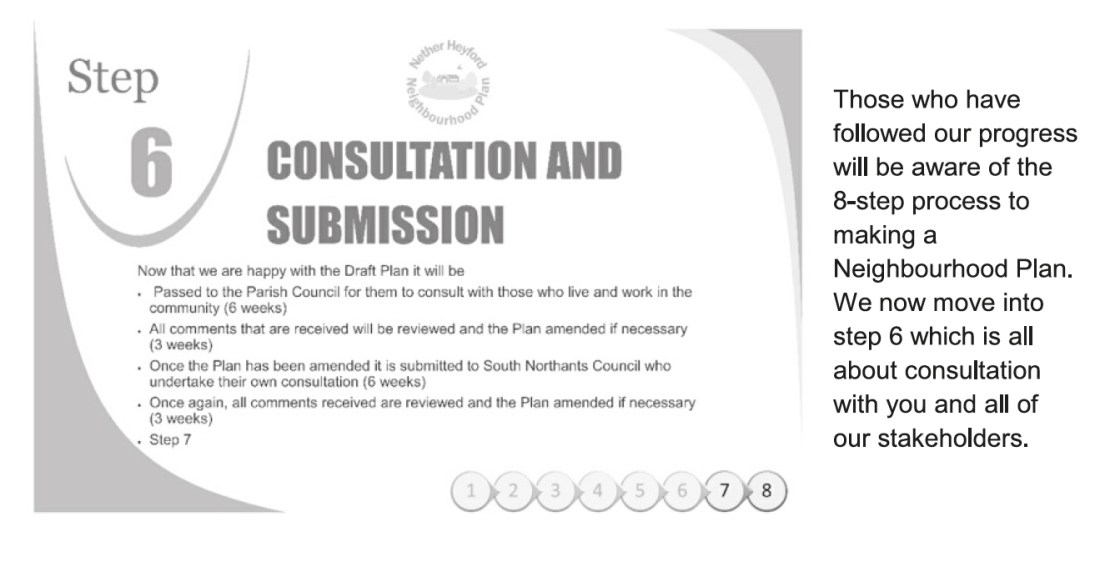
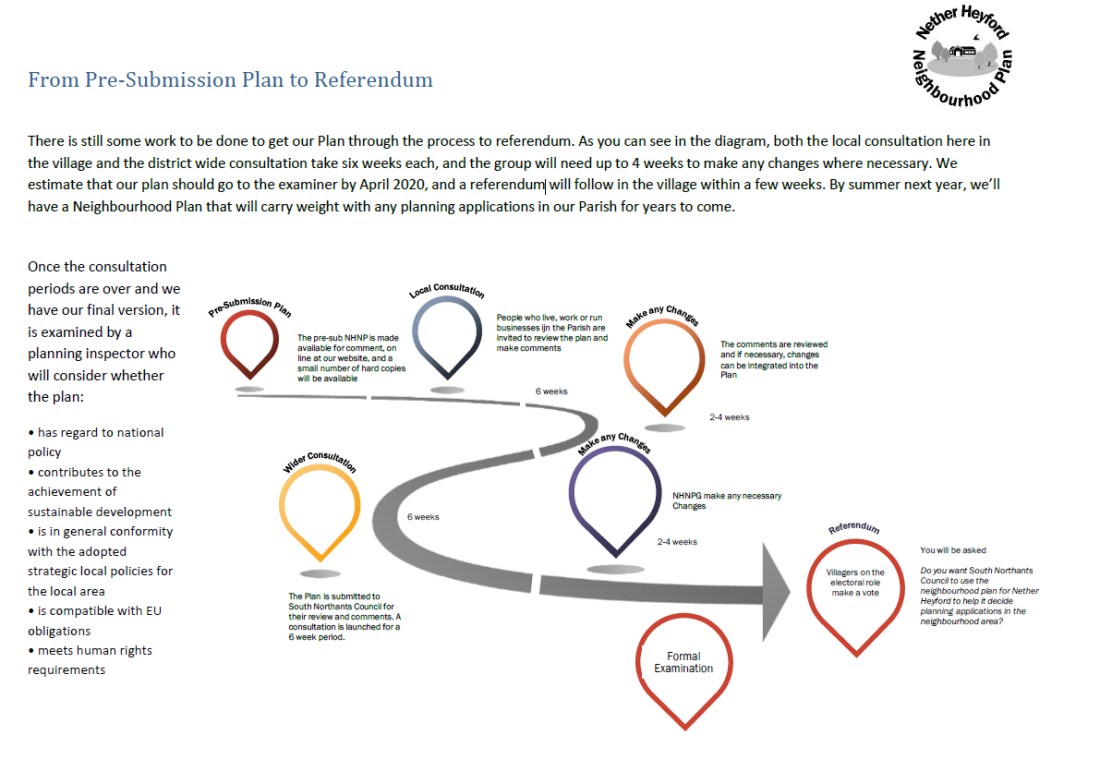
Neighbourhood Plan. The Neighbourhood Plan team reported on progress towards the next step in the process, Consultation. This process would be started shortly, after another bout of work, to follow 2 years of work done already. A draft/pre submission version of the plan was shown, highlighting the policies within the plan. The policies are the most significant part of the plan; as they will be part of what will become a legal document, that will be referred to by planning departments in the future. The policies are all evidenced by statements from residents, taken from previous questionnaires. Wellbeing is a core or overarching theme throughout the Plan, which is intended to always produce a positive impact. It was also hoped that any future development would be Community led rather than developer led. Attention was drawn to density of development, which should always reflect the character of the area. The village has less than 25 dwellings per hectare – apart from Bliss Close – and it is intended that any future development would not exceed this limit.

A Councillor expressed concern as to the definition of Affordable Housing. This
would be addressed within the plan with reference to the village. Cllr Phil Bignell asked whether disabled access to housing was being born in mind. It was replied that it was.

Play Area Inspection. The annual Play Area inspection had taken place and while no major problems were encountered, there are some low risk issues that will need addressing. Chair felt that the Play Area was showing its age and that Council should be looking at replacing and extending it.

Village Fete. Thanks to all involved in the preparations for this wonderful village event. The Green looked in excellent condition thanks to a lot of voluntary efforts in addition to the contractor’s work. Unfortunately the weather was less co-operative and threatened the day, but relented sufficiently for most of the event to take place.

Local Government Reorganisation. The situation has clarified somewhat now.

“The waiting is over, now the Government has given the go ahead for a new West Northants Council and a new North Northants Council, replacing the current County Council and seven District or Borough Councils. Subject to Parliamentary approval, it’s now full-speed ahead to the go-live date in April 2021.

“I’m pleased that the Government has listened to local voices, and included in its announcement the decision to hold elections in May 2020 for members of first the Shadow Authority (from May 2020 til March 2021), then taking over running each new Council when they go live in April 2021.

“In the meantime, I’ll be pressing ahead with my fellow councillors already elected to the current eight authorities to make all the preparations necessary ahead of those elections next year, as well as continuing to run the services we currently provide as business as usual.

“Here in South Northants, that will mean not taking our eye off the ball in delivering one of the best and most popular waste collection and recycling services in the whole country.

“The publication of this ‘Prospectus for Change’ sets out in more detail how we are approaching managing this change, and I am pleased that people can see from it that we really mean business.”

Cllr Ian McCord, Leader of South Northamptonshire Council

Next Meeting
The next Parish Council meeting will be on Monday July 1st at the Baptist Chapel Schoolroom at 7.30 pm and is, like all Parish Council meetings, open to all Parishioners.

Parish Council Notes by the Clerk; Guy Ravine June 2019

For further useful information about Nether Heyford Parish Council and full contact details for the clerk and the councillors please visit our Nether Heyford Parish Council page.

Roads and Pavements.
Parishioners are reminded that anyone can report a pothole or other highways
problem online to the Fixmystreet service, and this can refer to problems outside the village too. https://fixmystreet.northamptonshire.gov.uk/
Alternatively, phone 0300 126 1000 and ask for Streetdoctor.

The 2019 Village Hall Fete – July 2019

The 2019 Village Hall Fete – an act of faith which paid off

Due to the dire weather forecasts for Saturday 8 June, many local events were cancelled. However, as one later forecast indicated that the weather would gradually improve on Saturday, we in Nether Heyford decided not to cancel – especially as, even in the rain, our village green looked splendid, having been ‘litter-picked’ by the pupils of Bliss School, and given a last-minute mowing by Daniel, an ‘old boy’ of the school. We were so grateful for the encouragement they gave us to go ahead.

However, early Saturday morning as we were setting up in high winds and with heavy rain soaking us, we wondered if we were mad. But we all persevered, and by lunchtime, the rain slowly stopped, although the wind still made life interesting for the stalls with gazebos. Adaptability became our motto as we coped with some necessary adjustments: because of the wind, the bouncy castle and the gymnastics display had to cancel; the wind band moved into the village hall to perform, and one or two stalls weren’t able to come. A few of those who did come, moved into the Baptist school room and the village hall foyer.

After a slightly later start, we were ready. Our Rose Queen (Lily Davies) and King (Adam Gilkes) and their Attendants (Beth Manning and Chloe-Lea Holmes) arrived in state on our Land Train accompanied by their classmates, and opened the Fete in style.

Then, at last, the Fete came to life as people came along to support us. We started with maypole dancing and country dancing in the arena by the young people of Bliss School. Queues built up for the barbecue, beer tent, face-painting and the land train, which trundled around the village green for the whole afternoon, fully laden each time. The raffle tickets sold out. There were even queues for the ice cream van. The refreshments in the village hall did a roaring trade – and the performances by the Bliss School choir and the NMPAT wind band were greatly appreciated. The stalls were busy and the classic cars, tractors, mopeds and motorcycles all received their share of attention. Our final arena attraction – the tug of war- proved highly popular with contestants of all ages taking part, and this was followed by the raffle draw with £100 as first prize and many other prizes. Although this brought our Fete to its conclusion, the entertainment continued with Morris Dancing outside the Foresters Arms.

At this stage we are still receiving proceeds from the various activities so cannot forecast our final outcome. However, we were fortunate in receiving several generous donations: Heyford Picturedrome, Macflex, MN&TL Adams Heyford Marine, Alderman Roofing, Unusual Rigging Ltd and Heygates. The passengers on our Road Train, while technically free to ride, made many voluntary donations. We are also grateful to those who donated raffle prizes, including our village shops, and cakes. The Foresters Arms also gave us invaluable support. In addition, most of our expenses were covered by individual sponsors, and services such as the sound system, power cables and rubbish skip were provided free of charge.

So, despite our ‘typical English summer weather’ – we held our Fete, thanks to all the hard work done by so many volunteers – too many to name here – but we and they know who they are.

Finally, for all the help described above, plus our stall-holders and everyone who came and supported us, we offer our heartfelt thanks. We hope that you enjoyed this year’s Village Hall Fete as much as we did.

The Fete Committee

Nether Heyford Pre-School – July 2019

NetherHeyfordPreSchool2019

NetherHeyfordPreSchoolJuly2019

~/~

Nether Heyford Pre-School
Address: Church Rooms, Church Lane, Nether Heyford, Northamptonshire, NN7 3LQ
Telephone: 07984 055828
Website: www.netherheyfordpreschool.co.uk
Email: info@netherheyfordpreschool.co.uk
Facebook: www.facebook.com/netherheyfordpreschool
Facebook: www.facebook.com/netherheyfordafterschoolclub
Twitter: @NHeyfordPreSch

Ofsted Registration EY450747 – Charity No. 1029571

Flood Watch – July 2019

Flooding issues have hit the headlines with major incidents in Lincolnshire and Tewksbury in a year when climate change has surfaced as a major issue. The E/A’s Emma Howard Boyd and Sir James Bevan have initiated the launch of a review of Flood and Coastal Management Strategy in May 2019 which will form the basis of the Government Statement in October 2019 setting out their long term goals. They claim over 500,000 homes are at risk of regular flooding requiring families to relocate their homes.

Locally 2019 started the year up to the end of May with only 52% of the average rainfall which compares with 106% for 2018. However June has seen almost continuous rainfall currently at 64% above the June average at 88mm compared with 1mm for 2018. The River has coped well rising only 1.1m at its peak on 12/13th May largely as a result of limited run off due to excessively dry land in the catchment area and the effect of the E/A work on the River and Horestone Brook.

In May the Government extended “permitted development” to allow further increase in the size of extensions to properties as part of their policy to improve /increase housing. Many Councils have expressed concerns describing the PD Policy as a planning disaster often causing conflict between neighbours resulting in unsuitable developments over which the Councils have little control. Even more concerning is the lack of protection for the individual through any suitable complaints procedure. Recent experience shows that any so called “Complaints Processes” are ineffective and biased and can only assess following of procedures not change of decisions.

I have recently held several meetings with the E/A to discuss implementation of refusal for permitted development rights under Article 4 to ensure compliance with the legal responsibility of landowners not to impede the flow of flood water as this is a criminal offence under Common Law. Unless this is implemented then building on the floodplain will continue unabated.

As a result of conflict of interest I proposed to close down CFG. However the E/A wished to continue working together especially as a new submission for flood defence funding for the Village is proposed for August/September 2019. Having spent 21 years campaigning for improvements in Nether Heyford I feel its time to step back and invite anyone interested in flooding issues to contact me so that the future of the Village can be secured.

J.Arnold