In DESIRABLE FREEHOLD ESTATE
Consisting of The
MANOR or REPUTED MANOR
of
HEYFORD
Stone—Built Mansion or Manor House
with
Suitable Offices, Stabling, Gardens etc.
And
Sundry Eligible Farms with their Suitable Buildings
And
528A. 2R. 28P. of uncommon rich Arable, Meadow
Pasture and Wood Land
Let to Tenants on Leases which will expire at Lady Day next, at very low Old Rents (the Wood Lands in Hand included) of
FIVE HUNDRED AND NINETY~NINE POUNDS
These are how the Particulars and Conditions of Sale read on Thursday, February 2nd, 1792 at the Auction held by Mr Christie at his Great Room in Pall Mall. At that time a Fee Farm Rent, payable to the King was 3s. 4d, Land Tax for the whole of the Estate was £54.16s.0d and various Tithes to be paid meant total outgoings of ,£112.6s.9d. Part of the outgoings included an Annual Payment of £20 to the Hospital at Northampton, “out of which £4 is allowed in Land Tax”. The actual Manor House was much smaller than it is now — the East and West Wings came at the turn of the Century and the small ‘Garden House’ at the back, although keeping the original frontage and downstairs room complete with large stone fireplace, was added to as late as 1982.
The early estate
The original Manor House was at Upper Heyford and the remains of its foundations can still be seen. This was the Manor House of the Mauntells and Morgans, Prestons and Herbert Marquis of Powis and is supposed to have stood in the field called the Upper Park. John Mauntell of Heyford, descended from Michael Mauntell of ‘Rode’ married Elizabeth, daughter and heiress of John Lumley (also reputed to be of Heyford) and ‘levied fine of Heyford Manor’ in the reign of Henry VI (around 1446) and so founded a dynasty of Mauntells at Heyford.
Prior to the Mauntells the Tudenhams ruled the roost at Heyford (also ‘big’ in Suffolk; as you approach Bury St Edmunds you can see the village of Tudenham signposted) and presumably occupied the old Manor House, but we are going back to 1333 here and records are a little vague as to Lords of the Manor, but they were certainly large land owners and owned “the manor of Heyford with pertinences, lands and tenements in Bugbrook, Flore and Farthingstone, Grimscote, (Cold) Higham and Carsecoell (Carswell in Greens Norton?), lands and tenements in Cold Ashby and West Haddon”.
The Mauntells
What we do know, however, is that the ‘younger generation’ of Mauntells let the family name down as John and Elizabeth Mauntell had a son, Walter, later knighted, (buried in Heyford with his wife also called Elizabeth) and his son and heir, ]ohn Mauntell, well and truly blotted the family name. In 1541 John “sallying forth in company with his brother-in-law, Lord Dacre, and others, on a nocturnal frolic to chase the deer in Sir Nicholas Pelham’s park in Sussex, encountered three men, one of whom being mortally wounded in the affray; he and his associates were convicted of murder, executed, and their estates escheated to the crown.”
And to make matters even worse and to complete the irretrievable ruin of the house, his only son Walter Mauntell engaged in the Kentish insurrection to oppose the marriage of Queen Mary, headed by Sir Thomas Wyatt, and was taken prisoner with him, sent to the Tower and subsequently executed in Kent, 27th February 1553 and ‘attainted’ (i.e. he lost his estate to the crown).
However, due to a bit of forward planning the Manor was saved from the general wreck of the family fortune as John Mauntell had made a settlement of the Manor to his wife Anne (leafing through old cuttings I came across an article on the Manor written in the Herald September 1908 which said it was his mother, sister of Lord Dacre, who was the recipient of the settlement, but I am sure the Press were apt to make errors even then as old family trees show his wife Anne to have inherited) who with her second husband Richard Johnson and Francis Morgan ‘serjeant—at-law’ (who was lessee for the years 1555-56), “levied a fine of the three manors of Heyford, Over Heyford and Nether Heyford and the advowson, or rather two thirds of the advowson, of Nether Heyford, to the use of Sir Richard Sackville and his heirs.”
The Morgans and Prestons
This meant that Sackville took over the Mauntell estates in Heyford but Francis Morgan soon after obtained the ‘fee simple’ and after Francis Morgan died in 1558 ( he and his wife Anne are buried at Heyford) the estates descended to his son Thomas. However in the archives it is written that Matthew Mauntell ‘of Horton and of Collingtree’ son of the executed Walter, ‘was restored to his father’s estate in the 15th reign of Elizabeth’. This would make it 1573. So it is unclear whether there was another (short) ‘reign’ of Mauntells in between the Morgans.
In any event Thomas Morgan’s daughter and heiress married Sir John Preston of Furness in Lancashire and he was succeeded in his title and estates by his brother Sir Thomas Preston who in May 1685 settled the manors of Heyford, Nether Heyford and a whole lot more on Mary his eldest daughter and co-heiress in marriage with William Lord Herbert, son and heir of William Earl of Powis.
Now, the Earl was zealously attached to James II who selected him to accompany the Queen to France and on abandoning the throne in 1688 James joined them both there. In return the King gave him the titles of Duke of Powis and Marquis of Montgomery. But the Duke was outlawed for remaining abroad in the service of the deposed monarch and died at the court of St Germain’s in 1696.
After a lapse of 30 years, a ‘mandamus’ (judicial writ issued from the King’s Bench Division) was granted and it was accordingly reversed by the court of the King’s Bench in April 1722; by which reversal his only son, William Lord Herbert (as above) then Viscount Montgomery, was restored to the Marquisate and all the other honours to which his father was entitled prior to James II leaving his throne.
The Dukedom and second Marquisate were never legally recognised in England, though generally adopted by courtesy. William the 3rd Marquis or Duke of Powis, only surviving son of the preceding, died unmarried in 1747 and the titles became extinct; but by his will, dated 28 April of that year he left his extensive family possessions (by-passing his several sisters) in trust for Henry Arthur Herbert, then Lord Herbert of Chirbury, who was afterwards created Earl of Powis and in 1751 married Barbara, the posthumous daughter and heiress of his brother Edward.
Decay
Now, if you can keep up with any of this, comes the crunch. The Trustees under the Marquis’s will were empowered to sell all or any part of the Northamptonshire estates towards the liquidation of his debts, and towards raising a fund for working his lead mines and in November 1758 with the approbation of the Earl of Powis and under the authority of an act of Parliament, confirming the authority of the Trustees, the whole, comprising the manors of Heyford and surrounding manors with about 3000 acres of land were disposed of in lots by public auction and produced the princely sum of £65,424.
By this time Sir Thomas Preston may have demolished the actual Manor House, or it may have fallen into general decay during the Commonwealth period (the 1650s). Here again the Herald (and this is substantiated) states that early in the Civil war the Manor House was uninhabited. It was still unoccupied in 1652 as we learn from an entry in the Parish Registers (“lying open into vagrants”).
But in any event the estate itself remained intact and Miss Nelson writes “in 1758 the estate was sold by auction in London, the business taking three days. The names of some of the tenants of farms at that time were Ed Middleton, Richard Gardner, Sam Newbold, Thomas Payne and Richard Claridge. Also Will Simons, who farmed Pond Close, or Pastel Pan and Pastle Pightle. Other field names mentioned in the catalogue are The Spung, Stocking Meadows, Worsten Pond Field, Talland, Adal, Bell Pool Leys, Flash Close and Blakes Hitch.”
Thus the old Manor met its demise and its vast estates were split up.
A new house is built
But a new era had already begun with the building of the new Manor House where it still stands, in Nether Heyford. It is believed to have been built about 1740 by William the 3rd Marquis of Powis (as above) using the stone from the original Manor. (The earliest date found on the old walls of the existing Manor is 1794 but the stone is worn and could read ‘1714’). Some researchers have stated the Manor and 30 acres was then bought by Rev Henry Jephcot in 1759 (who in 1789 became Rector of Heyford) but according to Joan Wake in her book ‘The Life of Henry Isham Longden’ published in 1942 she states “Heyford, like Stowe IV (now Stowe IX) Churches was a Crawley living, a member of that family having bought the two advowsons and the Manor House at Heyford in 1764.”
Churchmen take up occupancy
However according to the auction details of 1792 they clearly state that the Manor was let to the Rev Mr Henry Jephcott “at Will, at a low old rent of £63.0s. 0d” so he would have been a tenant at that time. In 1800 we know that he died and the property passed to his daughter Elizabeth and her husband the Reverend R B Hughes, Rector of Kislingbury. And they must have owned the property as in 1802 they sold the house and land to Reverend John Lloyd Crawley who in 1800 had succeeded Henry Jephcott as Rector of Heyford. John Crawley remained at Heyford as both Rector and Lord of the Manor until his death in 1850 and was succeeded as Rector by his son, Thomas, but he moved into the newly built rectory in 1851.
So, interestingly enough, for the sixty years between 1789 and 1850 there were two successive rectors who were also Lords of the Manor and it was to the Manor House that ‘privileged young people’ went for Sunday School.
When John Lloyd died in 1850 his widow Anne Crawley (at that time 65) remained in the Manor House with her sons Alfred and Charles and three domestic servants (Footman, Ladies Maid and Housemaid) until 1871 when we know from details of a Census that John Smith, Curate of Norton, his wife and their five children and four domestic servants (Cook, Housemaid, Scullery Maid and Groom) took over for the next ten years and by 1881 Charles Carden, aged 61, a retired army captain lived there with his wife, six children and four servants (Housemaid, Ladies Maid, Cook and Groom), a Governess coming from as far afield as Liverpool and a Head Gardener, Richard Houghton, who hailed from Milton.
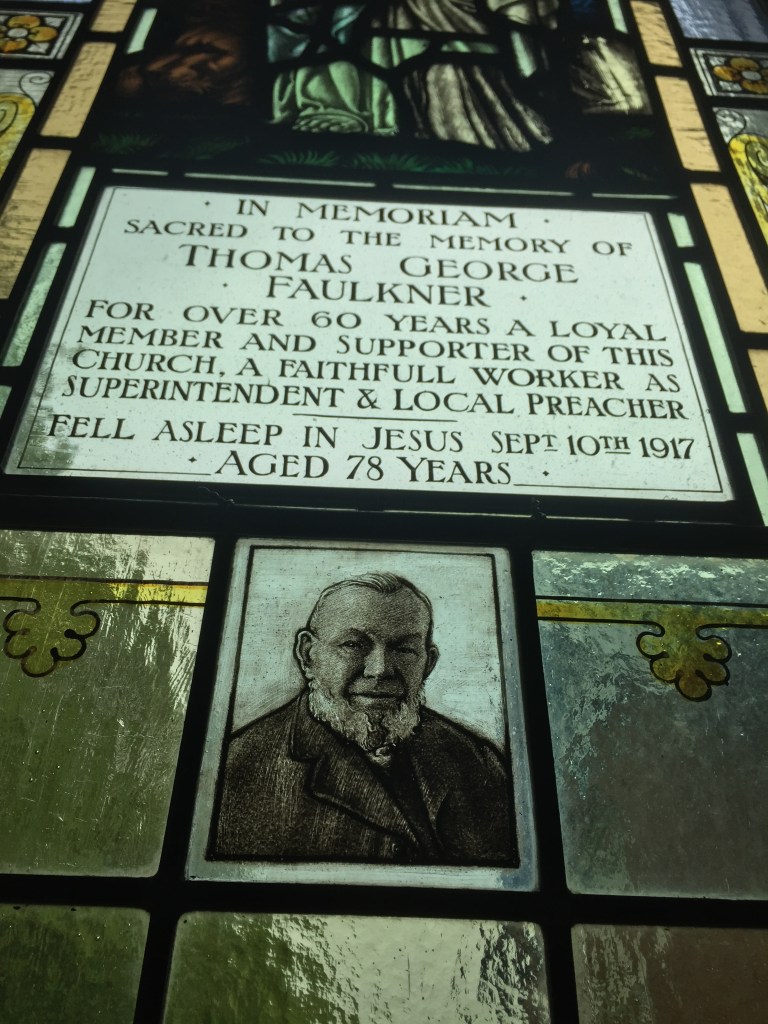
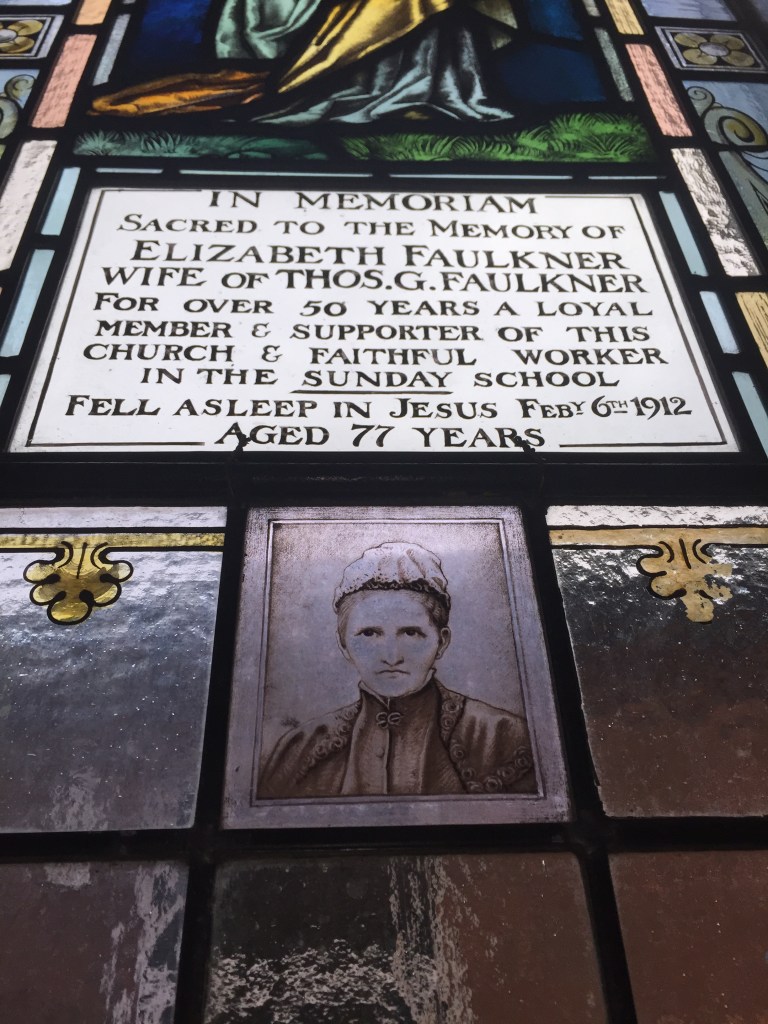
Then in 1891 Joseph Faulkner, a shoemaker aged 60 with his wife, four children, son-in-law and grand-daughter – who presumably helped out with all the chores as there were no domestic servants recorded – took over the Manor until the turn of the century when the ]eyes family arrived.
The Manor House in 1825
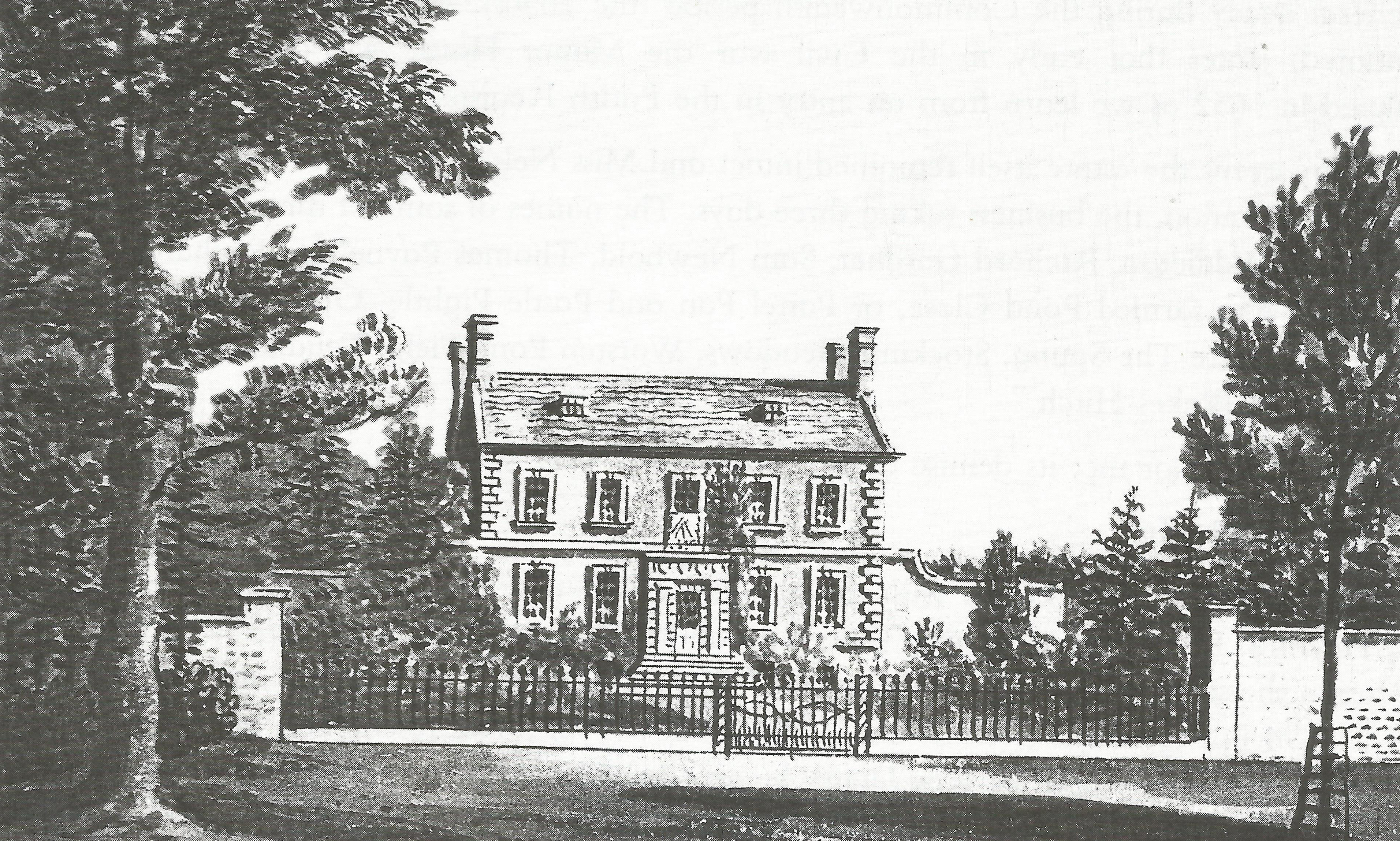
From a print lent by Tony Landon
The early 1900s – military men and merchants
Mr Jeyes was the brother of Philadelphus ]eyes who owned a chemist shop in the Drapery in Northampton. He was a ‘country gent’, sported a coach house and kept three or four hunters in the stables to the west of the Manor (now houses and garages). It was probably while the Jeyes family were in situ that a visit to Nether Heyford Church was arranged in 1906 by a local Architectural and Archaeological Society for the Archdeaconries of Northampton and Oakham as the Rector, the Rev H Isham Longden, was ‘a true archaeologist’ and a visit to the Manor House had been planned. But “time and the weather did not permit a visit” and instead they all headed back to the Rectory for tea presided over by ‘Mrs Crawley’.
After the Jeyes family moved out it was said that it was empty for a while, but then came the Muir family and documentation to this effect is available in the form of an Indenture made out in 1914 by John Buchanan Muir’s son Matthew Andrew which left everything to his wife, Jessie Agnes Muir, on the understanding she did not leave him, in which case she would lose the lot… What is interesting about this Indenture is that the Fee Farm Rent was still 3s.4d….
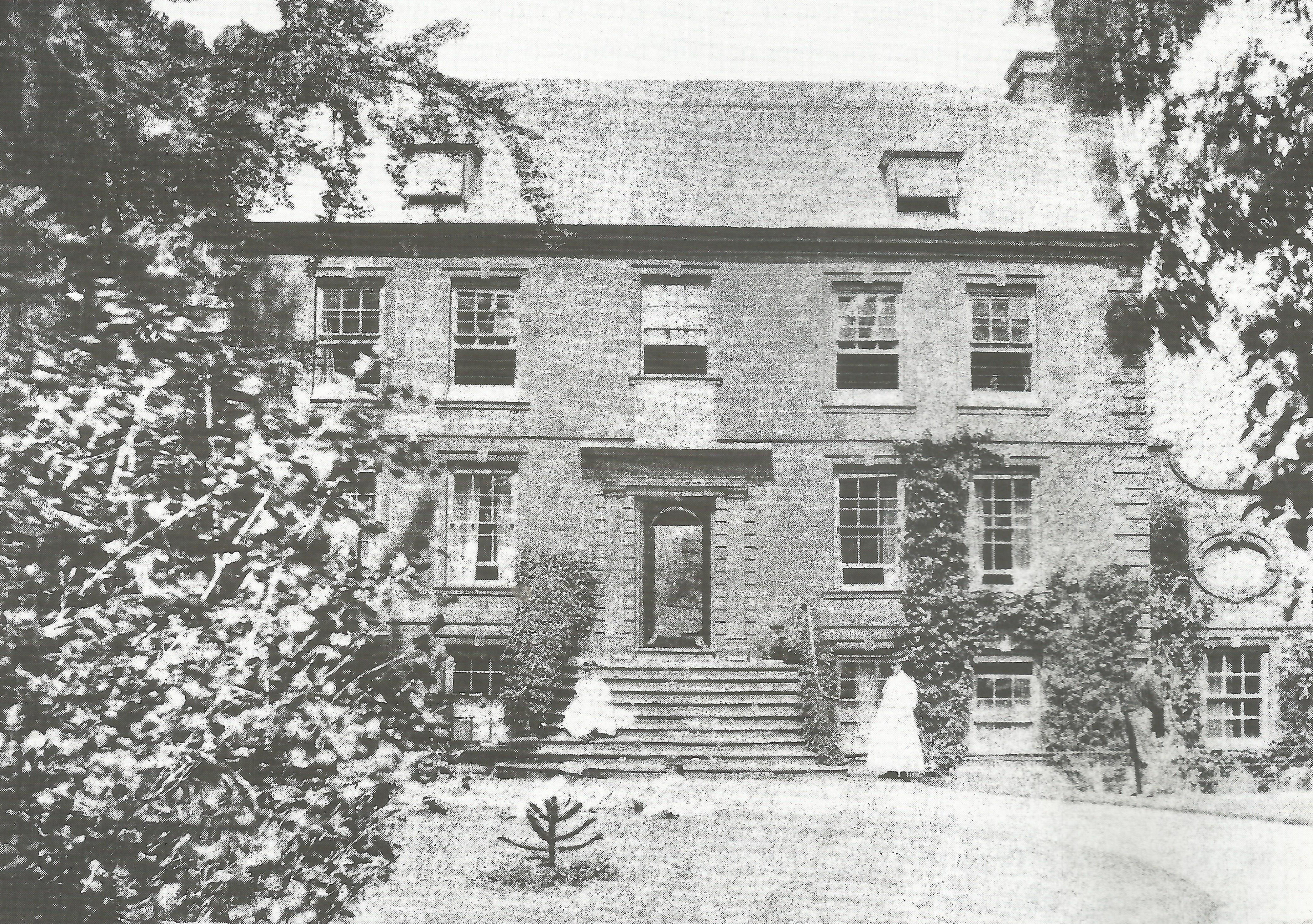
The Conveyance for the sale to the next occupant was dated 5th December 1919 and this was Lieutenant Colonel Livingstone-Learmouth who was based at the Ordnance Depot in Weedon and it is said that he had the house massively extended with new wings at each end. However it is more likely the East Wing was put on quite a bit earlier and the flat-roofed West Wing added during the first World War as wood was difficult to come by although one rumour has it that the occupant, a woman at the time – Mrs Muir? – could not afford a ‘proper’ roof .
The Manor house around the turn of the century
Gardens, stables and domestic service
But what we do know is that Frank Pearson’s parents came to Heyford in 1919, his father becoming Head Gardener at Heyford Manor until his death in 1948. Frank was born in the Head Gardener’s cottage which was situated backing on to the Churchyard and Frank himself helped his father in tending the Manor gardens. The earliest inhabitant of Heyford Manor Frank can remember was Brietmeyer “a big man who was very fond of hunting, which he enjoyed sometimes three times a week”. Certainly there are still memories in Heyford at the time of writing of the Master riding to Hounds and scattering coins to the children who had gathered in what is now Manor Walk to see this awesome sight.
But the Livingstone-Learmouth era (1920s and 30s) was probably the last of the ‘greats’ in the sense that here was a large Manor, acres of land, servants and a Head Gardener. The gardens, as remembered by Frank Pearson, comprised rose beds, rockeries, kitchen gardens,flower borders and grass walks, asparagus beds and apple stores and the horse and cart track led down to the ‘Coach Bridge’ and thereon down to the mill. Frank himself told of how he was responsible for raking the gravel drive in order to keep it tidy which ran by the existing boundary at the front of the Manor and on down to The Sun. At that time he said the servants used the West Wing and the ‘garden room’ there was the servants’ dining-room.
The whole of the bottom floor of the Manor was I believe devoted to kitchens and the old bread oven can still be seen in the middle part of the Manor – the little ‘Garden House’ at the back was reputed to be the dairy (although as the present occupants pointed out, strange that the dairy should be in the front of the building?) – and ladies from Heyford can remember helping out in these vast kitchens.
There is still an enormous cellar for the fine wines and the scribblings of the Butler above the store bins denoting the type of wine enclosed. The old bells to summon the servants are also still in place and until very recently so was the ‘dumb waiter’. In the East Wing the stairs to the attic where the servants slept are pitted with their constant footsteps and the bannisters uneven where they slid their hands down in their haste to attend to their duties. The attic roof was bare With no insulation but the coal fire must have been lit as there is an enormous chimney breast which goes through their attic rooms in order to give them some warmth. It must have been a hard life for the young girls who Would have been employed around this time.
But by now the First World War had struck, twenty three soldiers from Heyford losing their lives and Lieutenant Colonel Livingstone-Learmouth CMG, DSO, RHA unveiled the War Memorial in 1921 which stands on the green at the junction of four cross roads. The Rev Isham Longden conducted the service and amongst the names on the memorial is Captain T H O Crawley.
Bill Kingston remembers when there were no buildings between the Foresters Arms and Richard Denny’s house and there was a field stretching back to the Manor House in which the occupant at that time, Captain Shield, kept several hunters.
In 1928 another auction took place this time with only 23 acres attached, the land gradually being eroded by new buildings. This may have been bought by ‘the Diamond Merchant’. Unfortunately no other details as to this person emerges except he left strong evidence of his occupancy within the house itself!
For sale by auction – July 19th, 1928
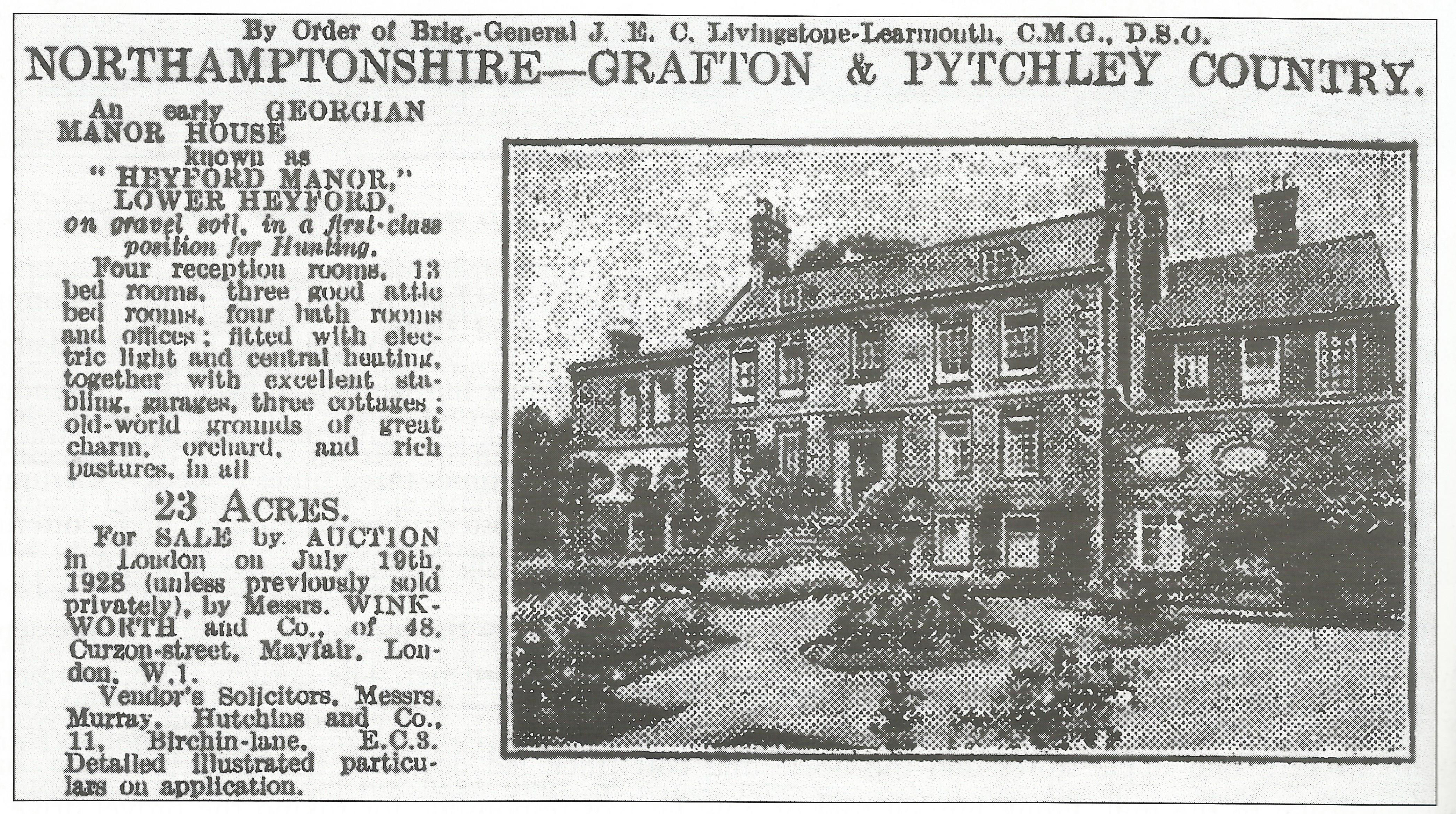
From a newspaper cutting (source unknown) lent by Tony Landon
The Manor House and gardens as they appeared between the wars
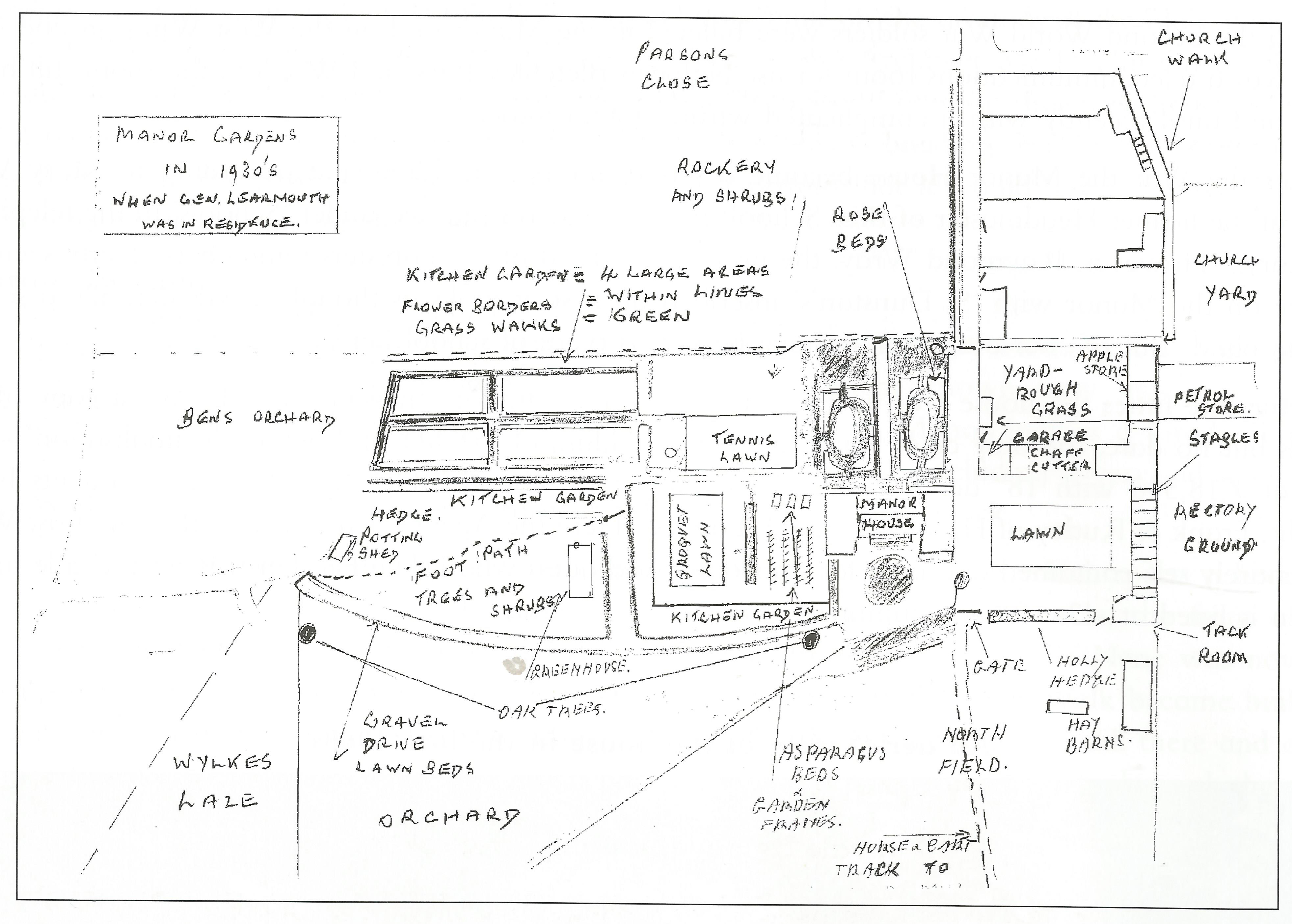
The surrounding fields
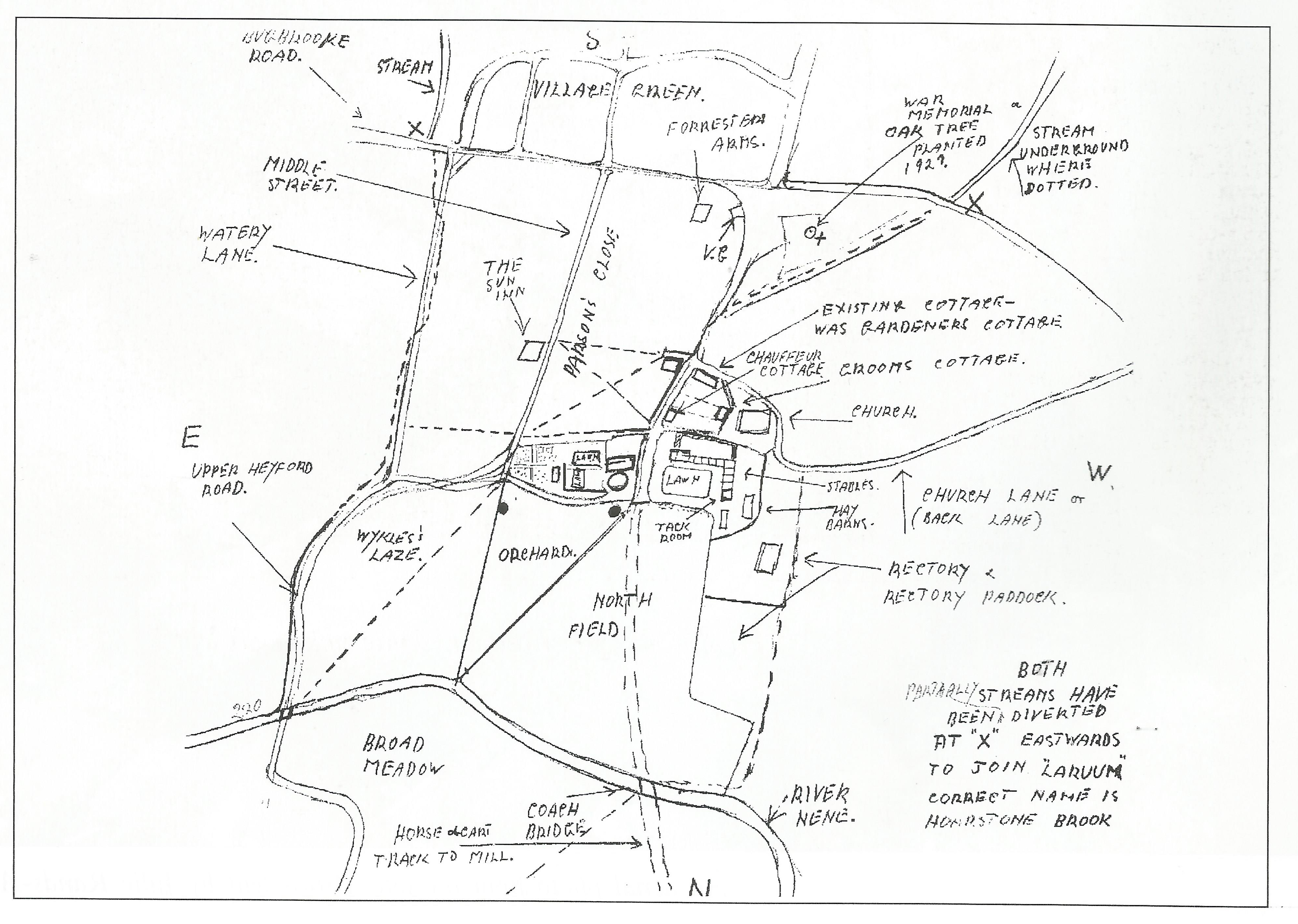
From illustrations made by the late Frank Pearson
The post-war years
During the Second World War soldiers were billeted in the Manor and on the West Wing ground floor there was a telecommunications room for use between Bletchley Park and Weedon, the room still being there and until recently with a complicated wiring system intact.
After the War the Manor House became a school for deaf children and according to Mary Warr (wife of the former Headmaster of Bliss School) in 1970 it was still listed under ‘Schools’ in the telephone directory… However, Raymond Wray, the present Landlord of the Foresters remembers clearly seeing a plaque on the Manor with ‘St Dunstan’s’ inscribed on it so it looks as though it was actually a school for the blind. But of course there may have been two types of school here.
In the latefifties the house was up for sale again – actually I’m guessing here. I have a copy of the details but no date, the only clues being ‘after the building of the M1 and before decimalisation’ – this time at £18,500 With 18° acres, having been subject to ‘considerable expenditure’, the agents being Knight, Frank & Rutley of Hanover Square, London. Here the Agent’s details reveal that the East Wing was entirely self-contained and used for staff only. And guess What? The Fee Farm Rent payable to the Queen is listed at – 3s. 4d. per annum…!
An aerial view of the house in the late 1960s
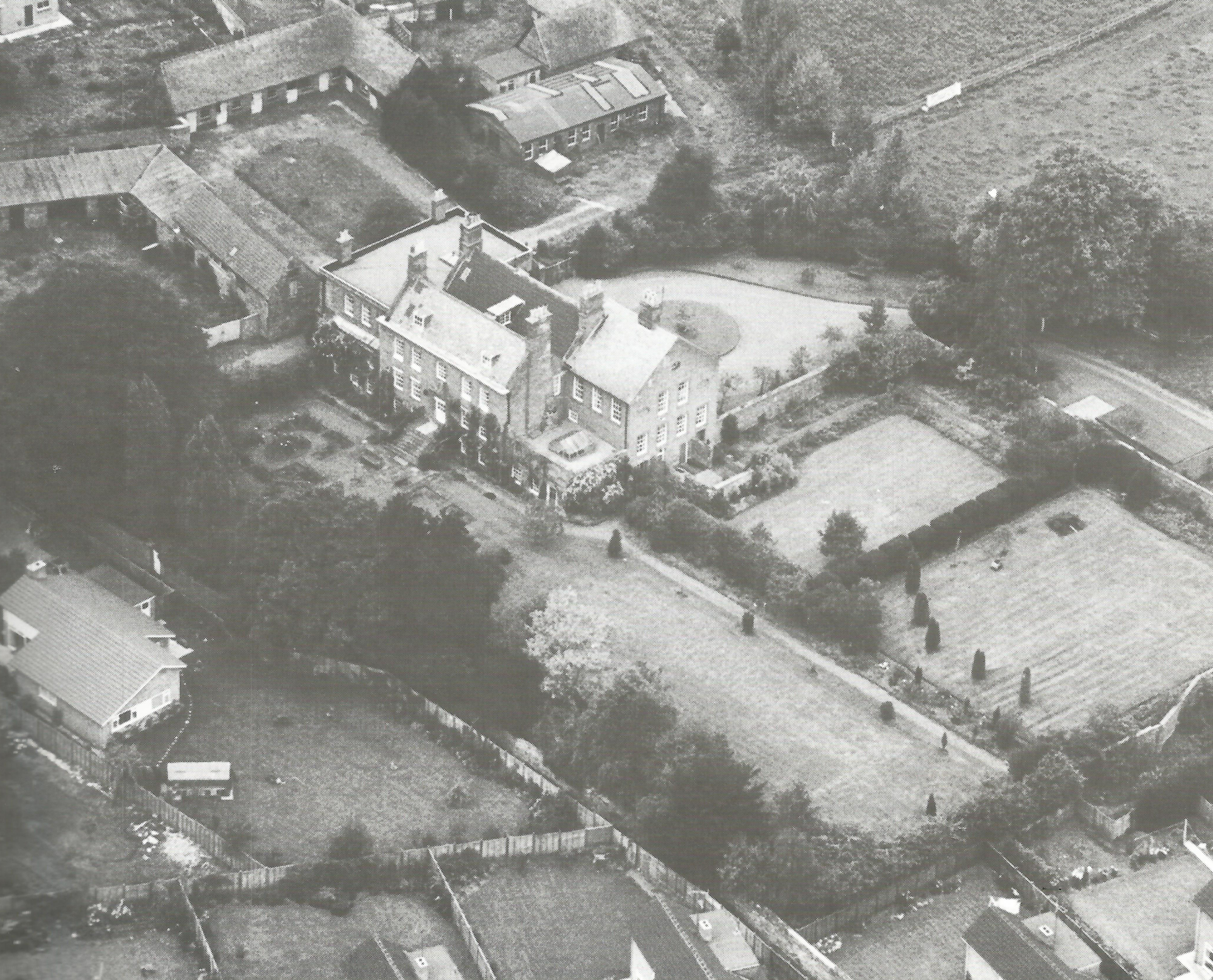
An aerial photo from the late 1960s lent by Julie Rands-Allen
By the sixties the Manor was still intact but with even less land as an old aerial photograph shows the beginning of the new chalet bungalows in Manor Walk built on the grounds of the old Chauffeur’s cottage. And we know that at this time it was occupied by the Architect Mr D Harwin as he was responsible for a lot of the new bungalows materialising. Raymond Wray (at that time living in Flore) was, at twenty-seven, the General Foreman for one of Mr Harwin’s building firms and was responsible for the building of this new development and he is almost certain that it would have been Mr Harwin who purchased the Manor for the sum of £18,500.
Separate dwellings
Then in 1975 with the rising tide of up-keep costs, the Manor and all its remaining land was sold to Cooper Construction Ltd of Lichfield for a housing development known now as Manor Park. Fortunately many of the trees were given Preservation Orders (the Manor itself is a Grade II listed building) and a fine old oak and many Scots Pines stand proudly still, including a very old apple tree which would have been in the old orchard near the stables and garage block.
And the Manor House became divided into three dwellings. The frontage which sports a beautiful old sundial and small oval windows became the back and the large grassed circle. the front of the Manor. The land which swept down passed the Horestone Brook and across the Nene was now all taken up with the new development. Its Glory Days were indeed over! Manor ‘Walk became built up with even more new houses but Manor Cottage — the old Gardener’s Cottage – is still there and other cottages dotted around Manor Walk and others backing on to the Churchyard still look much the same as they did when they belonged to the Manor and its estate. And although the drive that swept through Manor Park and through to Middle Street has long gone, one of the pillars which marked the entrance is still there at 15 Manor Park in Bernard Carpenter’s back garden…
Michael N Harbour, a former member of Northampton’s Royal Theatre Company bought the East Wing and was especially delighted when the BBC offered him a leading role in ‘A Last Visitor for Mr Hugh Peter’ as it depicted the story of Cromwell’s chaplain who is spending his last days after being imprisoned by the Royalists. The Battle of Naseby took place about ten miles from the Manor and Michael believes dead bodies could easily have been buried at Nether Heyford as the soldiers returned to London. Another bit of history to add to the already long one of Heyford Manor…And we mustn’t forget a piece of recent ‘history’. In the Great Northampton Floods of Easter 1998 both the East and West Wings were flooded when the River Nene broke its banks — the worst floods for over a hundred years.
Tony Landon bought the main part of the Manor and skillfully finished converting it into a period home for his family, and the Rands-Allens (appropriately hyphenated) bought the East Wing from Michael Harbour where they have lived for the past seventeen years. Gill and Tony Pont and their family live in the West Wing, keeping all of the original features, having been there for fourteen years, and Wayne and Ann Edmonds live in the little studio at the back which Michael Harbour built and lived in for a time before moving to London. Unfortunately there appear to be no sightings of ghosts from any of the occupants.
With all its history, both actual and imagined and with all the changes the years have seen, one thing remains constant. Families have lived in the Heyford Manor House over the centuries, are doing so now and will continue to do so over the Millennium and far beyond.
Julie Rands-Allen (with a little help from some friends!)
Article updated for the years 1947-1956 in Volume 4 Chapter 6:
The Story of Heyford: The Manor House 1947-1956 V4C6
~~
Extract from “The Story of Heyford” – Local book series published in the late 1990’s
Volume 2 of 4 | Chapter 5 of 11 | Pages 9 to 17
Heyford’s Historical Heritage | How the books were created
Index | Covers
52.219796
-1.033694