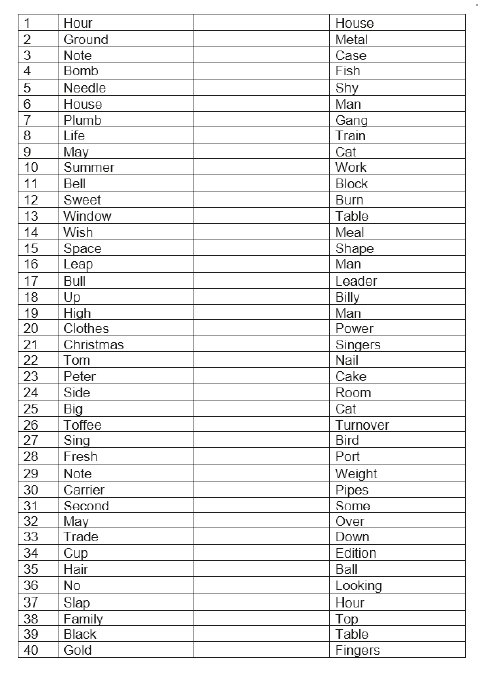
What word forms the second element of the first word or phrase and the first part of the other?

The newspaper for Nether Heyford & Upper Heyford, Northamptonshire, UK. Delivered free to every house since 1977.
What word forms the second element of the first word or phrase and the first part of the other?
Welcome packs are available for newcomers to the village.
The information in them helps people feel at home quickly.
If you notice that someone has moved in recently, get a pack for them delivered by calling:
Sue Morris, 21 The Green, Nether Heyford. Telephone: 01327 349387
2021 Calendar
The Prattler is producing a calendar for next year. We are currently selecting photos from the village photographers and they will be on sale in October.
About 200 years ago, in 1820, my great-great-great-grandfather was married in Nether Heyford. His name was Joseph Mann and he was born in Weedon Bec in 1800, and baptised there on 18th January 1801.
His first wife was Elizabeth Claridge (1801-1829), with whom he had two children, Lucy (b.1822) and Ann (b.1827), and after Elizabeth’s death, he married Charlotte Claridge (1810-1891) who may have been Elizabeth’s sister or a cousin; there were Claridge’s living in Heyford at that time but there may also have been a Claridge connection with Hertfordshire. Charlotte and Joseph had ten children, all born between 1831 and 1850 of which only one (George, b.1841?) was recorded as an infant death. The next boy, born in 1844, was named George, too.
When Lucy was married, aged 21, in c.1843, her father, Joseph, was described as a shoemaker. In fact, he developed a successful shoemaking business in the village. There were quite a lot of shoemakers (or people connected with the shoe trade) working in Heyford in the mid-19th century, nine in 1841, fourteen in 1851 and nineteen in 1861. The village itself had the first recorded mention of shoemaking in Northamptonshire in 1202.
Joseph died at the age of 61 in 1861 and is buried in Heyford. His widow, Charlotte, then married a John Smith of Heyford, whom she survived, and later she was buried at Cogenhoe. Joseph’s second son, William (b.1833) is the subject of an article in Volume 3 of “The Story of Heyford” and was also at one time a shoemaker. In that article William said that his father was not sympathetic to the established Church and followed the Baptist faith. In fact, it is recorded that Joseph was a “sponsor” of the chapel at Farthingstone. William also mentions that the people were not very happy with the way the Arnold Charity was being administered at that time.
William’s elder brother, the first child of Joseph and Charlotte, was named Thomas Claridge Mann (1831-1921). Tom almost certainly attended Bliss School. He followed his father into the shoemaking trade, working in several places in Nether Heyford. Eventually, he met a girl from Cogenhoe called Charlotte Smith, whom he married in 1852 at Cogenhoe Church. Charlotte came from a family of shoemakers in Cogenhoe. It is from this Thomas Claridge Mann (also known as “Old Tom”) that I am descended.
Old Tom and Charlotte settled in Cogenhoe and Thomas started making shoes in a room in Church Street, Cogenhoe. Eventually three of Tom’s Heyford brothers, Joseph (1836-1921), John (1839-1931) and George (1844-1932) followed him to join him in the business, but for some reason not William. They set up the company of T.C.Mann and Brothers, later to be dissolved in 1883 and renamed T.C.Mann and Sons. The company flourished, making the highest quality shoes, and they opened shops at 160, Regent Street, London and two more in Manchester, at 12, Cross St. and 123, Market St. They made shoes for foreign dignitaries and boots for one of Shackleton’s Antarctic expeditions. The Mann family in Cogenhoe, just like Joseph in Heyford, were chapel people and they built the Chapel in Station Road and a terrace of houses for some of the workers in the factory. At one time the firm
employed about a hundred workers, some of whom walked from Wellingborough and Piddington to work. And all this started from their experiences in Nether Heyford. The Story of Heyford states that William Mann lived to the ripe old age of 92, but Old Tom lived to 90, Joseph to 85, John to 92 and George to 88, so there must have been something in that Heyford air!
Old Tom and Charlotte had five children, including William Charles and Thomas Claridge (known as “Young Tom”), and Young Tom also had five children, the eldest being another Thomas Claridge (known as “ Young Tom’s son”) and the fourth child being my maternal grandmother. At one time there were so many family members in Cogenhoe that it was often said that “nearly every other woman that you see is probably a Mann”, but now I don’t think there are any left in either Cogenhoe or Heyford.
In October 1967 I got married at Cogenhoe Church to Ann, a Cogenhoe girl, and we made our home at Nether Heyford, basically because we could just about afford the house, and it was about halfway between Cogenhoe and Charwelton, which is where I was working at the time. In May of that year we had seen an advertisement in the evening paper for a cottage in Furnace Lane and as I was working at Charwelton on the Saturday, my mother brought Ann over from Cogenhoe to look at it. As they drove up the lane, my mother said to Ann that this was the village that her great-grandfather came from, and until then I knew nothing about the Mann connection with Nether Heyford, so it was a bit of a coincidence that we brought the family back to the village just over a hundred years after Old Tom left. We still live in the same house and have been here in Heyford for 53 years because we find the village and the villagers so friendly. We have almost been accepted too, I think!
Since then both our daughter Sarah and our son Kit, granddaughter Beckie and grandson Kyle have all been educated at Bliss School, and then they all went on to Campion School, where Kyle is still studying. Beckie was assisted by the same Arnold Charity that William Mann was so critical of, and then went on to University at Middlesbrough where she still lives, but the fact that the rest of us have remained in the village speaks volumes for Heyford village life. Kyle is the eighth generation of the family since Joseph married here in 1820.
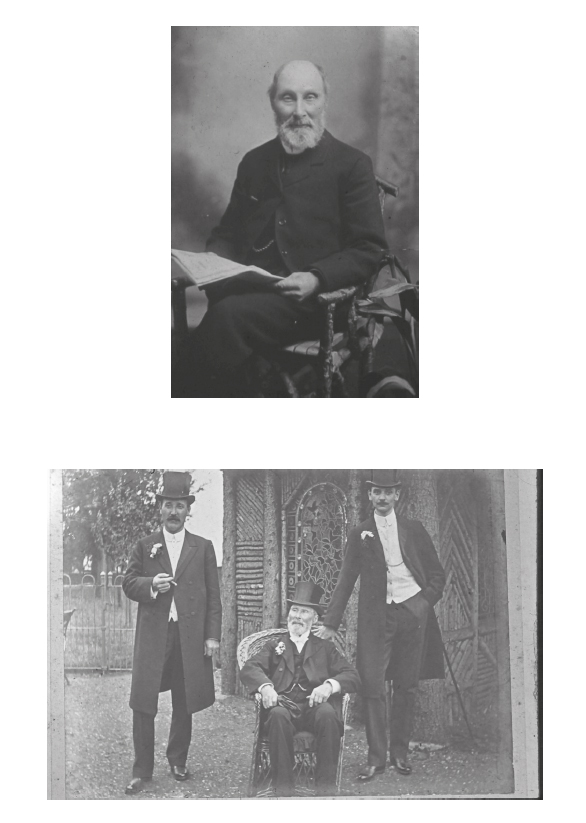
I have attached two photographs, one showing Old Tom, and the other showing, left to right, Young Tom, Old Tom (seated) and Young Tom’s Son.
If anyone can add to this story, especially regarding the people mentioned, or if they know that I have made errors, please let me know on 01327 340599
Pat Andrews
Letter published in The Prattler – September edition 2020
Food Banks are and will be a vital helping hand for so many people and families. Referrals are rising each week and sadly will continue.
As a church family we regularly collect for the Food Banks with drop off boxes in our churches. However, towards the end of February this year, it was becoming increasingly difficult to source dried and tinned goods from the shops and once sourced, items were restricted. This made it more difficult to support the Food Banks with suitable goods. When we had to close our churches, owing to the pandemic, we set up drop off points for donations in Upper Stowe, Heyford and two points in Flore.
I would like to take this opportunity to thank everyone who has and continues to support the Food Banks. I have been overwhelmed by such generosity. In conjunction with food donations we have also raised over £200.00 which has been donated to Daventry Food Bank so far, by various fund raisers, which included a “Back to School” quiz organised by our church secretary and sewn items for a golf tournament to name but a few.
Daventry Food Bank acts as a hub and supplies Weedon and other local Food Banks in Daventry District. They are always grateful for tinned, dried goods, cereals, toiletries, toilet rolls and fresh produce. Their web site www.daventryfoodbank.org.uk has a list of stock shortages for ideas. Deliveries from Nether Heyford are made twice a week. Donations can be dropped off in the box outside 15 Middle Street, or I can arrange to collect donations if you would like to phone me 01327 349754.
Whatever we can give, no matter how small will help. Matthew 7:12 puts this beautifully “So in everything, do to others what you would have them do to you”.
Thank you once again.
Maxine Edgington
Congratulations
Joseph (Joe) and Joan Garratt received a card from the Queen recently congratulating them on their 74th Wedding Anniversary.
They married on the 8th June 1936 at Nether Heyford Church and they lived in a cottage in Labrams Yard in Church Street when Joe returned from Army service in the Sudan and Joan worked in the war effort making aircraft parts for the Lancaster Bombers in the St James area of Northampton.
They settled in the village then brought up a family and were moved to the new Council Houses after about 5 years and continued to work and enjoy village life. Unfortunately Joe had a recent fall and was hospitalised with a damaged hip – the first time apart in all those years.
Joan says her family, friends and neighbours are a great support and thanks them all.
Jean Spokes
The Prattler team send them warmest congratulations on this special anniversary and wish Joe a speedy recovery. (Update 28/08/2020 Joe is now back at home)
Flood Watch
The summer solstice on the 20th June marked the change from spring to summer with the longest number of daylight hours,namely 16.75. The month ended with average rainfall and three days when the temperature rose above 30 degrees centigrade. A notable event in the early hours of the 26th was a totally red sky often associated with the saying “a red sky in the morning-shepherd’s warning” indicating the replacement of high pressure with more uncertain weather to follow. July returned to more typical temperatures until the last day when a record 36.1 degrees was recorded. Thundery conditions across the UK gave rise to a local tornado on the Saturday 25th which started in Weedon and tracked across Flore, Nobottle, Harlestone Heath and Moulton, lasting 15 minutes in total. The local ITV News recorded the devastation to allotments in Moulton. Again the month ended
recording average rainfall.
The beginning of August was marked by an African heat-wave when temperatures again rose to over 30 degrees for three consecutive days accompanied with night time temperatures over 20 degrees known as “tropical nights”. Inevitably these extreme conditions gave rise to thunderstorms which caused surface water flooding nationally. Locally our first rainfall of the month fell on the 13th with a 15 minute deluge. The longer term weather forecast for the remainder of the month looks to be unsettled with cooler, showery weather. As a result another month will end up with average rainfall resulting in the years total so far being average (brought about by extremely wet February and dry May).
23rd September will mark the autumnal equinox or start of autumn when day and night will be of equal length.
On the 3rd July a willow tree which was causing a complete obstruction to the free flow of river water was finally removed by E/A contractors.
For those interested in cosmic events a comet was forecast to be visible on 23rd July and extended meteor showers from mid July to the end of August. Given a clear sky these are best seen around 5 am just before sunrise.
In spite of all the problems caused by the introduction of Permitted Developments whereby properties could be extended without planning application which resulted in breaches of compliance with planning regulations and the continued building on floodplains, the Government has recently announced its intention to allow conversion of shops and offices to homes without formal planning application. It looks as though this marks the end of enforcement of strict building regulation and standards.
J.Arnold
September 1956
Dear Diary,
Well, that’s it. I’ve left Bliss Charity School and am preparing for the next stage of my learning at Duston Secondary Modern School. I didn’t pass the 11+ but that’s fine because all my friends are joining me on the daily bus trip to Duston. The few that passed the exam will bike to Upper Heyford, leave their bike in somebody’s garden and catch a bus to the Grammar School in Daventry. I’ve got my new school uniform, navy skirt and white blouse with school tie and a blazer with a badge for winter. For the summer we are to have a green striped dress made from Butterick Pattern No. 7741 available at Adnitts. Duston Secondary Modern School opens its doors this month and I am in Form 1A. A bus will leave Heyford at 8:20 am and bring us home after 4 o’clock. I’m looking forward to the next stage of my education.
I’ve enjoyed the school holidays, mostly outdoors. It was great not having to get up so early. By the time I opened my curtains nearly all the ladies in Furnace Lane had their washing out. They all have a line stretching from top to bottom, and they all seem to wash on a Monday, so it’s lovely to see rows of sheets blowing on a sunny summer’s day.
The other day I had a “butcher’s basket” on Sue’s bike and I jumped off when she started going too fast and ripped my knickers. I told dad I’d fallen down a tree because he knows I climb and he’d be really annoyed if he knew I’d been on somebody’s bike. He thinks they’re dangerous. Mind you that could be because he can’t afford to buy me one. It all started after we’d been scrumping down Ben’s Orchard and had to make a quick getaway because somebody shouted “Ben’s coming”. I have no idea who Ben is and don’t know of anybody who’s ever seen him but he has some lovely apples. I really don’t need to go scrumping because we have apples galore at home but I like to join in the fun.
I’m spending the morning with Nan while mum goes fruit picking up at Beck’s farm by the A5. They say that Mr. Beck was a pilot in WW1. He is a very kind man. Children are allowed in the school holidays but I like to help my Nan pod her peas and pick her gooseberries ready for Pap’s dinner and she lets me help make pastry in the kitchen sometimes. Having said that she’s not quite as bright as she used to be and doesn’t mind if I find a caterpillar in the peas, “adds a bit of meat” she says. I love her 3 cats which she has to keep the mice away. She falls asleep easily but she’s over 60 and she brought up 7 children, so it’s understandable. I might go off and play for a bit if she nods off.
Last Sunday my dad and uncle cut the hedge round pap’s garden & orchard. It’s a very long hedge and takes hours. Backing onto the orchard is Mr. Humphrey’s ladder making yard and you can hear the saws during the week in the woodshed but it’s quiet on Sunday because they all go to chapel.
The morning was spent with the men hedge trimming and mum cooking our meal. After dinner the men were clearing the hedge cuttings and making a bonfire at the top of the orchard, Nan and Pap were asleep in the living room, and me and mum washing up. All of a sudden mum gasped. “Oh blimey, they’ve set the hedge on fire. Go and sit with the oldies, and if Pap wakes up play dominoes with him, but make sure he doesn’t come into the kitchen, he’ll have a fit. What, miss all the fun,
again! Of course, I did as she asked and Pap didn’t wake up until the men came in, all black, saying the work had been done. Mum was grinning.
Polly
Letter published in The Prattler – September edition 2020
At about 11.20 am on the 21st September 1951, the 8.20 am Liverpool Express to London came off the track at the Stowe Hill Tunnel near Heyford and tipped over in the embankment. The crash killed eight people and another seven died later in hospital. There were also thirty-six other casualties.
David Blagrove, in his book, “Waterways of Northampton” describes how “the railway can be seen plunging into Stowe Hill Tunnel” and it was here that the train, “hauled by the Duchess class Pacific engine, Princess Arthur of Connaught, left the rails shortly after leaving the tunnel at a speed of between sixty and sixty-five miles an hour.”
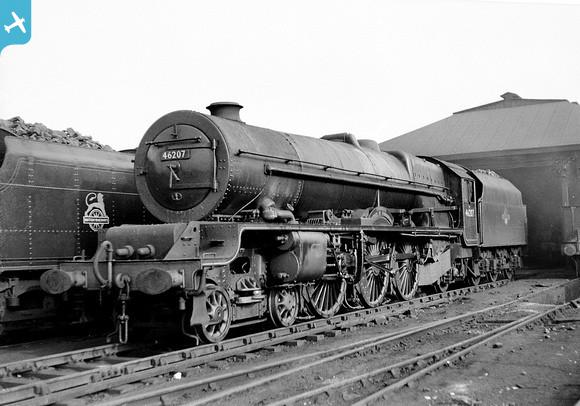
Engine 46207 Princess Arthur of Connaught

Photo taken by James Banner and lent by Ted Garrett
A prompt response
Frank Denny, the Heyford signal man that day, was the first to realise what happened. His signal box was located about a quarter of a mile from the railway bridge in Furnace Lane, along the stretch of line between Heyford and Bugbrooke. As the signalman, Frank was aware that the train had entered the tunnel from Weedon but he became anxious when it did not reappear. As he looked out of his box, he saw steam rising from the embankment near Tanborough Farm.
Frank instinctively knew something was wrong and realised that his first priority was to halt the Royal Scot which was travelling from London and due to pass at any moment. He therefore rang through to the Banbury Lane signal box at Bugbrooke to get the signal switched to stop. This duly happened the Royal Scot came to a halt near his own box. The driver got out to demand “what the hell is going on.” It was due to Frank’s swift response that a much more serious accident was averted.
MBE
At the same time, Mrs Cecily Hughes, the doctor’s wife at Weedon, took a call from the Weedon Stationmaster to say that the Liverpool Express had failed to clear his section of the line. He asked if she and her husband, Dr Stephen Hughes, would take a look. So far, that was all that anyone knew.
The couple set off in their car, armed with first aid that they always carried. They arrived at the tunnel within seven minutes of the accident. Mrs Hughes describes how they found nothing at the tunnel entrance so they climbed up over the hill – to be greeted by the sight of the crash strewn along the line.
The rescue operation

Photo taken by James Banner and lent by Ted Garrett
The first four coaches were the most damaged and contained the dead and badly injured. The doctor took one side of the train and his wife the other, clearing the debris in order to reach casualties. Mrs Hughes recalls how “Everyone was calm and patient. The last two carriages had not even left the rails and were still upright. They were full of boys returning to boarding school and one of the senior boys took charge, leading the others away from the scene and back to Weedon, to the Globe Inn.”
The doctors found the engine driver, Mr Tomlin, buried up to his shoulders in coal from the tender. It took a while to dig him out but he was quite unhurt, as was the train’s fireman who had clung to the cab as the engine tipped over.
After attending to all the serious casualties, Dr and Mrs Hughes returned to Weedon, only to find that many more people, including some of the rescuers, were waiting for treatment for minor cuts and bruises.
As some of the first medics on the scene, the contribution made by the Hughes’s was invaluable. Mrs Hughes was later awarded the MBE for her part in the rescue operation. She was reluctant to accept at first, as there were also others who had helped at the crash site and she felt that she was only doing her job. However, Mrs Hughes was described as “heroine of the morning” and duly received her medal.
Witnesses
Several Witness also came forward including a bus driver on the A5 who saw the immediate aftermath of the accident and reported it at Weedon station. It was also very fortunate that a police car happened to be passing the scene along Watling Street as it was one of only two police cars fitted with a radio in the entire county. They were able to summon medical help promptly.
Mr George Richardson of London Was driving along the A5 at the time and said: “I saw the train come out of the tunnel and begin to wobble.”
This “wobbling” and lurching was felt by passengers too. One survivor, Mr Blankfield of Liverpool, explained, “I was in a carriage half-way along the train . . . there were four or five jolts and then the train stopped completely.” He described how he and other passengers immediately climbed out of the windows to help others further along the train.
The damage
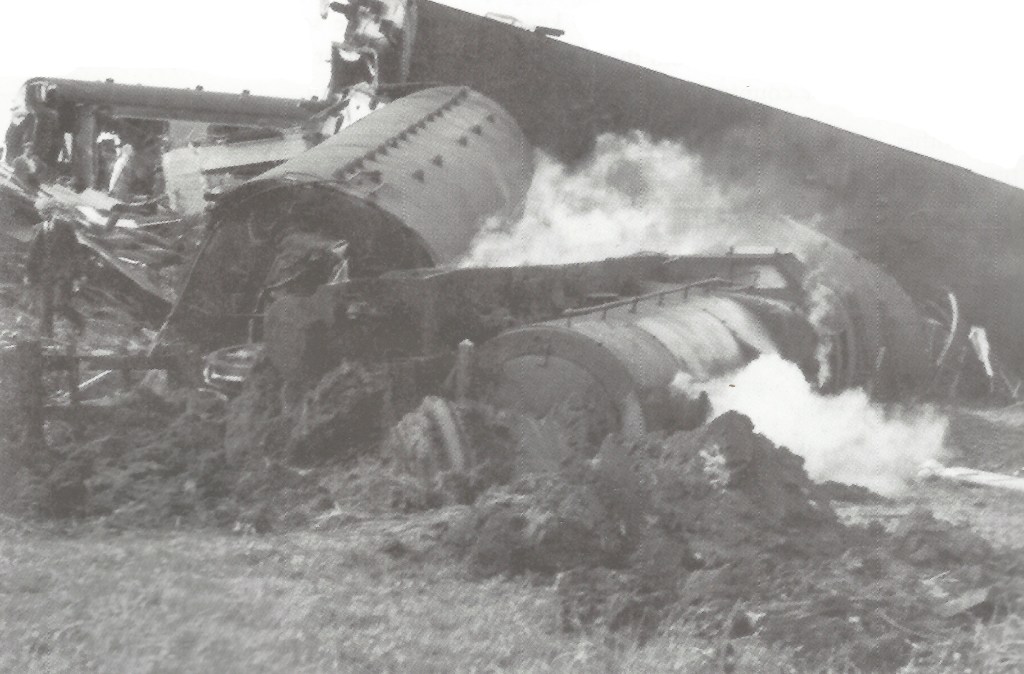
Photo taken by James Banner and lent by Ted Garrett
Local help
For local people in Heyford who worked near the railway, the sound of trains was a familiar one and you could tell exactly the time of day by the individual noise of each train that passed. When the crash occurred, Mr Gray of Tanborough Farm apparently thought that his wife had knocked over the dresser. But after that, apart from the hissing of the engine, there was an eerie silence.
Word quickly got around and people went up to help. Amongst the first on the scene were Reg and Joan Collins of Wharf Farm. They provided milk churns so that water could be carried up the hill to the casualties. There was no shortage of volunteers to take the churns but at the end of the day. Reg. had to go round and collect them all back again in his tractor and trailer in time for the evening milking.
Joan had to cycle down to Mrs Blaney at the Post Office with messages to be telegrammed to relatives. At this time, there was only the one phone with one public line out of the village. The officials did their telephoning from Holly Lodge which had one of the few phones in Heyford.
Ted Garrett was booking clerk at Weedon Station that day. When the crash happened, communications between Weedon and Heyford were suddenly lost, so they knew that something was amiss. In fact, as the train was thrown from the track, it had brought down the telegraph poles and cut all contact. A message finally arrived at Weedon via Roade Station that there had indeed been a crash. Ted Garrett was given charge to inform the army located at Weedon Depot and ask them to help at the crash site.
Frank Smith arrived with the Daventry ambulance and took the first casualties to Northampton General. He was actually on his second trip to the hospital by the time other ambulances appeared. Then the army from Weedon arrived to help. As they appeared over the hill, people recalled that it looked as though they were on manoeuvres.
Retired district nurse, Miss Raynor – over 70 years of age – walked two miles from Weedon to the crash site with a case of medical supplies. The Salvation Army and the W.V.S. set up mobile canteens and were there all day. The women from the Heyford railway cottages brought up hot tea for the survivors and people also brought blankets and sheets. The sheets were torn up to make bandages and the blankets kept the survivors warm. These were, of course, not returned but compensation was later given to those who had provided them.
The curse of the tunnel
The crash was reported in the national media and was news on the BBC Home Service. Local papers were full of the story; Northampton’s Chronicle and Echo carried the banner headline “8 KILLED IN WEEDON TRAIN CRASH” although this figure was unfortunately to rise. The Daventry paper went further and wondered if there was a more sinister aspect to Stowe Hill Tunnel. The paper reported that at the same spot in 1915 there had been another fatal train crash.
There were similarities between the two railway accidents. Both occurred about the same time of year with trains that had left at the same time in the morning. On 14th August 1915, the Irish Mail left Euston at 8.30 am and it too was disrailed; this time as it left the tunnel at the Weedon end heading north. The crash killed nine and injured 13 and many of those on board were troops in service during World War One.
However, despite the comparisons, the crash of 1915 was caused by a broken coupling left by a passing train. The coupling had ploughed into the track and so dislodged the oncoming mail train.
Board of Trade
In both crashes, the stretch of line was not found to be at fault. In 1951, the investigation by the Board of Trade was led by Lieutenant-Colonel G.R.S. Wilson. He concluded that the engine (number 46207 for train buffs) had an axle incorrectly fitted after its servicing at Crewe. The axle was slightly too tight, enough to cause a problem when it reached Stowe Hill Tunnel. There is a small change in rail type leading in and out of the tunnel (from flat bottom to bull head track) and, with the axle too tight, the Express dislodged when it went over these rails. The service engineer responsible at Crewe was named but, this being the 50’s and not the 90’s, there was no huge compensation claim or court case.
The engine itself had embedded in the soft clay around Stowe Hill and actually suffered little damage. However, it took almost a month before it could be lifted because of the steep ditch of the embankment. The engine had to be lifted out by a crane and villagers can remember its massive size as it was hauled into the air. It was then towed back to Crewe and was running again within six weeks. Driver Tomlin actually drove the Liverpool Express one more time to London, but never again after that.
By Sarah Croutear. A number of people have contributed to this story but we must give particular thanks to Joan Collins, Ted Garrett, Cecily Hughes and Doris Lovell, Frank Denny’s daughter.
~~
Added 2020:

British Pathe News
British Movietone News
The Illustrated London News
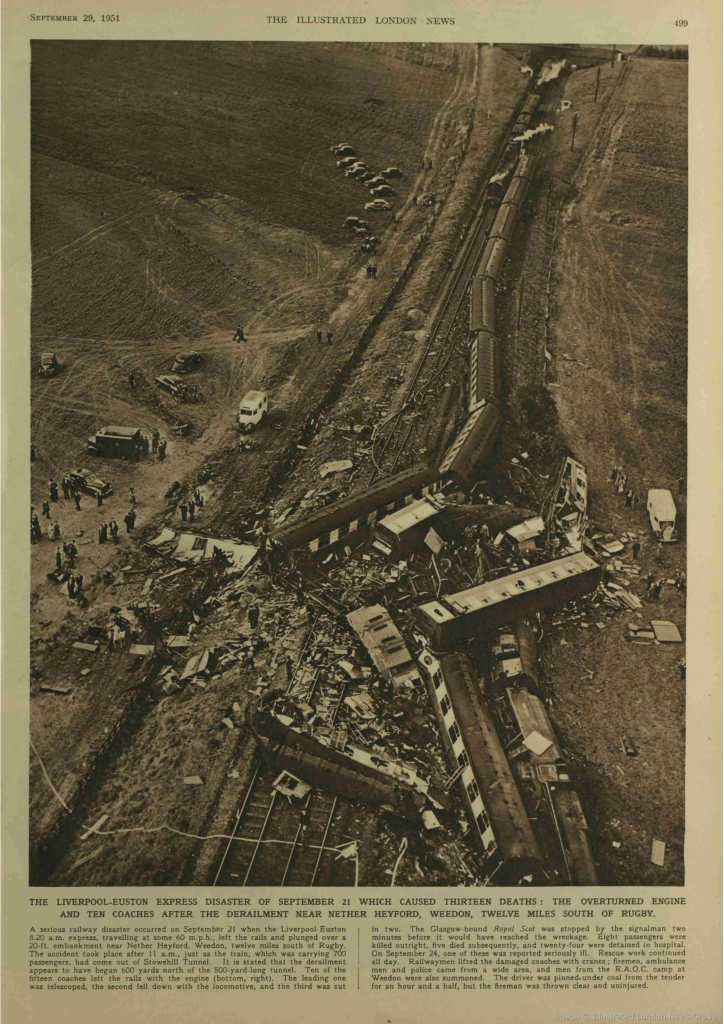
Britain From Above
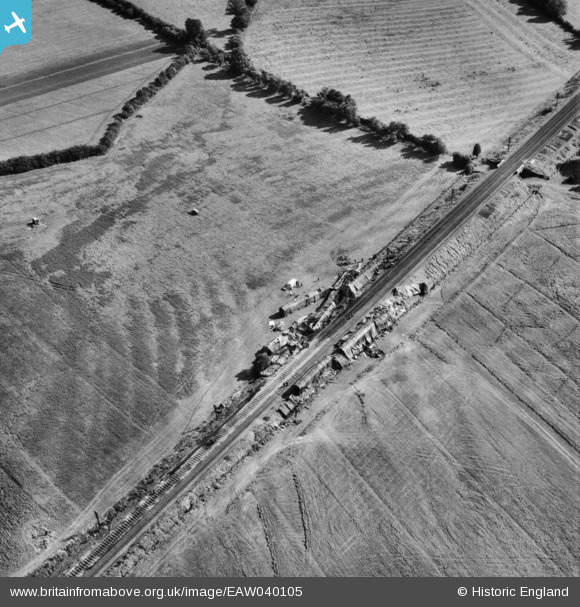

https://www.britainfromabove.org.uk/en/image/EAW040105
No. 6207, A Study in Steel (1935) LMS
Ministry of Transport Crash Report
Report on the Derailment which occurred on 21st September 1951 near Weedon in the London Midland Region British Railways
“The 8.20 a.m. Up express passenger train from Liverpool to Euston, comprising 15 bogie coaches hauled by a Pacific type engine, was travelling at 60-65 m.p.h. on the leaving transition of a left handed curve of about 50 chains radius, when the leading bogie wheels of the engine were derailed to the right ; the cause was an engine defect. The derailment was not noticed by the enginemen at this stage and the train continued forward at speed for more than £¾ mile on the straight without serious damage to the flat bottom track. No more wheels were derailed until the train reached the bull head rails just beyond the short Stowe Hill tunnel, when the leading bogie wheels began to smash the chairs and break up the track with the result that the whole of the train left the rails except for the last two vehicles.
The engine went down the 12 ft. embankment to the left, and fell on its left hand side: on soft ground. The wreckage of the coaches at the front of the train was severe, and I regret to state that seven passengers and one of the dining car staff were killed outright and seven passengers died subsequently in hospital. In addition, 26 passengers, the engine driver, and nine members of the dining car staff were admitted to hospital, or 36 persons in all, of whom 15 were discharged on the same day, and 25 others sustained minor injuries or shock. The driver, who was on the left hand side of the footplate, had a fortunate escape from serious injury when he was buried in coal from the tender as the engine overturned ; the fireman clung to the right hand side of the cab and was unhurt.
The wreckage of the eight leading coaches was piled behind and alongside the overturned engine across both the tracks. It was seen by the signalman at Heyford box 950 yards ahead when he heard the noise of the final derailment, and he stopped the approaching Down “Royal Scot” express at his outer home signal at 11.19 am., and afterwards drew it forward to the box. The block and telephone wires northward were severed, but the signalman got a message through to the Control via Blisworth, the next junction box to the south. Medical and other assistance was also summoned from all possible sources by some officers of the Metropolitan Police who had seen the wreckage from their car on the neighbouring main road. The Northamptonshire County Police were quickly on the scene and performed outstanding services in co-ordinating the work of rescue.”
Magazine Article
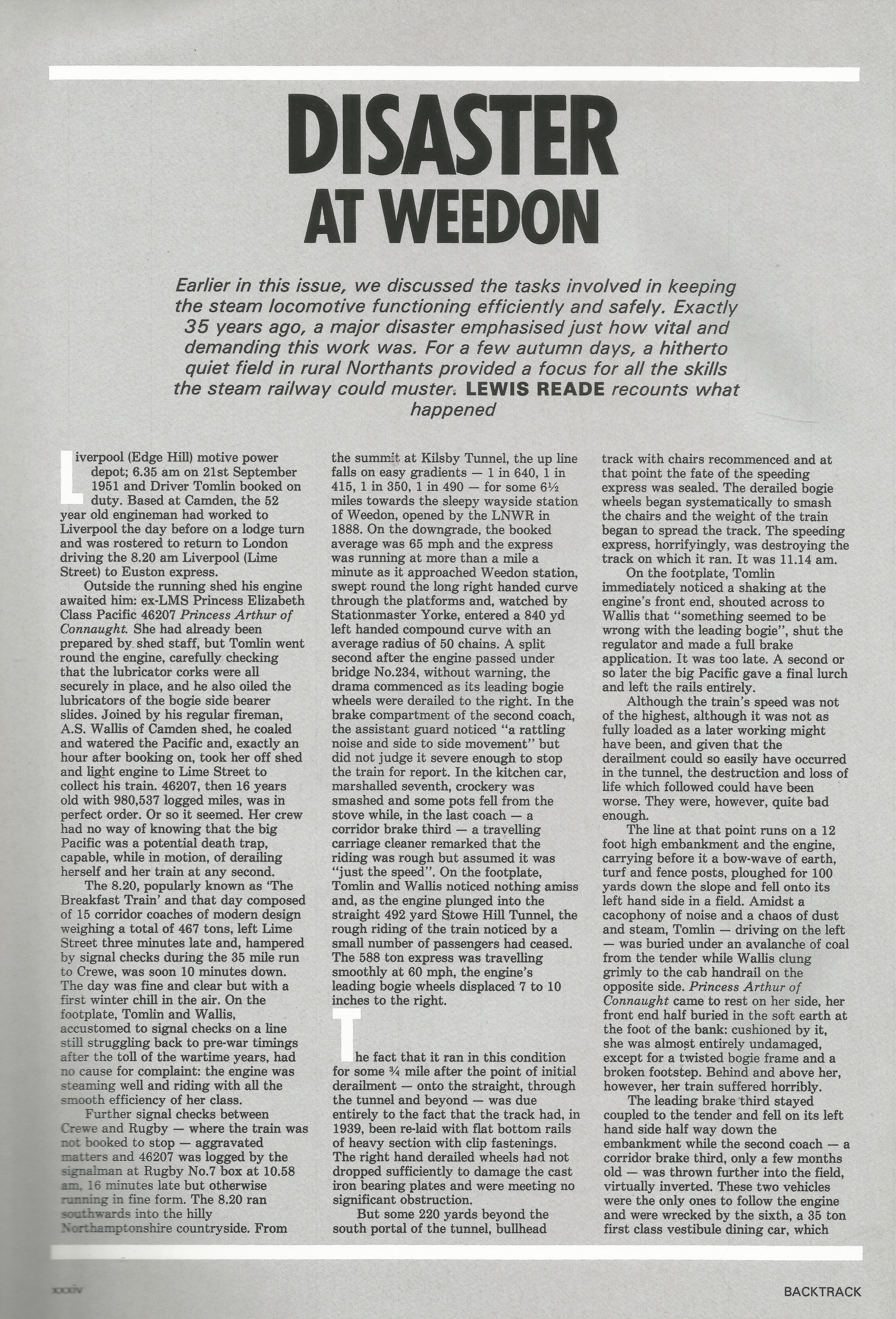

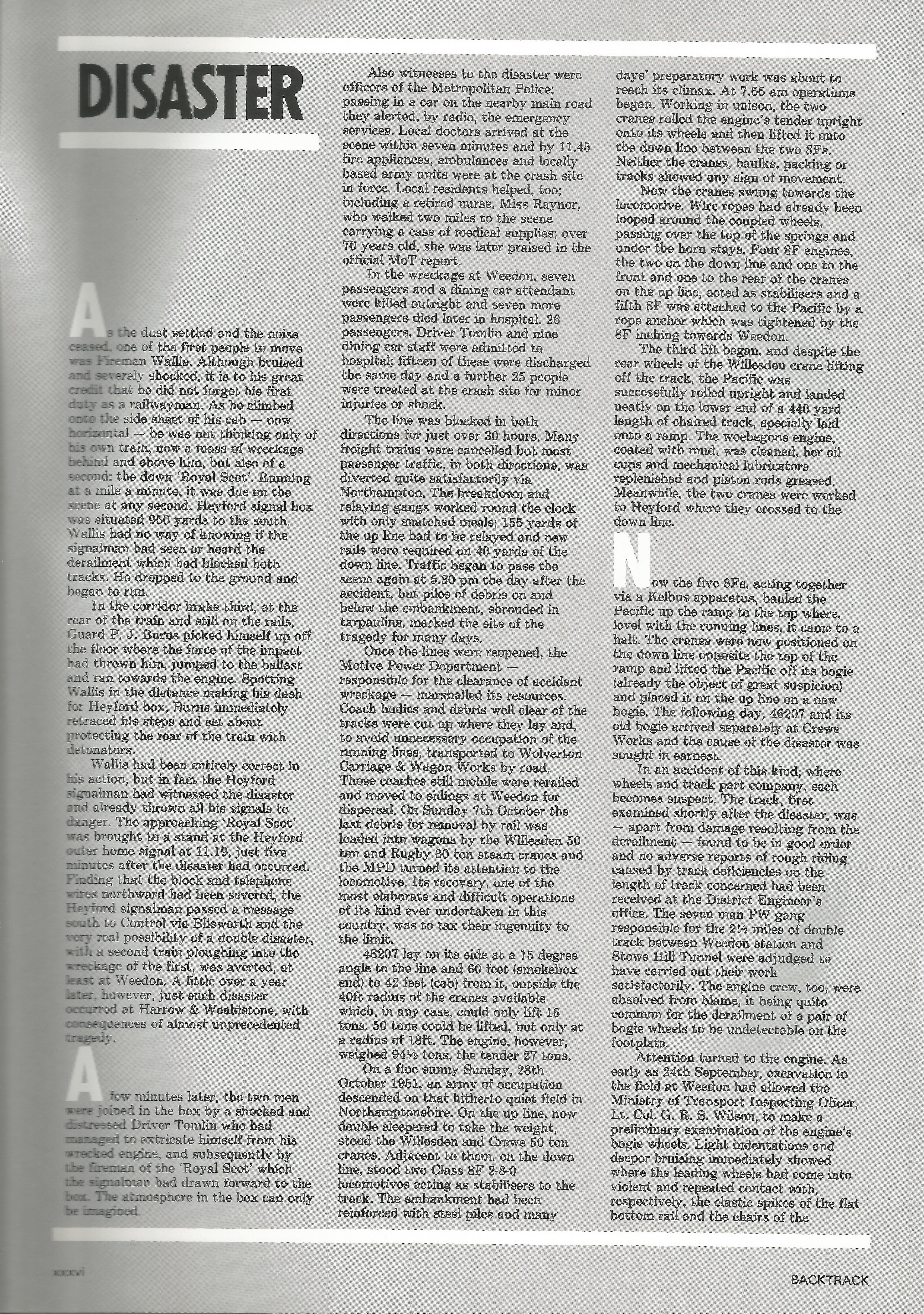

Jez Wilson – Updates added September 2021
~~
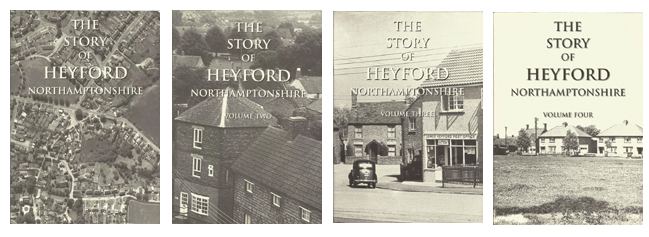
Extract from “The Story of Heyford” – Local book series published in the late 1990’s
Volume 3 of 4 | Chapter 3 of 17 | Page 4 to 7
STEP 1: JOIN THE OURWATCH.ORG.UK NATIONAL NEIGHBOURHOOD WATCH WEBSITE
Visit www.ourwatch.org.uk/scheme/25380/nether-heyford-and-upper-heyford – select the middle box – “Not a member yet ? – JOIN”
Complete your details in the online form (Name, Postcode, Email Address) then click the “Join Us” box. You will then receive a code via email which is needed to enter on the next screen for verification. Complete further details via the next online form (House Number, Check Map Marker, Year of Birth, Choose a password)
Options are now given to subscribe to email messages from other licenced information providers: Fire & Rescue Service | Get Safe Online | Office of the Police & Crime Commissioner | SGN (Gas Emergency Service) | The Police | Action Fraud (NFIB)
You are now successfully registered as a member of www.ourwatch.org.uk – You will receive an email with your unique membership number. [Keep your membership number safe as it can be used to claim discounts and member benefits]
STEP 2: JOIN THE LOCAL NEIGHBOURHOOD WATCH SCHEME FOR NETHER HEYFORD AND UPPER HEYFORD
Select the option “SCHEME ADMIN” from the top navigation menu – Then select “Nether Heyford and Upper Heyford” from your local schemes options to join.
STEP 3: SIGN UP TO NORTHAMPTONSHIRE NEIGHBOURHOOD EMAIL ALERTS FOR NETHER HEYFORD AND UPPER HEYFORD
Select the option “MESSAGES” from the top navigation menu and then select “Alerting Areas”. Use the region options next to the map and using the + symbol select England > East Midlands > Northamptonshire > South Northants District > S014 Heyfords and Bugbrooke – then tick the box and finish by clicking the yellow box “Save extra alerting level”
You should now be fully signed up. If you experience any difficulties please visit: www.ourwatch.org.uk/scheme/25380/nether-heyford-and-upper-heyford and use the button “Send a message EMAIL SCHEME COORDINATOR”

Northamptonshire Neighbourhood Alert is a free messaging service that allows Northamptonshire Police, Neighbourhood Watch and other partner organisations keep you informed about issues in your area that are relevant to you. Once you’ve signed up you’ll receive information about crime and suspicious activity where you live or work – helping to prevent and detect crime and anti-social behaviour.

Jez Wilson – August 2020

