The Census return of 1891
The details from Census Returns are not made available to the public until they are one hundred years old so the one most recently available to us is that of 1891. An analysis of this gives us a pretty good idea of what life in the village was like at the turn of the century.
The houses and people
The details below tell us about the number of houses, people and canal boats.
Lower Heyford
- 164 houses inhabited, 28 uninhabited
- 750 people, 365 males and 385 females
- 7 canal boats with 23 people on board
Upper Heyford
- 22 houses inhabited, 7 uninhabited
- 96 people, 41 males and 55 females
The houses listed as uninhabited were either vacant because the occupants were away on the night of the census, or more likely because they were uninhabitable.
A number of the families listed in the 1891 Census have continued to live in the area throughout the century: Names such as Adams, Charville, Clarke, Collins, Denny, Eales, Faulkner, Foster, Furniss, Garrett, Kingston, and Masters are still well known in the village today.
In those days street names were generally not used and there were certainly no house numbers. However several specific buildings are mentioned in the census.
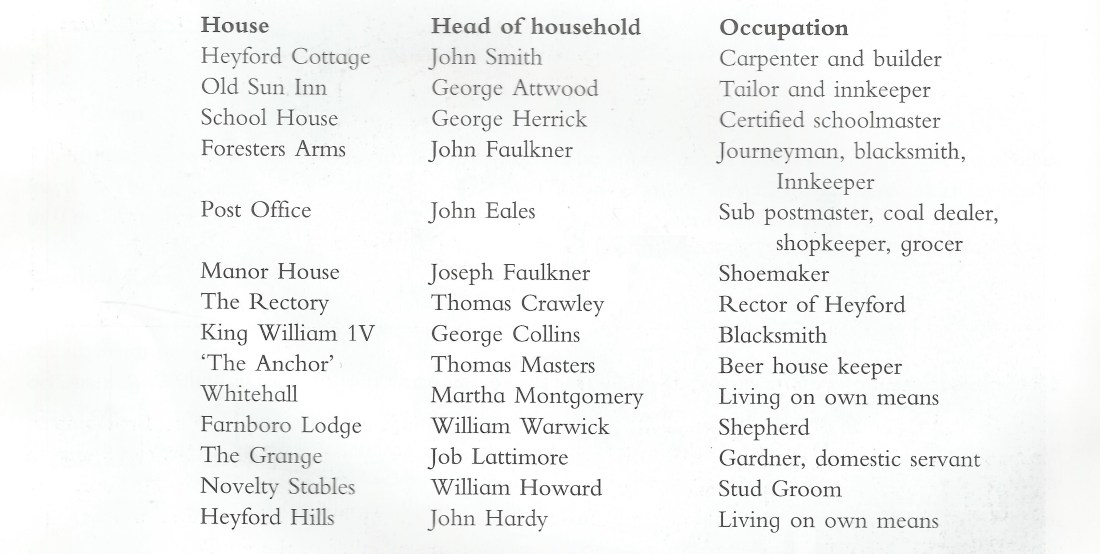
Working life
The occupations listed in the census also give some insight into working life in the village. Here is a breakdown into the main types of occupation.
Farming. The census lists 2 farmers, 2 flour millers, 1 milkman, 3 shepherds, 1 tractor engine driver and 26 agricultural labourers.
Building. 1 builder, 1 plasterer, 1 stonemason, 3 bricklayers and 7 carpenters.
Boot and shoe making. 5 shoemakers, 2 shoe rivetters, 1 boot and shoe finisher.
Other trades. 1 tailor, 2 lacemakers, 11 dressmakers, 2 blacksmiths, 1 harness maker, 1 wheelwright, 1 gunmaker, 3 boatbuilders, 1 organ builder.
Dealers. 1 butcher, 2 bakers, 3 coal merchants, 1 timber merchant, 1 corn merchant, 1 draper, 2 carriers, and 5 publicans, beer sellers and innkeepers.
Blast furnaces. These were the biggest single employers in the village with 1 blast furnace foreman, 2 blast furnace engine drivers, 2 stationary drivers, 1 engine fitter, 2 ironstone labourers, 1 weighboy, and 28 labourers.
Brickworks. 16 brickyard labourers.
Railway. 1 railway engine driver, 1 goods shed labourer, 1 engine fitter, 1 telegraph clerk, 3 signalmen and 4 platelayers.
Domestic and educational. 1 schoolmaster, 2 school mistresses, 1 clerk, 1 governess, 14 housemaids and domestic servants, 2 grooms, 1 nurse girl, 3 laundresses, 1 midwife.
Other. 28 general labourers.
The village as it appeared in 1900
The memories of Bob Browning (1892-1997)
Many of the details in the remainder of this chapter came from information given by Bob Browning to Stephen Ferneyhough on Tuesday 9th April 1996. Bob Browning was born in August 1892 and died in March 1997, aged 104. He was one of two brothers and four sisters all born in Nether Heyford. The story of this family appeared in Volume 2 of this series of booklets. All lived well into their nineties (94, 96, 98, 99, 101, 104) and Bob was the last and oldest surviving member of the family.
I visited him in his room at Bethany Homestead in Northampton. He was smartly dressed in a suit and tie. He greeted me with a handshake and made me feel very welcome by telling the nurse that I was a very good friend of his. He was very lively, interested in anything historical and was very glad to pass on anything he could for the interest of future generations. He lived in the village until he moved to Northampton in 1922, and most of the memories below are from that period.
Everyday life in Heyford
Life for most people was a matter of survival and self-sufficiency. The days were long, money was scarce and life was simple. Most families had an allotment and grew most of their own vegetable needs. After work in the light evenings, this was one of the main activities.
Most families kept hens. At harvest time the children went ‘gleaning’, that is picking up any remaining ears of corn to feed to the chickens. If a hen went broody, you’d put a dozen eggs under her in the spring time and so continue the supply of chickens and eggs.
Most people also kept a pig, usually in the backyard but sometimes on the allotment. The straw from the pigsty Was tipped onto the allotment, and the vegetable waste from the kitchen was fed to the pig. The boys went collecting acorns for the pigs in the autumn which they could sell for a tanner a bagful. The pigs were killed and butchered in the autumn to give a winter supply of meat. This was usually done by the butcher Ted Capel, and later by his son jack. The butcher went to the home or allotment to kill the pig. The meat was salted, and then laid in trays or hung in nets in the living room or hallway.
There were several farmers in the village producing milk. They delivered the milk, which was unpasteurised, each day in large cans. They had pint and half-pint measures which they filled and tipped into the jugs of the housewives who bought it. During the war there were shortages of anything that they couldn’t grow themselves. Sugar was rationed to half a pound a week. Butter was scarce and margarine became more common. However, they made a kind of butter by leaving the milk to stand overnight so that the cream came to the surface. By scooping it off and shaking it up they were able to make a sort of butter to use as a treat at the weekend.
There were two orchards in the village. john Barker had the one owned by the school behind Church Street. There was also Ben’s Orchard in Middle Street. This had a wall all around it, but it didn’t keep the boys out. They went scrumping for apples and pears in the autumn and stored them under the eaves the hayricks which were thatched for protection against the rain. They would always know the right time to retrieve them before the farmer came to dismantle the ricks. Nowadays there are no orchards, but the boys go garden hopping instead… presumably to get the same sense of excitement.
Lack of services
There was no sanitation, just an outside toilet. Some of these still exist in village as tool sheds or stores. but most have gone. The toilet would be emptied around once a week, usually onto the allotment. Sometime before the first world war the cart started coming. Two men employed by the council brought a two-wheeled cart pulled by horse to collect the toilet contents. It was then taken away for disposal. It had only two wheels to allow it to tip for emptying.
There was no gas or electricity. Gas came to the village just before the first world war via the Bugbrooke gasworks. Electricity didn’t come until after the second war. For light there were candles and oil lamps. For cooking there was a range with an open fire. On one side was a boiler for heating water and on the other side a small oven for baking cakes. You could divert the flames and heat to one or the other. On Sundays the wife would cook the vegetables, but the joint and yorkshire puddings were usually taken to one of the bakers for cooking while the family was at church or chapel. The main bakery for this was the one in Furnace Lane run by Wesley Faulkner. Most people had a bath once a week, often on Friday. Each house had a tin bath. The water for the bath was heated in the copper in the kitchen over an open fire. The fires were fuelled mostly by coal. There was a ready supply of coal to the village which came by canal. The Eales family who ran the post office kept a coal yard. Tom Dunkley at the Bricklayers Arms beside the canal also had a coalyard. He made deliveries by cart from which people would buy; enough to last the week.
The water supply consisted of four taps and many wells. There were four public taps in the village. One outside the jubilee Hall, one opposite the school outside Dennys house, one on the wall in Church Lane, and one near the Church rooms. A lot of the houses had wells, all supplied by the many springs in the area. The wells were dug two or three feet wide, five or six feet deep, and brick lined. The water was obtained by means of a bucket and rope. Later after the first war it became common to fit a handpump to the well.
The top of Church Street in 1913 This photograph, lent by Bob Smith, was taken in 1913 and shows a view from the top of Church Street. In the distance can be seen a small group of cottages, since demolished.
The homes
Most of the houses were of stone (either limestone or sandstone) with thatched roofs and stone slabs for flooring. Some of the older ones like the tinsmith forge opposite the war memorial had mud walls. But many of the newer houses built late nineteenth and early twentieth centuries were of brick and slate with red quarry floor tiles. There was a brickworks in Furnace Lane where Wickes now is, but again the canal brought a ready supply of both brick and slate into the village. The owners of Flore Lane Wharf were dealers in brick and slate.
Inside the homes, most walls were plastered. This was made with a mixture of sand and lime. There were two good sandpits in Furnace Lane and there were a number of lime kilns along the canal which supplied slaked lime.
Church Street – the working heart of the village
In those days there were no street names or numbers. It was just ‘Barkers yard’ or ‘Tandy’s place’. Everybody knew who everybody was and where they lived.
The stone and thatch house behind the war memorial known as ‘the Springs’ was a laundry owned by a family called Smith. Sometime before the first world war the laundry was closed and the house was taken over by the Ward family.
In front of ‘the Springs’ was the Jubilee Hall. An article on this appeared in volume one of this series of booklets.
On the site of the jitty opposite the war memorial was a tinsmith forge. The path of the jitty then ran further to the left and came out beside the house known as ‘the Springs’. The forge was made of mud walls but became derelict and was demolished in 1920 when the New School house was built.
The small building to the right of the jitty which housed ‘Tops the Hairdressers’, and more recently ‘Heyford Antiques’ was built by William Browning, (Bob’s father) as a haberdashery and material business. Bob grandparents, Mr and Mrs Alfred Marsh (maternal side) lived next door.
To the right of this is a small three bedroomed cottage where the six Browning children were born and grew up. Behind these buildings was a saw pit and builders yard.
Next door is the house known as Tandy’s place. There used to be a right of way here through the yard to the jitty. Before Tandy was there it was occupied by a man named Gammage who ran a boot and shoe business. He married into the Faulkner family but later moved his business into Northampton. After he left it was taken over by Mr Tandy who made only heels and soles. He bought scraps from the leather factories and cut them up with special knives, building them up in layers to make heels and soles which were then sold on to shoe factories. After Mr Tandy left, it was occupied by a man named Williams who kept three or four cows and supplied milk to the village.
Further down Church Street, where the road turns sharply to the left, the red brick building on the inside of that corner was a bakehouse. It was owned by Thomas Faulkner who also ran the Methodist chapel for around 50 years until his death in 1940. He lived opposite in the stone and thatch building known as Ash Tree Cottage.
To the right of Ash Tree Cottage are some black doors. Here there used to be a blacksmith. The building belonged to the Faulkner family but the forge was used only once a week by Mr Green who came over from Flore. Later on it was Edward Wright who came (Bob Browning’s father in law). It was closed sometime before the second world war.
To the left of Ash Tree Cottage is Capel Cottage. so called because it was where a butchers business was run by the Capel family for three generations. Firstly by Ted before the first world war, then later by his son Jack. Most of the pigs in the village were slaughtered by the Capels.
Just around the corner was a small wheelwright shop run by Mr Foster. He learned his trade as an apprentice sponsored by the Arnold charity. The main local wheelwright was in Flore.
Further down Church Street, round the corner, almost opposite the Church is a stone, brick and thatch house that was a shop selling sweets, general groceries and beer. It was run by Mrs Oliver. Her husband worked on the roads (building and repairing).
Two views of Church Street
 This view of Church Street at the corner of Manor Walk shows Manor Cottage and Capell Cottage. The lady in the picture is Mrs David Browning.
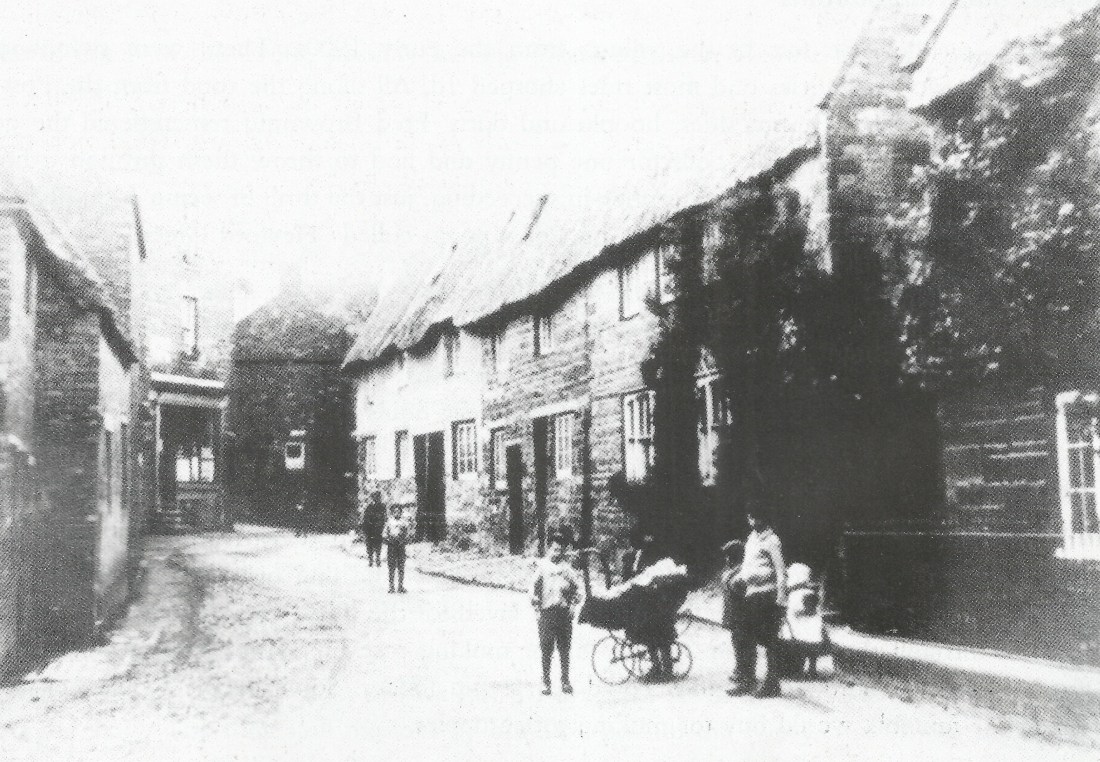 This picture above shows the row of cottages between the two bends in Church Street. The ones at the far end have since been demolished.
Stephen Ferneyhough
~~
Extract from “The Story of Heyford” – Local book series published in the late 1990’s
Volume 4 of 4 | Chapter 3 of 8 | Pages 12 to 17

Heyford’s Historical Heritage | How the books were created
Index | Covers
52.219796
-1.033694
 The Nether Heyford Prattler