The Story of Heyford: Civil Justice in 1819 V3C17

In 1819 William West and Joseph Masters were employed by Thomas Adams to transport thirty-nine thousand bricks by boat from Heyford to Northampton. It appears that they performed the task but were not paid. So they took their case to the court in Northampton. The following pages are copied from the legal documentation which shows how the case proceeded.

The Agreement – 24th March, 1819. The agreement to transport the bricks consisted of the following hand-written note, written presumably by Thomas Adams.

March 24th, 1819. Mr Thomas Adams for Joseph Masters and William West of Lower Heyford for boating from Heyford to Northampton 39 thousand bricks @ 2s per thousand which comes to £3.185s.od. Due to the said Joseph Masters and William West.

The Complaint – 13th Novemer 1819. When they were not paid they took their case to court in Northampton:

Northamptonshire to wit. Be it remembered that this thirteenth day of November in the year of our Lord One thousand eight hundred and nineteen, William West and Joseph Masters of Nether Heyford in the county aforesaid, labourers, complaineth and maketh oath before me, one of His Majesty’s Justices of the Peace for the said county, that in March last the said William West and Joseph Masters were hired by Thomas Adams of Nether Heyford in the county aforesaid, yeoman, to be labourers in the business of removing bricks to him the said Thomas Adams for the wages of 2s per thousand, and that they the said William West and Thomas Adams did accordingly as aforesaid enter upon and afterwards perform the said service, and that he the said Thomas Adams hath refused to pay to them the said William West and Joseph Masters the sum of three pounds and 18s justly due for the said service, and thereupon they the said William West and Joseph Masters prayeth that justice may be done in the premises.

CivilJusticeMarks1819

The Summons — 13th November 1819. As a result of the complaint, the constable of Nether Heyford was commanded to summon Thomas Adams to appear before the court the following week.

County of Northamptonshire to wit. To the constable of Nether Heyford in the said county. Whereas information and complaint hath been made unto me ].S.W. Tamwell Esq. one of His Majesty’s Justices of the Peace in and for the said county , upon the oath of William West and Joseph Masters of Nether Heyford in the said county, that in March last they the said William West and Joseph Masters were hired by Thomas Adams of Nether Heyford in the county aforesaid, yeoman, to be his labourers in the business of removing thirty-nine thousand bricks for the wages of two shillings per thousand and that they the said William West and Joseph Masters have duly performed the said service and that the said Thomas Adams doth refuse to pay to them the said William West and Joseph Masters the wages justly due unto them for the said service amounting to three pounds and eighteen shillings. These are therefore to command you forthwith to summon the said Thomas Adams to appear before me at the Record House in Northampton in the said county on Saturday the twentieth day of November instant at the hour of eleven in the fore noon of the same day, to shew cause why the said wages should not be paid. And be you then there to certify what you shall have done in the premises. Given under my hand and seal the thirteenth day of November in the Year of Our Lord One thousand eight hundred and nineteen.

J.S.W. Tamwell

The Summons is delivered. The justice of the Peace heard from the Constable how the summons had been given:

County of Northampton to wit. William Robinson of Heyford in the said county stated on his oath that he is Constable of Heyford aforesaid and that he gave to Thomas Adams the summons now produced and saw him take and read it.

The Judgement – 20th November 1819. It seems that Thomas Adams didn’t turn up on 20th November for the hearing and the justice of the Peace gives his judgement.

Northamptonshire to wit. Whereas information and complaint hath been made unto J.S.W. Tamwell Esq. one of His Majesty’s Justices of the Peace in and for the said county upon the oath of William West and Joseph Masters of Nether Heyford in the said county that in March they the said William West and Joseph Masters were hired by Thomas Adams of Nether Heyford in the county aforesaid, yeoman, to be his labourers in the business of removing thirty-nine thousand bricks for him the said Thomas Adams. And that they the said William West and Joseph Masters hath duly performed the said service. And that he the said Thomas Adams doth refuse to pay to them the said William West and Joseph Masters the wages justly due unto them for such service as aforesaid. And whereas the said Thomas Adams was duly summoned to appear before me to shew cause why the said wages should not be paid to the said William West and Joseph Masters, but has not appeared and hath not showed any just cause as aforesaid, and hath not paid the same. We therefore having duly examined into the Truth and Matter of the said complaint, and upon due consideration had thereof, do hereby judge, determine, and order, that he the said Thomas Adams upon due notice hereof do pay or cause to be paid to them the said William West and Joseph Masters the sum of three pounds and eighteen shillings which appears to us to be just and reasonable to be paid by him the said Thomas Adams to them the said William West and Joseph Masters as and for their wages as aforesaid. Given under our hands and seals the twentieth day of November in the year of our Lord One thousand eight hundred and nineteen.

The order is delivered. Following the judgement, the constable of Heyford, William Robinson then served the order on Thomas Adams.

The above William Robinson on his saith that on the twenty third day of November last he served the order hereto annexed on Thomas Adams therein named and who read the same in the presence of this informant. Sworn before us this 18 December 1819.

The outcome. There are no further documents with these records so we don’t know if the debt was eventually paid or whether there was any further legal action. But these documents do give us an insight into the workings of civil justice in the early 1800s.

~~

Extract from “The Story of Heyford” – Local book series published in the late 1990’s

Volume 3 of 4 | Chapter 17 of 17 | Page 30 to 32

TheStoryOfHeyford_NetherHeyford_Footer

Heyford’s Historical Heritage  |  How the books were created

Index  |  Covers

The Story of Heyford (Extra): Nether Heyford WW2 veteran Hugh Adams recalls VE day in 1945

Northampton WWII veteran who was involved in liberating Denmark recalls celebrations in the street – Hugh ended up watching England winning the World Cup with Danish friends he made after VE Day

A Second World War veteran who was in Denmark when the end of the Second World War was announced is recalling memories as the 75th anniversary approaches.

Hugh Adams, who is now 96, was part of the Royal Dragoons, the regiment that was responsible for liberating Denmark three days before VE Day.

As the war was drawing to a close, there were tens of thousands of German soldiers in Denmark and it was Hugh’s regiment that was tasked with liberating them.

NetherHeyford_VEDay2020_HughAdams

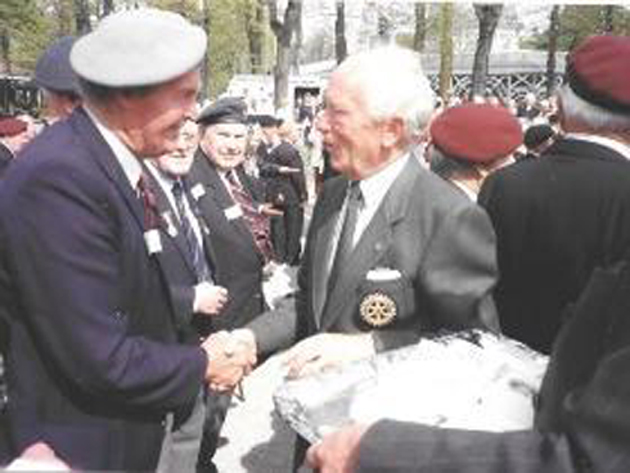
Hugh with the President of Danish Rotary at the celebrations for the 50th anniversary of VE Day.

The great-grandfather-of-four said: “We travelled through northern Germany and some of the towns were in complete devastation. They were really badly damaged and it was a startling experience to witness that.

“I even got some poor shots on my little camera as we went through.

“As we arrived in Copenhagen on May 4 I was driving the jeep. Half of Copenhagen were on the streets.

“The reception we got was something that I shall never forget.

“It was so different to anywhere we had seen in the previous six months.”

On the night of the liberation on May 5, 1945 Hugh and his regiment stayed in Copenhagen before travelling to Odense, the following day where they remained for the summer.

Hugh added: “My regiment moved back to Odense where we spent the summer and looked after the repatriation of Germans in Denmark.

“Germany was keen on looking after Denmark because it was a source of food.

“They called it the land of milk and honey.

“We made friends with Danish people and got to know quite a lot of the resistance people who did a fantastic job.”

As the liberation of Denmark happened a number of days before the end of the war was announced, VE Day was not as iconic for the Royals.

“VE Day brings back memories and so forth, but I was actually back in Odense in a school when the news broke through the radio that war was over,” Hugh continued.

“It was, to me, a bit of an anti-climax after the excitement of liberating Denmark days earlier.

“Obviously we celebrated then with the Danish people who were wonderful and it was a great experience.”

Hugh, who still lives at the family farm in Nether Heyford, was granted an early repatriation in the September of 1945, due to his family’s important work.

“We were short of food after the war and my family were farming so I needed to get back to help with that,” he said.

“I was 21 when I was demobilised and I settled in Northampton where the family farm was and that was my career from then on.

“That was the end of my connection with the army until 50 years later when we went back to celebrate.”

Hugh married in 1950 and also kept in contact with some of the Danish people he made friends with.

The veteran and his family went back to visit Denmark 21 years after the war ended.

“I stayed with a delightful family with whom I had befriended in 1945. They were all very musical and we sang all the old wartime songs and drank lots of Schnapps,” Hugh added.

“We also watched England win the football World Cup on their television.”

Hugh, who is one of the founding members of Northampton West Rotary Club, also visited Denmark again, alongside many other British veterans, in 1995 when the people of Denmark invited them to celebrate the 50th anniversary of VE Day.

Published in the Daventry Express – Monday May 11th 2020

The Story of Heyford (Extra): Heyford Residents who served in WW2

Many Heyford residents served in the Second World War 1939-1945 in the various services.

Hazel Adams – Red Cross Nurse, Royal Navy

Hugh Adams – Royal Dragoons

Albert Beharrell – Army

Richard (Dicky) Bishop-Bailey – Army

Ken Boyes – Army

Helen Cadman – WAAF (Women’s Auxiliary Air Force)

Arthur Charvill – Royal Navy & Army (MP)

Harry Charvill – Army

Charles Copson – Army

Tom Davies – Fleet Air Arm / RAF

Ralph Faulkner – Bevan boy / Army

Gordon Hayes – RAF

Marjorie Hamborg – Red Cross

Frank Higginbottom – Army

Frank Hyde – RAF

Donald Jafkins – Argyle & Sutherland Highlanders

Ernest Jones – Army

Bill Kingston – RAF

Nan Kingston – WAAF (Women’s Auxiliary Air Force)

Robert (Bob) Kingston – RAF (1939-1946)

Jack Lee – Royal Engineers

Joe Matthews – Army

Charles Masters – Army

George Masters – Royal Army Medical Corps

Sheila Masters – ATS (Auxiliary Territorial Service)

Sid Masters – Army

Ray Metcalfe – Army

Cyril Mitchell – Royal Army Ordnance Corps

John Moore – Merchant Navy

Rita Moore – NAAFI (Navy, Army and Air Force Institutes)

Alec Nial – Royal Navy

Bill Norrie – Royal Navy

Tom Oliver – Royal Navy

Joan Pearson – Woman’s Land Army

Dorothy Reeve – COD (Central Ordnance Depot)

Margaret Reeve – Woman’s Land Army

Derek Roberts – Royal Marines

Paul Rogers – Royal Army Medical Corps

William Rogers – HAC (Honourable Artillery Company)

Jack Rossiter – Royal Army Ordnance Corps

Dennis Searle – Merchant Navy

Frank Townsend – Army

Arthur Turland – RAF

Mabel Wallace – WAAF (Women’s Auxiliary Air Force)

William Wallace – Highland Light Infantry

Dennis Weaver – Royal Army Intelligence Corps

Bert Wilkinson – 13/18th Hussars

Rev Wintersgill – Queens Royal Regiment

And those sadly killed in action:

Charles Leslie Foster – Flight Sergeant (Air Gunner) RAF – Killed in Action 23.5.1944 – Aged 24

Frederick Heeler – Lance Corporal Army – Killed in Action 24.7.1944 – Aged 28

Frederick Watson – Sapper Army – Killed in Action 10.10.1944 – Aged 22

John Bennett Whiting – Lieutenant Army – Killed in Action 1.9.1942 – Aged 25

Published in The Prattler – July & August 2020

Many thanks to Hugh Adams for originally compiling a list and to those that have contacted us and added to it since the original publication via the

Facebook “Nether Heyford Past” group

Jez Wilson

Updated 15/10/2021 with Robert (Bob) Kingston – RAF (1939-1946) – thanks to Annie Powell

Jez Wilson

The Story of Heyford (Extra): Dear Diary – July 1955

July 1955

Dear Diary,

It’ll be the factory fortnight soon. Dad will spend his first week decorating as usual. The walls and ceilings are quite stained after a year, probably because my parents both smoke, as do most grown-ups. I dare say we’ll have the chimney sweep come first or it would be a bit of a waste of time decorating. The second week we may go on one of Mrs. Hilliers’ day trips to the seaside, although they are long days.

Last year we went to Blackpool in a boarding house for a week, but I know we can’t afford to go again this year. If we ever do go again I’ll be able to swim because the school are taking us for lessons at Midsummer Meadow outdoor pool. The water is heated by the cooling towers but the air can be really cold when you get out. The bottom is really rough to your feet and the water is murky sometimes.

I love our village green, especially in the summer because so much happens there. It’s the largest village green in the county and it’s great after it’s been mown because we can build dens. The grass won’t be there long though because they’ll want to play cricket at the weekend, so somebody will clear the cut grass away.

Mrs. Blaney has taken over the running of the Post Office from her dad. She was a school teacher once so I bet she knows most of the people in the village.

I was nearly late for school this morning. Dad had borrowed my school pen to write to his brother in Northampton. He is thinking of emigrating to Australia on the £10 package being offered to British citizens and dad wants to talk to him about making this drastic decision. The letter was on the table with the 2 ½ d for a stamp but no pen so I’ll have to go without it. He probably wrote out his bet with it. Does he know how hard it is to get a pen?

Mum was messing about taking the milk off the step before the birds pecked through the lid, then she stopped to talk to Mr. Wigley, the road sweeper, so the bell was ringing before we even reached the green. I ran the rest of the way. Blimey, I’m 10 now so I don’t need her to come with me, but she’s got a little cleaning job and she starts at 9 o’clock when I start school. It’s not like she spent hours in the bathroom as she only has what she calls “a lick & a promise” when she’s going to work.

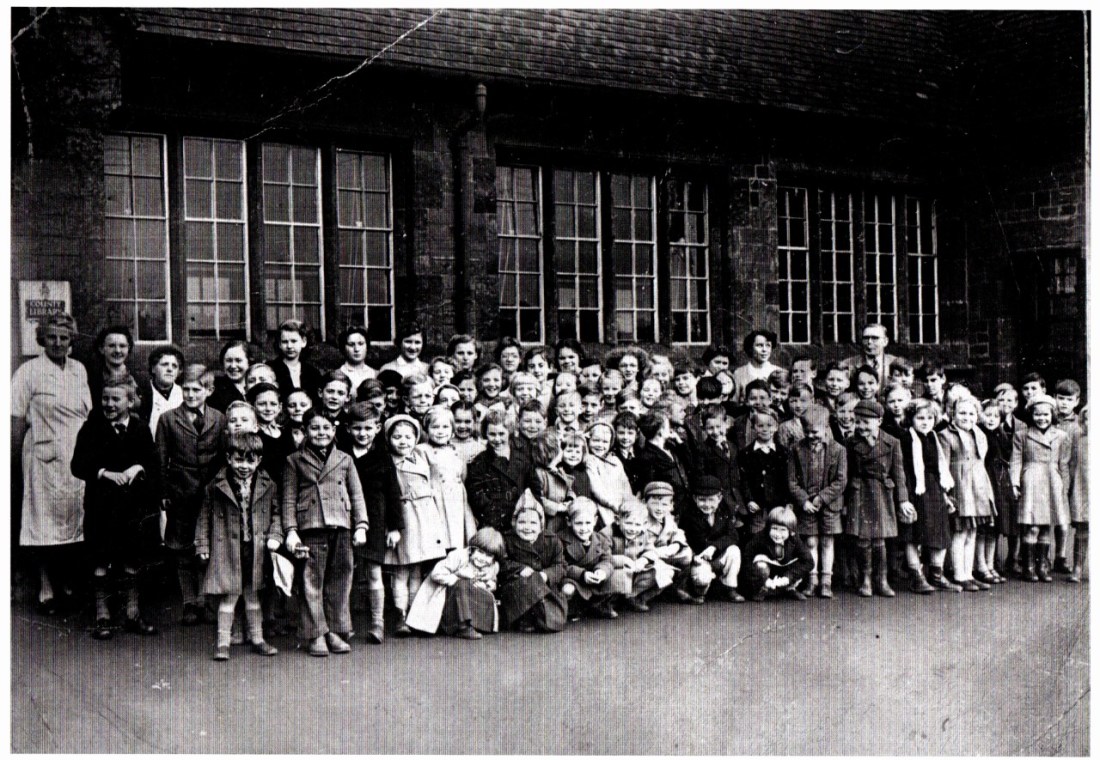
I’m school monitor this week so I’m to give out the milk at break time and we are having a group photograph in front of the school, with all 70 of us in it, this afternoon. That should be a laugh, trying to get us all looking the same way and smiling. I think we might have country dancing with the boys this afternoon – they hate that. After the holidays I shall be on my last year at Bliss School because they are to build a new secondary school at Duston and those over 11 who don’t pass the 11+, and no doubt that’ll be me, will go by bus. Can’t wait.

Polly

Letter published in The Prattler – July & August edition 2020


The Story of Heyford: William Mann V3C5

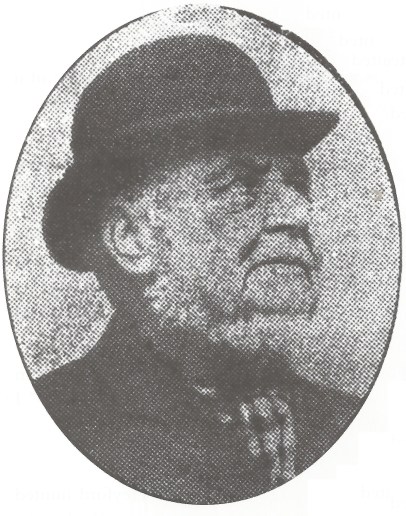
The words below are an exact copy from an article which originally appeared in the Northampton Mercury in 1911. It consists of an interview with Mr William Mann who was born in Heyford in 1833. It tells of life in Heyford in the middle 1800’s.

A Vigorous Veteran – Mr William Mann of Heyford

NetherHeyfordWilliamMann

There are not many stronger men of his age than Mr William Mann of Lower Heyford with whom I had a ‘crack’ the other afternoon. In his 79th year he still stands firm and erect, has a clear eye, a sound mind and a memory that takes him back to the ‘hungry ‘40s’. They were hungry indeed. The wages of farm labourers in his early days were not more than 8s. a week, and many capable men were working for less. Two good workers who he remembers were paid only 6s. which was increased to 7s. in one case when the man married. “Seven bob a week,” exclaimed Mr Mann in scorn, “to keep a nice bird and himself on.”

Like charity

Working folk in the villages, he said, never had meat in those days unless they stole it – and there was a good deal stolen. He remembers one man in the adjacent parish of Stowe who was sent to penal servitude for ten years for sheep stealing. The bread they ate was made from barley flour, and they were very glad to get that.

His old smock frock was the best suit of clothes he had. Like charity it covered a multitude of sins, and he remembers going without his trousers while his mother washed them — a performance which has been scarcely tolerable since the smock disappeared. “I wouldn’t give threepence for all the clothes I had at that time,” he said. “Boys nowadays are young gentlemen compared with what we were in my young days.”

Not good old days

No. Mr Mann would not go back to the old days. His pension now is nearly as much as men in the prime of life earned seventy years ago. Things are better in every respect. There is more liberty as well as better living, greater freedom for the mind as well as more nourishment for the body.

“Years ago in my parish,” he said, “the parsons would not bury unbabtised people. I remember one funeral which took place in the dark at eight o’clock at night. Some Staffordshire men were working with me at furnaces and they said they never saw anything like it before. We used some poetry about it:

“Not a sound of bell nor funeral note
As the corpse to the grave was hurried.”

“You know where that comes from?” he said, and I pleaded guilty to remembering something rather like it.

Sunday schools and charities

Continuing his reminiscences, Mr Mann told me that in those days no Sunday School was permitted except for a few privileged young people who went to the Manor House. He himself and some others used to walk to Bugbrooke Chapel on Sunday morning and take their dinner with them. Afterwards a school was started at the Heyford Baptist Chapel.

Another incident in his memory concerns the local Arnold’s Charity, which like many other charities has been a bone of contention. His father – “he was just such a man as me” – wrote up on the end of his house near to the Church: “No flannel or calico wanted here, but money according to the testator’s will” – and money was afterwards distributed.

An election reminiscence

The powers that be at Heyford were very Tory in those days but the people, said Mr Mann, were of a different sort. “Five out of six of them would have voted for the disestablishment of the Church in England as Well as in Wales.”

At one election a sightless old man called Blind Tom Robinson, being a freeholder, was taken in a Tory conveyance to vote at the booth on Northampton Market Square. There were no ballot papers in those days – the man had to say straight out who he wanted to vote for. When he was asked to whom his vote should be given, he shouted out boldly, “Althorpe!” for Lord Althorpe was the Liberal champion in that fight. “Who?” said the Tory who brought over, thinking the man had made a mistake. Blind Tom gave the same answer again and again, till the shoemakers and others standing by shouted “He’s just told you,” and then (when the man had voted) “Take him away,” but the Tory escort would have nothing to do with him on the return journey.

Blind Tom Was left stranded on the Market Square. He found his way to St James’ End, and then was given a ride in one of a number of coal wagons that were going to the Near Fields. “Where?” I asked. “The Near Fields,” he said, meaning the nearest coal fields in Warwickshire.

A hunting story

Another of my old friends stories was of the hunting field. Mr John Stanton of Upper Heyford hunted a good deal and was very fond of his joke. One day he was after the hounds, and near to Bugbrooke Mill a rev. gentleman’s horse refused a fence and pitched him over the hedge into the brook. “Help!” he cried. Mr Stanton, hot for the chase, looked to see who it was, and then said, “Oh, never mind him, he won’t be wanted till next Sunday.” It was then Monday morning!

Mr Mann has any number of these old yarns with their broad humour, redolent of the soil. Although the rigours of the old days killed a vast number, some of the survivors are extraordinarily fine old fellows. He was one of a family of twenty-four, and his father was a poor man. The old age pension of which Mr Mann is the proud possessor, was then beyond the wildest dreams of avarice. May he live long to enjoy it.

With many thanks to the Northampton Mercury

He did indeed live a long time

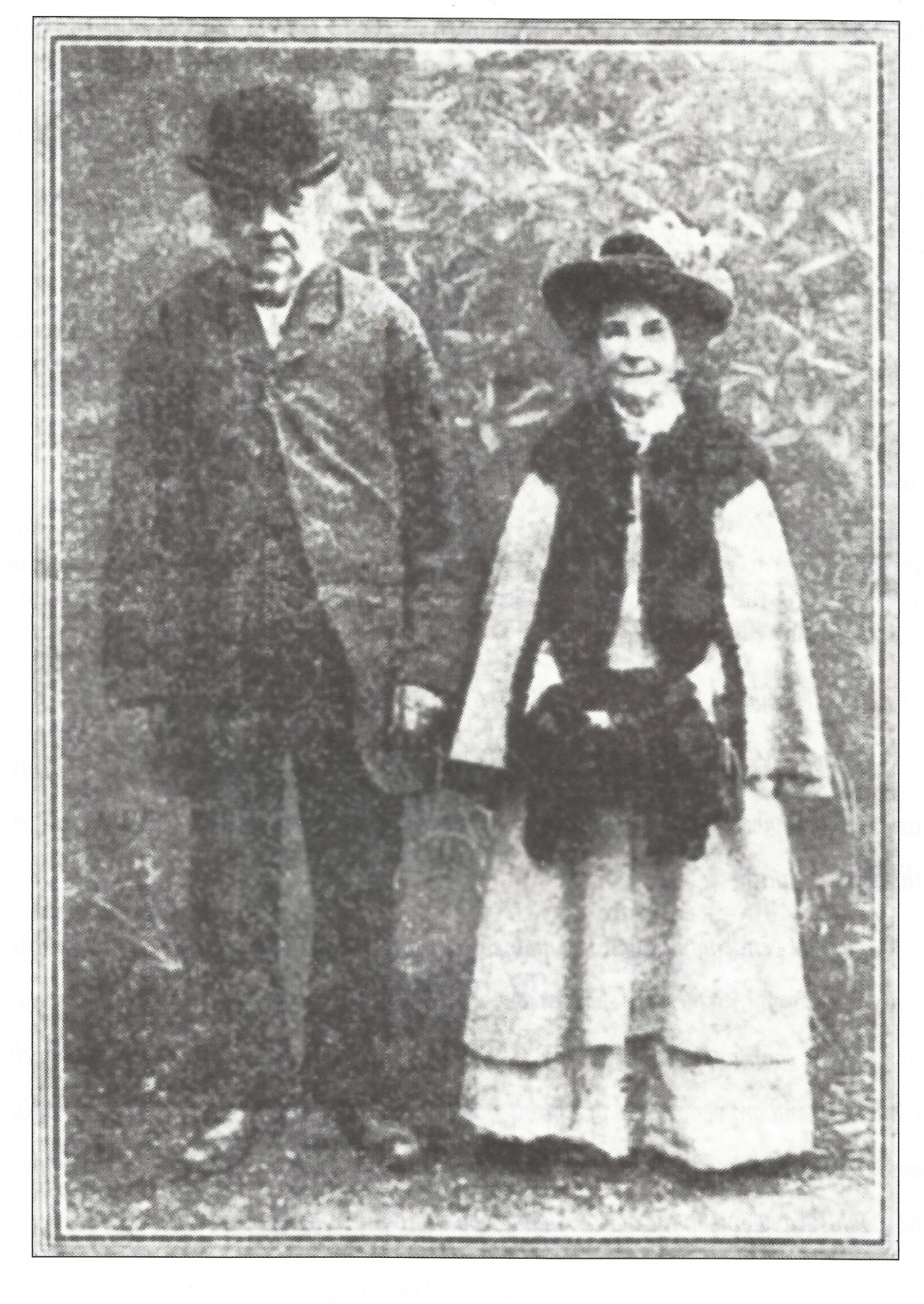
Mr Mann did indeed live a long time. His first wife Sarah had died in 1870, his second wife Sophia died in March 1913, aged 77. But on Saturday 19th December 1914 he was married again. His bride this time Was Elizabeth Green, aged 77, also from Lower Heyford. They were married at the Registry Office at Derngate in Northampton. The photograph below appeared in the Daily Chronicle on Monday December 21st, 1914 under the heading of ‘A Northampton Romance’.

NetherHeyfordMann

William Mann eventually died on December 23rd 1925, aged 92 and is buried in Heyford cemetery. With three marriages and a long life behind him it seems that the Mercury correspondent was absolutely correct in referring to him as ‘a vigorous veteran’.

~~

Extract from “The Story of Heyford” – Local book series published in the late 1990’s

Volume 3 of 4 | Chapter 5 of 17 | Pages 9 to 11

TheStoryOfHeyford_NetherHeyford_Footer

Heyford’s Historical Heritage  |  How the books were created

Index  |  Covers

The Story of Heyford: The Domesday Survey V3C4

All the information in this article was taken from ‘Domesday Book – History from the Sources’ published by Phillimore in 1979.

In 1066 Duke William of Normandy conquered England. He was crowned King, and most of the lands of the English nobility were soon granted to his followers. Domesday Book was compiled 20 years later. The Saxon Chronicle records that in 1085 ‘at Gloucester in midwinter . . . the King had deep speech with his counsellors . . . and sent men all over England to each shire . . . to find out . . . what or how much each landholder held . . . in land and livestock, and what it was worth.’

The Domesday Book was undertaken not only as a means of tax assessment, but also so that ‘every man should know his right and not usurp anothers’. Because it was the final authoritative register of rightful possession, the natives called it Domesday Book as an analogy to the Day of Judgement.

The Domesday Book described old English society under new management. Foreign lords had taken over but little else had changed. The chief landholders and those who held from them are named, and the rest of the population was counted.

The detail below shows the names of the primary landlords in Heyford and of those to whom the land was sub-let. It also shows the size and value of the land, the number of ploughs, and the working population, both slaves and free. It also shows the name of the person who held it prior to 1066.

Definitions
Hide. A unit of land measurement, generally about 120 acres. A measure of tax liability.
Virgate. A fraction of a hide, usually a quarter, notionally 30 acres.

Land of the Bishop of Bayeux
William Peverel holds (from the bishop) 2 hides and 1 ½ virgates of land in Heyford.

Land for four ploughs. In lordship 2 ploughs; 2 slaves;
7 villagers and 2 smallholders with 1 plough.
Meadow 10 acres.
The value was 10s.; now 20s.
Bishop and Aelid held it freely before 1066.

Land of the Count of Mortain
(Robert, Count of Mortain was a half brother of King William 1. He also held land in Weston Favell and many other manors scattered all over England.)

Walter holds 1 virgate and 3 parts of 1 virgate. Land for 1 plough, which is there, with 2 slaves.

A mill at 16s; meadow, 4 acres
The value was 10s; now 30s.
Bishop held it. The jurisdiction lies in Bugbrooke.

Ralph holds one virgate of land and two parts of 1 virgate.

The jurisdiction lies in Bugbrooke. Land for one plough; it is there.
Meadow 1 acre
The value was 5s; now 10s
Wulfstan held it.

Land of Gilbert of Ghent
Sasgar holds 1 hide and 1 ½ virgates of land from Gilbert in Heyford. Land for 2 ploughs.

In lordship ½ plough.
3 villagers with 1 smallholder have 1 plough.
Meadow 4 acres.
The value was 10s; now 20s

~~

Extract from “The Story of Heyford” – Local book series published in the late 1990’s

Volume 3 of 4 | Chapter 4 of 17 | Page 8

TheStoryOfHeyford_NetherHeyford_Footer

Heyford’s Historical Heritage  |  How the books were created

Index  |  Covers

The Story of Heyford: Bugbrooke Gasworks V3C14

Did you know that there used to be a gasworks serving Nether Heyford. It was wedged between the road and the canal half way between Nether Heyford and Bugbrooke. The tiny gasworks served the communities of Bugbrooke and Heyford until the trunk gas main was laid in the 1960’s, bringing natural gas.

David Blagrove describes in his book ‘The Waterways of Northamptonshire’ how its waste tar or gas water used to be taken away by canal to a refinery in the London area. ‘A wide beamed tank boat used to make about one journey each year to collect the tar, bearing upon its decked-in hold a two-wheeled cart with hand pump and tank. This was worked back and forth from the gas water pit to the boat, using the boat’s horse. After many laborious journeys the boat would be loaded.’

All that remains now is the small brick building which can just be seen from the road. The tank was originally flanked by poplar trees, but the site is now just a scrap yard and is flanked by sheets of corrugated iron.

(Reprinted from the Prattler April 1995)

Update 2020: The poplar trees, scrap yard and corrugated iron sheets are now gone.


~~

Extract from “The Story of Heyford” – Local book series published in the late 1990’s

Volume 3 of 4 | Chapter 14 of 17 | Page 27

TheStoryOfHeyford_NetherHeyford_Footer

Heyford’s Historical Heritage  |  How the books were created

Index  |  Covers

The Story of Heyford: Inquest, Heyford Wharf V3C13

The following extract is taken from the Northampton Herald, dated 26th November 1864. It refers to the inquest into the death of William Gibson. The cutting was supplied to us by Mrs Maggie Ingram, great grand-daughter of William Gibson.

“On Monday last an inquest was held at Heyford Wharf before W Terry Esq., county coroner, on the body of William Gibson, who was found drowned in the Grand Junction Canal at Heyford Wharf on the previous day. It appeared that deceased, a labourer, 53 years of age, went on Friday afternoon to the Boot at Heyford Wharf. He did not have a great deal to drink, but when he left between half past six and seven, was not quite sober. It was supposed by the landlord of the Boot that deceased was going straight home to Pattishall. He had left a can, however, at the side of the canal, where he had been working, breaking slag, and it would seem that he went to fetch it, and by some means fell into the water. When found, deceased ’s clothes were much torn; his head was badly wounded, as was also his left shoulder, and both his arms were broken. On Saturday, a steamer which passes up and down was stopped at the place where deceased was found by something catching in the screw. Mr Walker, surgeon of Bugbrooke, stated in his evidence that the above mentioned injuries, it was his opinion, had been caused by machinery of some kind after death. The cause of death he attributed to drowning. At the conclusion of the evidence the jury returned a verdict of found drowned.”

The reference to ‘the Boot’ must surely be a mis-spelling, as the pub at Heyford Wharf was called ‘the Boat’. It was the white building now known as Wharf Farm.

~~

Extract from “The Story of Heyford” – Local book series published in the late 1990’s

Volume 3 of 4 | Chapter 13 of 17 | Page 27

TheStoryOfHeyford_NetherHeyford_Footer

Heyford’s Historical Heritage  |  How the books were created

Index  |  Covers

The Story of Heyford (Extra): The Playing Fields

Nether Heyford Playing Fields – ‘A community asset to be proud of’

The Playing Fields are a fantastic local asset and the facilities have only been in existence for 34 years – which makes what has been achieved in that period a truly outstanding achievement. With that in mind, here is a brief history of the Playing Fields and our future plans…

In the mid-1980s, the Parish Council realised that with the growing population, the village green which had always been suitable for community sporting activities, was sadly no longer fit for purpose.

Consequently, the decision was made to purchase 14.47 acres of land to be used for sport from Mr Spokes at a cost of £39,500 which is now Nether Heyford Playing Fields.

The acquisition was funded by the sale of allotments on Furnace Lane and the Purchase Agreement was signed on behalf of the Parish Council by Mrs Sally Foulkes and Mrs Joan Kirkbride on the 1st August 1986.

There were several conditions to the sale, the main ones being that no building could be constructed on the site without the written permission of the vendor, although this would not be refused if the request was in pursuance of sport.

Also, if the land ceased to be used for sport and was to be disposed of, it must initially be offered for sale back to the vendor at the current agricultural price of land.

Once purchased the Parish Council set up by a Declaration of Trust, the Nether Heyford Playing Fields Association Committee to administer, manage and financially indemnify the Parish Council from any costs and with the remit to support sport and leisure for the local and outlying community. The Parish Council remain the Trustees.

The formation of the Playing Fields in the early years required the movement of the old portacabin changing rooms from the Village Hall to the Playing Fields to form the  existing pavilion. The following seasons saw the setting up of football and cricket teams at the new location, together with the construction of tennis courts, then later in 1996 a Bowls Club was formed with the grant of £72,000 from the Sports Lottery and South Northants Council.

Over the years the Playing Fields continued to develop with the increase of participation in the four main sports clubs. These four clubs form the Playing Fields Association. They are all independently run with their own committees and finances.

The cost of running the Playing Fields – and excluding the running costs of individual clubs – is in excess of £10k per year (e.g. utilities, maintenance and insurance) and is met mainly from Member Club annual fees, a grant of £400 annually from the Parish Council (although the Parish Council has contributed to specific projects), the 300 Club, and percentage of the Bar profits.

The Football Club now has two Saturday senior teams and various age groups including U7, U9, U12, U15, and U18s teams and an enjoyable ‘Thursday evening of walking football’. They also hire out their facilities to two Sunday teams.

The Cricket Club field three senior Saturday teams and they also enthusiastically promote youth sport with competitive cricket for U11s and All-Star cricket for younger children and have recently completely renovated their nets.

The Tennis and Bowls Clubs also have strong membership of about 60 members each.

The Tennis Club are currently refurbishing their Tennis Courts with new surfaces and fencing.

Also, in recent history (in 2017) an additional 2.35 acres of land was purchased from Northamptonshire County Council with a grant of £45,000 from South Northants District Council, and with further funding from SNC (£10,000) and the London Marathon Charitable Trust (£20,000), a brand-new Netball and Basketball court has been constructed.

The Playing Fields have also established close ties with the village Scouts and Bliss Charity School – with the procurement of a storage container so that they can safely store their own equipment and make use of the facilities.

Along with the Parish Council , the  Playing Fields also supported the creation of the Community Orchard at the allotments by planting the hedge that includes several varieties of fruit trees.

The Nether Heyford Playing Fields Committee has been lucky in gratefully securing grants over the years which have been used to construct Bowls Club Changing Rooms, Basketball/Netball Court, Land purchase and other minor projects, and the committee are continuously working tirelessly to improve the facilities… we have plans for the construction of a new building with new changing rooms, storage facilities, kitchen and toilets. It has been designed by Ellis Architectural Design and Planning Permission has been approved. The provision of this building will be extremely challenging as the cost is estimated at approximately £450,000. It is hoped to raise the money by matched grants from South Northants District Council, Sport England and the Football Foundation.

Over the years the Playing Fields have been supported by the Parish, Local and District Councils, local farmers, grant bodies, professionals and numerous individuals all of whom are too many to mention.

The Committee and Clubs are lucky to have so many enthusiastic individuals serve on their respective committees and give their time for coaching and ground maintenance.

The 17 acres of Playing Fields are now a valuable and much prized community asset of which we should all be rightly proud. We encourage and welcome everyone to enjoy all it has to offer and thank you for your ongoing support.

Published in The Prattler – July & August 2020

Thanks to The Nether Heyford Playing Fields Committee

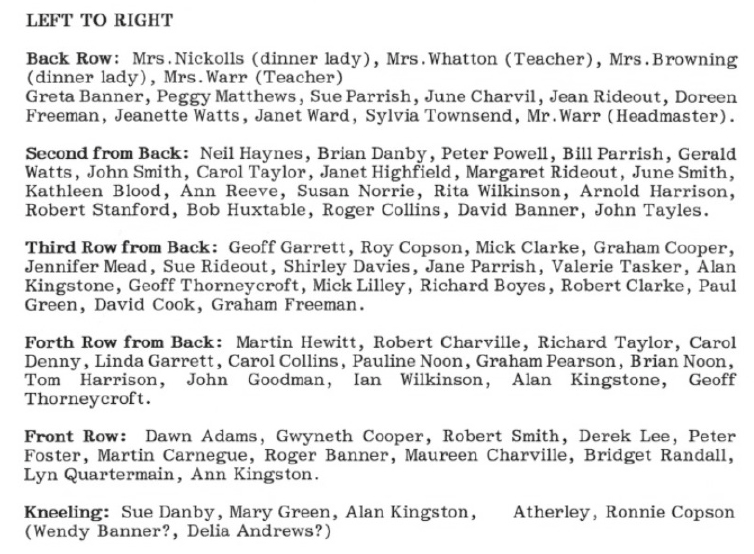
The Story of Heyford (Extra): Bliss School 1955 Group Photograph

Bliss Charity Primary School

BlissCharitySchool-NetherHeyford1954

BlissCharitySchool-NetherHeyford1954-Names

“Our Towns and Villages #45 Lower Heyford by Wayfarer”

Published in The Prattler – July & August 2020

Thanks to Shirley Collins