The Story of Heyford: Two hundred years of the Grand Union Canal V3C12

Two hundred years of the Grand Union Canal

ln 1791 a proposal was made to run a canal direct from Braunston (already served by the Oxford canal) to London. The bill received Royal assent on 30th April 1793 and construction on the Grand Junction Canal began the next day.

The Northamptonshire section had the greatest challenges because there were to be two tunnels, at Braunston and Blisworth; three flights of locks, at Braunston, Long Buckby and Stoke Bruerne; and four high embankments across river valleys, at Weedon, Heyford, Bugbrooke, and Cosgrove. It was the greatest civil undertaking ever planned in England. It was built wide to take 14 foot barges, but gradually the narrow boats were found to be more flexible because there was reduced queuing at the locks and tunnels, and they could also be used on the other, narrower waterways within the canal network.

Coal and lime
The canals brought coal to our local communities. There is still a coal yard operated by Fred Tarry on the canalside in Furnace Lane, although it no longer uses the canal for transport. The boat builders yard at High House Wharf in Weedon Road was also formerly a coal yard, as was the wharf at Flore Lane.

The coal and the canals encouraged the development of the lime kilns, of which there were several along this stretch of the canal. There was one beside Banbury Road in Bugbrooke where Pinnegar and Barnes now operate; one between bridges 33 and 32 near where the ironworks later developed; and one near the Narrow Boat and Stowe Hill Marina. The burning of lime created dressings for acid soils. The coal for burning could be brought by boat and the lime could be taken away by the same means.

Iron ore
Even more significantly for Nether Heyford was the development of the iron industry. There was a quarry just below Church Stowe from where the iron ore was brought down to the furnaces by a single track railway. The coal for the furnaces could be brought by canal from Coventry or Nuneaton. The lime was used in the smelting process. And the canal was used to take away the pig iron in the form of iron bars. There were two furnaces. The first, known as Heyford Ironworks, began in 1861 and was on the site of Furnace Wharf between the canal and the railway. The second, known as Stowe Ironworks began in 1866 and was on the other side of the railway near where Wickes now is. This second site later became a brickworks after the ironworks had closed.

Commercial wharves
These industries encouraged the development of local services. There was a boat building yard at High House Wharf, just beyond the bridge over the canal in Weedon Road. It was run before the war by Frank Jones. He employed two men from the village, Mr Causebrook and Charlie Knowles. There was a carpenters shop, a saw pit, a paint shop, a blacksmiths shop, and a steam box (where the planks were steamed into shape). There was also on the same site a coal merchants operated by Mr Bazely. Although the boat building had ceased by the first world war, the coal yard continued to operate for  another sixty  or seventy years under the West Brothers.

Flore Lane Wharf was also a commercial wharf during the nineteenth century. In 1871 it was sold by auction and raised £450. According to the particulars of sale, ‘the premises which are highly eligibly situated, were for several years in the occupation of Mrs Mary Tibbs who carried on an extensive trade in slate, tile, and bricks, coal and lime, in addition to that of a general wharfingers business, but are now in the occupation of Mr Meleycock, coal dealer’. In the 1960’s, the property was used as a coffin makers workshop, run by a man named ]enks or Jelks.

The boat people
All this activity brought with it a lot of local boat traffic. Life for the boat people was hard. They often travelled 20 miles a day. Many of the boats carried coal and it had to be barrowed across a board from the boat to the bank. Shops were few and far between, so the boat people were largely self sufficient, making whatever they needed such as pegs and clothes. Some kept a dog which was used to catch rabbits. Some took ducks from the water, and sometimes potatoes and swedes from the fields. They often got the blame for anything that went missing.

The women worked as hard as the men, helping to load the boats, as well as deal with all the domestic chores. Many children didn’t learn to read or write because it was impossible to attend regular schooling. Instead they had to look after the horse. They used to swing the nose bag into the canal to dampen the oats and corn, and so prevent it from blowing away when the horse blew down its nose.

Sometimes they would need the services of the village such as the blacksmith or farrier. The house on the canal bridge in Furnace Lane, now known as ‘Wharf House’ was originally a barn where the boat horses were stabled at night. We also know that Mrs Anne Clarke, who was midwife in Nether Heyford in the late 1800’s / early 1900’s, was sometimes called upon to deliver babies on the boats.

Many of them drank quite a bit, particularly the men. The canal was well served for pubs. There was ‘The Crown’ beside bridge number 35 towards Bugbrooke; ‘The Boat’ (now Wharf Farm) by the bridge in Furnace Lane, ‘The Bricklayers Arms’ (now Bridge Cottage, opposite Wharf Farm) and ‘The Narrowboat’, formerly called ‘The Globe’, on the A5. The high house at Flore Lane Wharf, though never a pub, was like many houses on the canals a brewhouse, selling ale to passing boat traffic.

Changing times
It was during the busy industrial period of the 1860’s and 1870’s that the canal reached its heyday, bringing much activity to the village. However, the development of the railways, and cheaper imported iron ore around the turn of the century began the decline of these canalside industries. Although the first world war brought some renewed activity, most of the industry had gone by the mid 1920’s, and with it the local canal traffic.

However since the 1960’s there has been a strong revival in the use of pleasure craft. The moorings on Furnace Wharf are full, and there are two boat yards. There is Stowe Hill Marina near the Narrowboat pub where a dry dock was installed in 1977. The boat yard at High House Wharf (formerly the site of West Brothers coal merchants) which had been a boatyard until the first world war, was re-opened in 1986 by Mr Gardner, and extensively rebuilt. During the rebuilding, they discovered the remains of an old brick tar pot. This would have been used by the original boat yard in the days when the hulls were made of wood and sealed with tar. Beside the boat yard a marina was recently opened with room for twenty-four private moorings. Also, the towpath is regularly used by both fishermen and walkers, so the canals are still very much alive around Nether Heyford, albeit with a rather different character from that of a hundred years ago.

The information for this article came from ‘Waterways of Northamptonshire’ by David Blagrove, from ‘Like Dew Before the Sun’ by Dorothy Grimes, and from the knowledge of local people.

~~

Extract from “The Story of Heyford” – Local book series published in the late 1990’s

Volume 3 of 4 | Chapter 12 of 17 | Page 25 & 26

TheStoryOfHeyford_NetherHeyford_Footer

Heyford’s Historical Heritage  |  How the books were created

Index  |  Covers

The Story of Heyford: A Concert in 1865 V3C6

A Concert in 1865

The poster shown opposite advertises a concert which took place in the village in 1865. An original of this poster is held in the Public Records Office at Wooton Hall in Northampton and it is to them that we owe our thanks for allowing us to reproduce it here. It raises several interesting points.

The School room
You could be forgiven for assuming that this might have been the Church Sunday School Rooms or the Chapel School Room. However neither of these buildings existed in 1865. Also the poster states that the room was ‘lent by Thomas Stanton for the occasion’. Thomas Stanton was the School headmaster at that time so the concert presumably took place in the School. However the current school building wasn’t built until 1879 so the concert must have taken place in the original school which stood on the site where the playground now is. The old school consisted of one room. Hence the concert took place ‘in the school room kindly lent by Thomas Stanton for the occasion’.

Those who left their homes when on fire
The concert was held ‘for the benefit of those who left their homes when on fire’. In the days of candle light, open fires, and thatched roofs, fire was a real hazard. With no insurance available for ordinary people, fire could leave a family destitute. Had there been a particular fire in the village or was the concert to raise money for more general funds to help fire victims?

The Blind organist
A key figure at the concert was Mr Beaver of Flore, the blind organist. We have a personal memory of Mr Beaver in the words of Bob Browning who was born in Heyford in 1892 and died in 1997 aged 104. Some details from this poster were published in the Prattler in May 1996 and Bob Browning responded with the following letter.

Dear Mrs Hamborg,

Many thanks for the Prattler which I find most interesting. I was interested in the May
issue which reported an item regarding a concert in the School—room in 1865 by Mr Beaver the blind organist.

Well, that gentleman taught my mother the organ and piano. When she was a girl she played the organ at Heyford Baptist Chapel and built up a good choir. When she was married the choir and members presented her with a marble clock and five oratorios which I still have and am very proud of. She often used to tell as children about the blind organist and how he used to walk from Flore to give her lessons. Some of us children wondered how he saw his way home in the dark. What a wonderful thing memory is!

Kindest regards and best wishes,

R. Browning

TheStoryOfHeyfordV3C6Concert1865

~~

Extract from “The Story of Heyford” – Local book series published in the late 1990’s

Volume 3 of 4 | Chapter 6 of 17 | Page 12 & 13

TheStoryOfHeyford_NetherHeyford_Footer

Heyford’s Historical Heritage  |  How the books were created

Index  |  Covers

The Story of Heyford: Sparrow Pie V3C2

Sparrow Pie

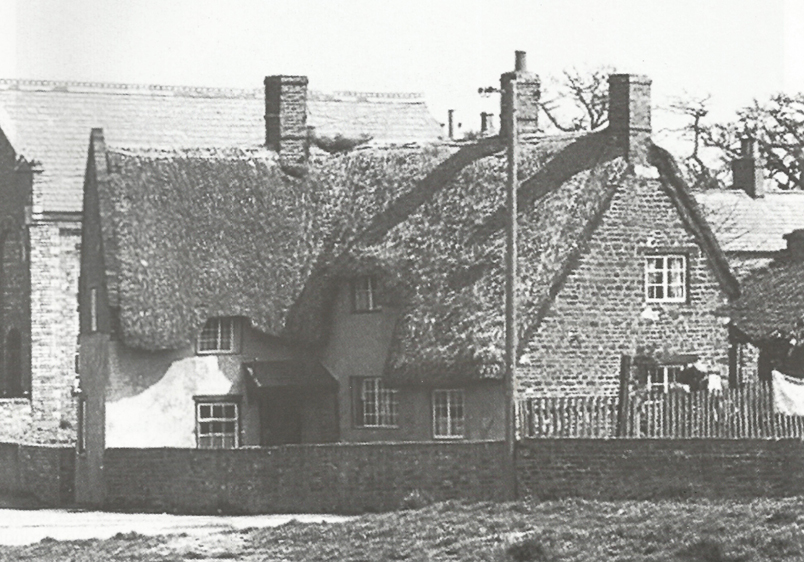
Reading the article “Heyford’s Midwife” in Volume 1 of The Story of Heyford, and in particular seeing the photograph of Anne Clarke’s cottage, reminded me of a family story associated with Thomas Clarke, my grandfather, and the cottage.

Sometime in the 1930’s the thatch had become infested with sparrows which were causing problems by burrowing and nesting. My grandfather decided to poison them by laying down food laced with strychnine. This apparently worked because two or three days later there were dozens of dead sparrows lying on the ground under the thatch. Unfortunately there were also two dead cats which had been poisoned by eating the sparrows.

My grandfather was in the Foresters Arms that Sunday lunchtime and heard a neighbour say, “We haven’t seen our old tom cat for two or three days, he’s probably gone off and got lost”. My grandfather guessed the truth and decided to keep quiet until the same neighbour said, “We’ve got sparrow pie for dinner today. We found them round the back of your cottage”. Apparently sparrow pie was quite a treat for poor country folk in the days of The Depression.

My grandfather was forced to blurt out the whole story and they rushed round the neighbours house just in time to stop the pie being dished up for Sunday lunch!

The Clarke’s house in Church Street

TheStoryOfHeyfordV3C2-ClarkesCottage-SparrowPie

Dick Clarke

~~

Extract from “The Story of Heyford” – Local book series published in the late 1990’s

Volume 3 of 4 | Chapter 2 of 17 | Page 3

TheStoryOfHeyford_NetherHeyford_Footer

Heyford’s Historical Heritage  |  How the books were created

Index  |  Covers


The Story of Heyford (Extra): Dear Diary – June 1954

June 1954

Dear Diary,

There are lots of new homes going up in Hillside Road and Hillside Crescent and new families moving in, including my friend Jane who used to live at Novelty Farm on the A5. It’ll be great having her so near, although we’ll miss our games in the hay bales and with the animals. Apparently her new next door neighbour is to be presented with the “key of the door” to mark the 100th Council house to be completed and the newspaper reporters will be there to take photographs, how exciting is that?

The old cottages nearest the green in Close Road have been pulled down. At the other end of the road there is a five-barred gate close to a little stream that comes down from the hills. The water then goes under the road and comes up again to flow along in front of The Peak, along Hillside Road, down the side of the green and again underground as far as Watery Lane, which is how it got its name. It then finds its way to the river. We have so much water around the village with the river and the canal and all these little streams in between. Let’s hope it all stays on course.

The old Jubilee Hall is to be pulled down because it’s no longer safe. They are only leaving the little wall at the front. Where will everyone meet now? Maybe in The Foresters Arms, I’m sure Mr. Rolfe would be pleased to have them. I don’t think the couple at The Old Sun would have them. I sit in their kitchen sometimes while mum and dad go into the pub and they bring me a bottle of pop, Dandelion and Burdock is my favourite.

Our new Headmaster, Mr. Warr, and his wife have settled in nicely, Mrs. Hazel has left and Mrs. Whatton or Madam as we are to call her, has started, so some changes have been made. This afternoon we are getting ready for Sports Day on the village green. I’m not very good at sports so I shall try for the Sack Race or The Egg & Spoon Race. I know I won’t win either but I better show willing. At last the school has toilets inside the building so no traipsing up the yard next winter.

I’m going to dress as Maureen ‘Little Mo’ Connolly at the church fete Fancy Dress competition next weekend. At 16 she was the youngest tennis player to win at the US Open tournament. I love the church fete with stalls, games and tea on the lawn. Most of the villagers turn out for it.

Because it was warm yesterday me and my cousin played a game in the chicken house. We got covered in fleas so mum got the tin bath out of the barn, put it on the back lawn, filled it with warm water and made us have a strip wash to get rid of them before we went indoors. We did giggle. So much for our chicken army. We’ll pester the pigs next time, they’re cleaner.

Polly

Letter published in The Prattler – June 2020


The Story of Heyford (Extra): Furnace Lane Bomb – John Butcher

bomb3

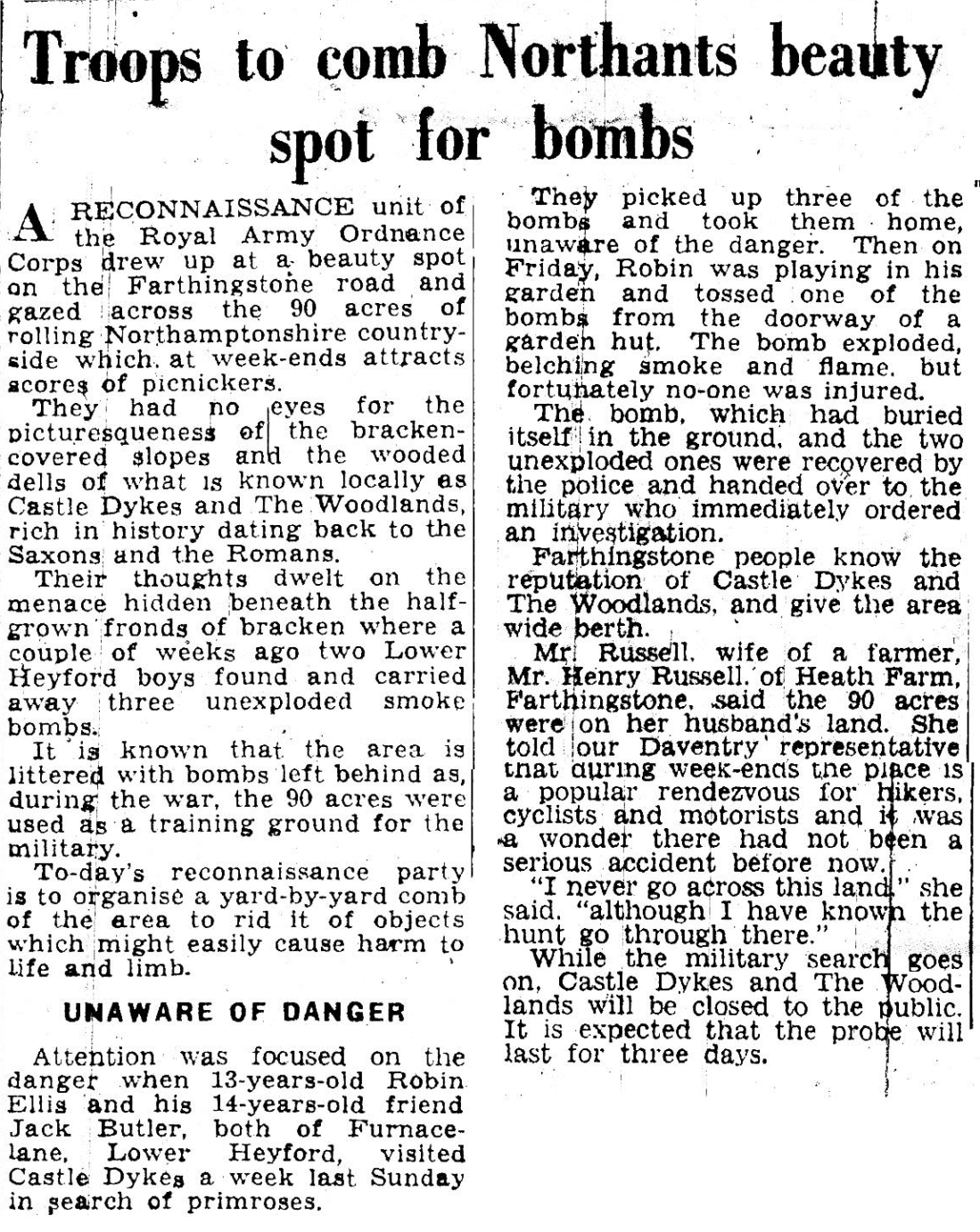
The copy of the local paper dated May 1952 does not give a very accurate account of what actually happened. My friend Robin Ellis (a Daventry Grammar School boy who was taking Chemistry lessons) believed that the powder inside the shells that littered the wood at Stowe could be used to make fireworks. We were not picking primroses as the article stated. We visited the woods and carried home in our cycle bags 6 bombs which we believed were dud.

We then took them into Mr Ellis’s garden shed at 19 Furnace Lane and proceeded to dismantle them. Robin then discovered that the detonator in one shell (Mortar bomb) had not been used. The pin however had fallen out and could not be found so we substituted it with a wood screw. We then decided to see if the detonator would go off ignoring the fact that if it did the bomb would also explode. We threw the bomb out of the door about 4 feet away from where we stood. It exploded making a hole in the ground about 4 foot round and 4 foot deep. The resulting noise being heard in Northampton. The shrapnel from the bomb split the chestnut fencing and went through Mr Denny’s (the next door neighbour) Greenhouse.

However Rob and I were unhurt and our first thought was to fill in the hole before his Dad returned from work. Before we could complete this though many men from the village arrived in the garden and we were both escorted into our homes by our mothers.

The local press arrived and interviewed our mothers and the attached cutting was the result. My mother was accused of bribing the press to change my name but I was very disappointed not to have my correct name in print.

The next day the army arrived and dug out the hole in the garden. What did they find? A piece of mortar bomb with a wood screw through it. This was the first of Rob’s and mine 9 lives.

John Butcher – December 2019

The Story of Heyford (Extra): VH 60th Grand Opening: 7th May 1960

Nether Heyford Village Hall 60th Anniversary

Grand opening: 7th May 1960 

vh1

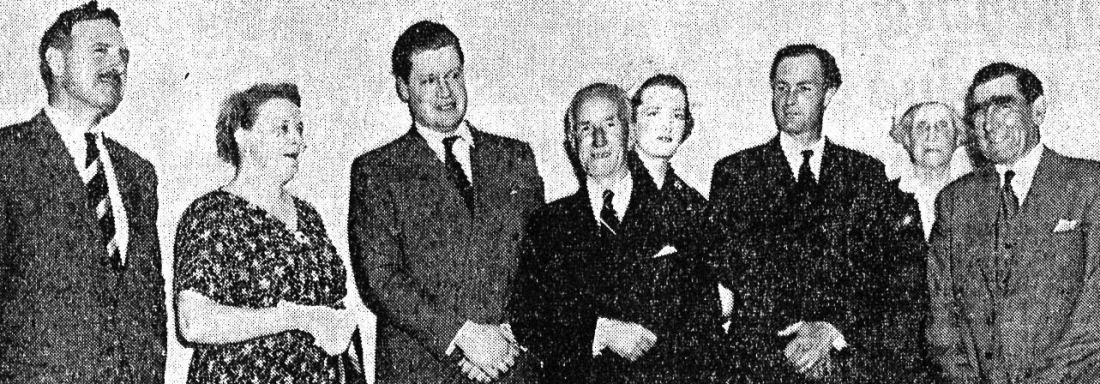
Left to Right: Lieut.-Colonel C C S Genese, Miss L N D La Touche, Viscount Althorp, Major W Blaney, Viscountess Althorp, Mr R H Adams, Mrs M M Bartlett and Mr C E North.

Their children and grandchildren will owe them gratitude

‘A memorial to industry and good sense’. That is how Viscount Althorp described Lower Heyford’s new village hall when he declared it open on Saturday Afternoon. Not one penny, he said had been spent on labour costs since the first soil was turned by the villagers in 1958, apart from the short period when the roof was being erected by contractors. He mentioned the generous help from the Rural Community Council and the grant from the Ministry of Education. Village organisations he mentioned with gratitude were the Parish Council, Parochial Council, Methodist and Baptist Churches, British Legion, W.I., Darby & Joan, School managers and the local Athletic Club.

Viscount Althorp said he was sure the Hall would not become a passive venture –
this was most likely to happen when there was a lack of youth among the committee members. The children and grandchildren of those concerned in the building would owe them a great debt of gratitude. Viscount Althorp, accompanied by the Viscountess was introduced by Major W Blaney (president of the building committee) who said the opening was an outstanding day in the life and history of the village. The committee had been exceptionally good, and he mentioned especially Mr George Masters and Mr H Thorneycroft.

Mr Hugh Adams (committee member) gave a history of the building from the first decision (by the W.I. in 1933) to form a special building fund and praised the determination and loyalty of those who gave up their spare time to work on the hall. He also paid tribute to Major Blaney as chairman of the committee. The hall must now be utilized to the fullest extent he said. The building committee would hand over to a management committee.

Mrs M Bartlett, chairman of the executive committee of the Northamptonshire Rural Community Council, said the hall should be used for everybody in the village and supply the social needs of both the old and the young. She mentioned a conference to be held in the County Hall, Northampton next October at which representatives of all village halls in the county would meet. She paid tribute to the help give by Lt-Col Charles Genese (secretary of Northants Rural Community Council and Miss L N La Touche (HM Inspector, Ministry of education). Mr C North voiced thanks to the speakers and Major Blaney a comprehensive vote of thanks. Two visitors from London who attended the ceremony were Miss M Hann (Architect from the National Council of Social Services and Miss O Emerson-Price from the Ministry of Education.

An opening dance was held at the hall in the evening.

An article from the Mercury & Herald – Friday 13th May 1960

Published in The Prattler – May 2020

The Story of Heyford (Extra): Growing Up in Heyford – John Butcher

I was born on Nov 18th 1937 at 15 Furnace Lane, or as my mother always called it Stowe Lane. Our house was built in 1934 by Denny and Sons and for whom my father worked as a carpenter.

I remember little of my early years other than playing with my friend, Norman Denny who lived next door. Apparently my mother used to allow a young girl from the village to walk me out in my pram, she had special needs and it seems a man attempted to rape her. She was sent to Berry Wood (St Crispins) where she remained for the rest of her life, about sixty years. I don’t think anyone from the village ever visited her!

Another of my very early memories was of my father holding me up at the bedroom window to show me Coventry burning and of hearing German planes flying overhead. In June 1942 my brother David was born and because of medical problems he had to have an operation. He remained in hospital for many weeks and my mother had to visit the hospital every day to feed him, so I was sent to live with my grandparents at Caldecote near Towcester. Since I was the only child in the household I was thoroughly spoilt and given the sweet rations of all the adults in the family. It is no wonder then that when I eventually returned to Heyford to start school I was not very happy about it and of course was no longer an only child. On my first day at school I was taken by Daf Thompson (Holtham) because my mother was still pre-occupied with my brother.

At this time my father was working in London and Coventry repairing war damage. He was unable to do military service because of deafness. At the end of the war he was eligible for a large bonus, but he refused it saying it was his contribution to the war in which many of his friends had suffered.

I attended Sunday school as did most of us in the village at that time and each Sunday was given a penny for the collection. However, most of us put a half penny in the collection and used the other halfpenny for an ice cream on the way home. Sunday morning was the time for slaughtering pigs in the village and there was always competition for the pig’s bladders which the butcher threw over the wall, and if you should wonder why, a pig’s bladder makes a great football.

They were happy days which consisted of going to school, playing sports on the green, playing in the brook that ran at the bottom of the field behind my house and cycling around the local villages. Sometimes I would cycle to Banbury with my other good friend, Robin Ellis, we always bought Banbury cakes home to prove that we had actually been there.

I remember V J day September 1945 very clearly. My father was playing in a celebration football match on the village green. In those days, chickens roamed freely on the green and making themselves dust baths. During the match the ball landed in one of the dust baths and unbeknown to my father when he went to kick the ball he hit the side of the dust bath instead, resulting in the bone in his leg snapping, the sound of which was heard all over the green.

When I was 10 we had a new headmaster at Heyford school, Mr Woods, he made drastic changes to the school and the village. He introduced a school uniform and changed the attitude of the village. We were to become the best village school in the county winning most competitions from sport to gardening as well as in the field of education. Two of our pupils, Norman Freeman and Eileen Garrett were selected to represent England in the junior Olympics. Mr Woods together with Mr Wilkinson started the Heyford Boy Scouts and later I became the leader of Peewit Patrol. We often camped at the stone quarry in Stowe and at Brockhall travelling on foot and carrying our tent etc on Denny’s 2 wheel builders cart, quite a journey uphill to Stowe. We once camped at Compton Verney but that time we travelled by bus. Also camping there was a troop of Girl Guides who Mr Woods warned us not to get involved with. However, he did agree that we should dig their latrines about which we were not very happy. We did as instructed, well not quite, instead of 18” wide, we dug them at 30”, quite a stretch for the girls, that was our protest. The estate was overrun with rabbits so on the first night I decided to set some snares and actually caught 3 rabbit’s, but Mr Woods was not happy, accused me of poaching and told me to bury them.

I remember well the winter of 1947 when the whole village was snowed in and the Grand Union canal was frozen. Coal was normally delivered to Mr West by barge so there was an acute shortage. We were rationed to one sack of coal and I remember going up Weedon Road with my parents to collect it by sledge.

At the age of 11 we all took the exam to get into Daventry Grammar School, I failed. However, some time later we were given a second chance which involved an interview with some of the teachers, this I failed too. Some weeks later I was on a train to Peterborough to run in the 440 yards representing South Northants at the East Midlands School competition. One of the teachers who had interviewed me was on the train, he asked ”haven’t I met you recently?” I said yes you interviewed me for a place at Daventry School, but I failed. He said then why didn’t you tell me that you could run? My education could have been completely different.

It was around this time that I had three narrow escapes from death. The first was when I sledged down Furnace Lane and went underneath a lorry which was travelling from Weedon to Bugbrooke. I went under behind the front wheels and came out the other side just before the rear wheels. Next was when my friend Robin Ellis and I exploded a mortar bomb which we had found in Stowe wood (details of this are in an old copy of The Prattler). The next lucky escape took place at Heyford mill which was no longer in use. One day, together with a group of other village boys we started to hoist ourselves up the mill floors on the chain which had previously been used to lift the corn sacks to the top floor. I had my feet in the chain and pulled on a rope that operated the lift, however, as my head went through a trapdoor in the floor, I lost my grip on the rope and was left hanging by my neck in the trapdoor. Fortunately, after a few seconds I managed to find the rope and am still here to tell the tale.

Another tale involving the mill started at a jumble sale at the school. I was sitting in a large armchair and when the time came for it to be sold I bid one shilling expecting others to bid higher. It was knocked down to me and thus I became the owner of a chair that I didn’t want. After the sale, a lady who had just moved into the mill asked if she could buy it from me. I was relieved and gave it to her for nothing and offered to carry it down to the mill for her. My offer might have been influenced by the fact that she had two pretty daughters about my age.

Guy Fawkes night was always celebrated with a large bonfire on the green. We boys would collect the wood from Crow Lane and drag it down to the village. If we were lucky sometimes we would stop a passing truck and ask them to tow it to the green for us. We saved our money to buy fireworks and had great fun throwing Jumping Jacks at the girls.

Another event that remains fixed in my mind occurred in Stowe. In those days children were allowed time off from school to help in the potato fields. We boys together with many ladies of the village were collected in an old army lorry with a tailboard held up by hooks and chains. I think it was Mrs Sargent who jumped from the lorry and landed just in front of me, minus her ring finger which had been ripped from her hand and remained on the hook of the tailboard together with her wedding ring. I swore on that day I would never ever wear a ring.

At the age of 15 I started on a two year O level course at Northampton Tech and along with two other boys we decided during our Easter holiday we would cycle to Scotland. I started out from Heyford and met them in Northampton. After 2 days we arrived in Redcar where we stayed overnight with an aunt of one of the boys. Next morning, they told me that they had decided not to continue but if I wanted they would wait for me for 2 days in Redcar. It was agreed and I continued to the Scottish border and back. Of course, they were fresh as daisies having had two days of rest but for me it was another two days of cycling to return home. I said goodbye to the boys in Northampton and travelled home only to find that my house was locked and empty.

I walked back out into the road to be met by Mrs Eales who told me how sorry she was to heat about my dad. Of course, I knew nothing about what had happened. She told me that he had had a very serious motorbike accident and was in Northampton general hospital and my mother had gone to stay with her parents at Caldecote. I got back on my bike and cycled the longest six miles of all. My father remained in hospital for many weeks and never did recover completely.

When I was 17, I decided I would like to become a Fleet Air Arm pilot, I had big ambitions and went for a medical only to be told that although I was tall enough, my legs were too short. It was after that I decided that I would like to join the Merchant Navy as a marine engineer, even though I had never even seen a big merchant ship. I gained an interview with Shell Tankers and was offered a four and a half year apprenticeship. This was to be 2 years at college in London, 18 months at sea as a cadet and then 1 year working in the shipyards. All was signed up and I left Heyford for the first time returning once a month since my father had agreed to pay my rail fare. I lived in London on a wage of £2.12 shillings a week out of which I had to pay for my food and accommodation etc.

I returned to live in Heyford after 7 years, but that story is for another day.

John Butcher – December 2019

The Story of Heyford (Extra): Dear Diary – May 1953

May 1953

Dear Diary,

What an exciting year this promises to be. Two weddings and a Coronation and they will all be different.

The first wedding is to be this month when Keith Clarke marries Brenda at the Methodist Chapel in Church Street. They are to have a reception at the Foresters Arms, and a neighbour is making them a wedding cake. I expect they will live in Hillside Road when Brenda’s parents move out.

The second wedding is my auntie Beryl who is to marry Jack Gibbins in Heyford church in June. This is special to me because I am to be a bridesmaid. Three of us are having long dresses in lemon with purple bows around the bottom and bonnets to match. Mum is putting ringlets in my hair which probably means sleeping with rags in. They are to live with Jack’s mother in Furnace Lane until a Council house becomes available for them.

We have posies to carry and I am to hold my auntie’s bouquet while she says “I do”. This means I can’t hold the hymn book, so we are all gathered around Nan’s piano while mum plays and we learn the hymns by heart. All her family play an instrument.

She wanted me to have piano lessons but I refused to practice so she said she wouldn’t be wasting money on me learning and dad said I was to stop being an awkward young lady. “What else will you do on a Saturday evening when you’re older?” Maybe I’ll regret not learning, who knows.

Last but not least, our lovely Queen Elizabeth is to be crowned in June in London and it is to be shown on the television. We don’t have one so I have been asked to go to a neighbour’s house to watch it. The Queen’s mother will be there but her grandmother died in March so she’ll miss it and I bet she would have loved to see another Coronation. The school children from Bliss school are to plant Acacia and May trees along what is now to be called Coronation Row, the little road opposite the school which splits up the village green. Dad got us some flags to pin up above our front door, and everybody seems to have something to hang up on the big day.

More good news. At last they have taken the railings down from around the war memorial on the little green and it is to be the end of sweet rationing. Bring on the lolly pops.

Until all this happens I think I’ll get my head in a book and read another Famous Five story. Shall I chose “Go Off in a Caravan”, “Go To Kirren Island” or, as normal, “Get Into Trouble”, all exciting stories with my favourite characters. I might look at my School Friend comic as well. Mum says I should keep my comics “in case we run out of toilet paper”, I mean, can you imagine?

Polly

Letter published in The Prattler – May 2020


The Story of Heyford (Extra): VH 60th “Happiness is … A can of hot tea” – Sheila Masters

Happiness is … A can of hot tea

It was a Sunday afternoon some 35 years ago and I was coming home from Church along the Green (in those days the Baptists had afternoon services) battling with the wind and trying to keep my umbrella up against a nasty thin rain. It was cold and wet and thoroughly miserable and as I passed the embryonic Village Hall, my heart went out to the volunteers slogging away inside without any home comforts.

Full of Christian charity I thought, ‘Poor Souls! They must be fed up to the teeth. I’ll pop in and cheer them up. I wonder if they’d like a flask of hot tea?’

I needn’t have worried. Work was progressing steadily, with paintbrush and hammer, drill and screwdriver; someone was singing “Granada”, someone was whistling ,”Roll out the barrel”. Jokes and chaff flew back and forth. Cold, wet and miserable, it may have been outdoors, indoors they were warm, dry and happy. And to put the final touch to their contentment, as I stood there, Freddy Partridge arrived with a large steaming tea-can. I slunk away feeling decidedly de trop, and reflecting that, for keeping the chaps entertained, and out of mischief and the wife’s way, Heyford Village Hall project was the best thing since the Home Guard.

Sheila Masters

Reprinted from The Prattler April 1995 Edition

The Story of Heyford (Extra): VH 60th “Gentleman’s Smoking Club”

Friday 27th February 1987

A highly entertaining evening was enjoyed by a predominantly male audience. The noise level reached 7.3 on the RICHTER scale on occasions due to some of the younger members getting overexcited, too much beer probably.

A good appetite was worked up by the time the food was served which consisted of pork pie, cheese, roll & pickle. Some people were lucky enough to have marshmallow for dessert. Over £300 was raised.

Reprinted from The Prattler May 1987 Edition