
The Story of Heyford: Memories of Heyford Scouts in the 1950’s V1C11

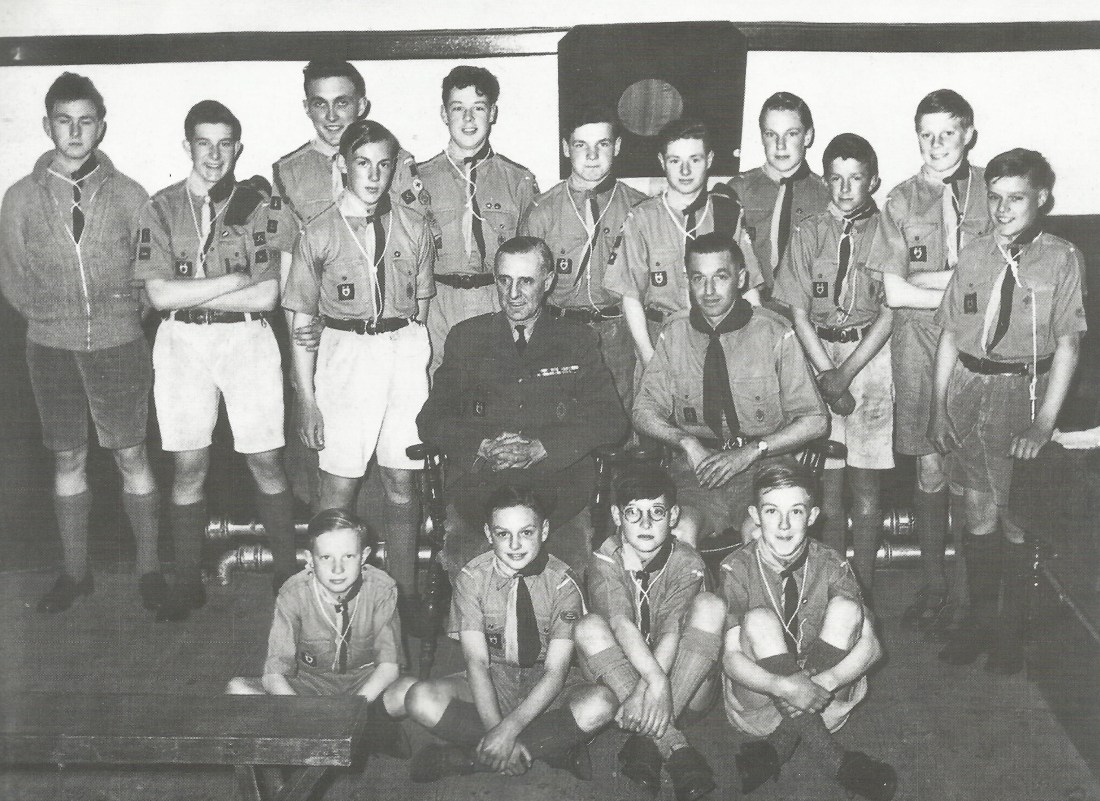
Heyford Scouts was formed in 1952. The School headmaster, Mr Woods, was the scoutmaster, ably assisted by Mr Bert Wilkinson. During the 1950s it had a thriving troop of more than 20 boys. The troop was split into several patrols – peewit, kingfisher, etc., each with their own patrol leader, and weekly meetings were held in the school hall.

The Scout Troop in the 1950s
StoryOfNetherHeyford_Scouts1.jpg

Back row: Terry Randall, Norman Denny, Tony Lovell, David Butcher, Brian Eales, Anthony Hinnick, Colin Haynes, Michael Eales, John Smith, Colin Harrison, John Haynes
Seated centre: Gordon Cabbam, Bert Wilkinson 
Front row: Michael Royle, Roger Wilkinson, Richard Danby, Ken Garrett

Photo lent by Mrs Mary Butcher

Gang shows
Gang shows were very much a part of the scout year and were always a great success. They were presented on stage in the church rooms on the corner of Church Street and Church Lane and consisted of the normal songs (such as Ging Gang Gooly) and sketches. Rehearsals seemed to go on for ever and parents must have torn their hair out trying to provide costumes for some of these. The show was sometimes taken on tour for one night only to places as far afield as Flore, and it was just as daunting performing to strangers as to family and friends.

Soap Box Derbys
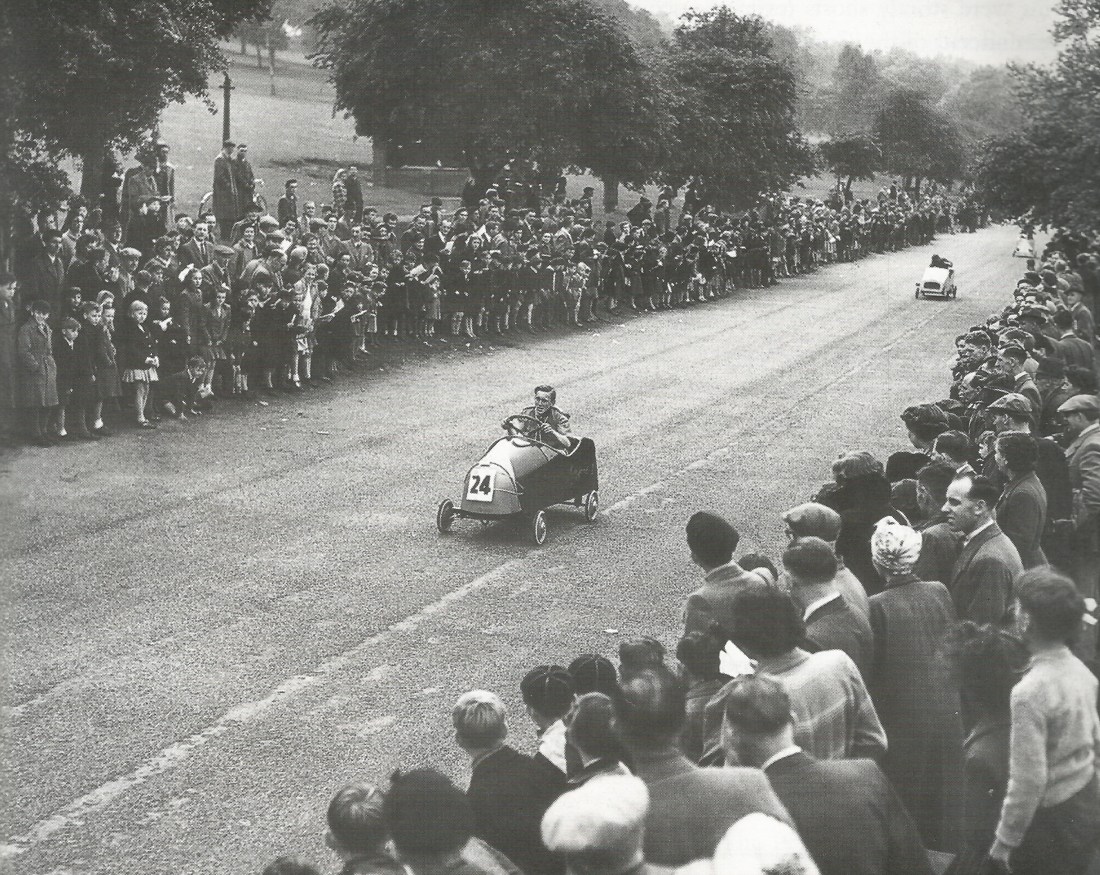
During my time in the scouts the troop entered the National Soap Box Derby. We built our soap box with a lot of help from Grose’s garage, and to our great delight we reached the national final held in Morecambe. To reach there we had to leave the village at about five o’clock in the morning and didn’t return home until late. The excitement of winning, however, got us through. The ‘car’ was on display for a month in the garage showroom, which at that time was in Marefair where the Barclaycard building is now situated. Boy, were we proud!

David Butcher winning the Soap Box Derby at Morecambe
StoryOfNetherHeyford_Scouts2

Photo lent by Mrs Mary Butcher

Camps
From later Spring until early Autumn several weekend camps were held fairly locally, and once a year the annual camp took place. This was always further afield and normally lasted for two weeks. One of these camps took us to the Pendle Hills in Lancashire, and inevitably it was raining when we arrived. After showing us to the field in which we were to make camp, the farmer pointed to the hill behind us and solemnly declared that, “If you can see those hills it’s going to rain, and if you can’t see them it’s already raining.” If memory serves me right we had about one day of dry bright weather in the whole fortnight and I seem to remember using washing bowls to scrape mud away from the front of the tents. No-one suffered any ill effects from this experience however and all returned to the village quite healthy.

During these camps one patrol was responsible for cooking the breakfast each morning and the others all went for an early morning run accompanied by the scoutmaster in order to work up an appetite. Each patrol took it in turns during the week so that nobody missed out on the joys of the run. Breakfast consisted normally of porridge made in a large billycan and coated with golden syrup diluted with hot water. This was followed by bacon and omelette. It was never a surprise if you found a generous helping of grass in either or both courses, but it never had any adverse effects on anybody.

The morning ablutions were always an adventure as we normally washed in cold water. One camp in the Lake District was near to a small stream and this was used by one or two hardy souls.

Street cred
Uniforms were strictly shorts (even the scoutmaster wore them!) and the distinctive hats with the stiff brim, reminiscent of the Canadian Mountie. These were terribly difficult to get flat again once you had bent it out of shape. This often happened, especially at camp.

I spent many pleasant and happy years in the scouts and during that time learned to cook, tie knots (some of which I still use, especially the granny), semaphore and Morse codes (all of which I have forgotten!). I also learned that it was easy to be polite and helpful and that this didn’t damage your street cred. I feel that I am better for the things I did and look back to this time with much pleasure.

Ken Garrett

~~

Extract from “The Story of Heyford” – Local book series published in the late 1990’s

Volume 1 of 4 | Chapter 11 of 13 | Pages 30 to 32

TheStoryOfHeyford_NetherHeyford_Footer

Heyford’s Historical Heritage  |  How the books were created

Index  |  Covers

The Story of Heyford: Book series – How the books were created (Afterword)

‘The Story of Heyford’ was a series of 4 books published by the Nether Heyford village community as a result of the research work completed during 1996-1997

The Heyford Local History Group

These booklets were born out of a small group of local people meeting together with the aim of recording Heyford’s past. The group became known as the `Heyford Local History Group.’

The first meeting was held at the house of Eiluned Morgan in Church Street in the Spring of 1996. During a series of informal meetings we discussed how we could collect information, photographs and stories, how we could involve other people, and in what form the information could be recorded.

The people involved in these early meetings were Eiluned Morgan, Ken Garrett, Shirley Collins, John Smith, Pam Clements, Stephen Ferneyhough and Steve Young.

Our original aim was to publish a paperback style book with photographs, probably by the end of 1998. We held two open meetings in the school hall, one in October 1996 and one in February 1997. At these meetings we had various information and photographs on display.  At the second meeting Barry Highfield gave a short talk about Mrs Court’s shop and we showed a video of old Heyford photographs. About forty people came to each of these meetings. We served tea and coffee, we made new contacts, we collected more stories, and both occasions were good social events.

By this time however it had become clear that the funds necessary and the time commitment needed to publish a full scale book were beyond our means. All of us in the group were working full time and had various other commitments. So the idea of a series of smaller scale booklets came about and what you see here is the result. There will be several booklets in the series, but with no formal structure. We have worked on the principle that it is better to write down the information as we find it, publish it and then move our efforts on to the next subject. We can always add to it in a later issue as more information becomes available.

By the people, of the people and for the people

Many local villagers have contributed to these booklets by giving information, lending photographs, offering documents, telling stories and exchanging memories. Their names will appear with particular stories as you read through them. It is truly a history prepared by, written about, and published for the people of Heyford.

However we would like to make several particular acknowledgements in relation to the preparation and publishing of these booklets. All the people mentioned below live in the village. Use of school facilities for our open meetings: Alan Watson, headmaster;  Scanning and preparation of photographs: Tim Beard of Manor Park; Typesetting and origination: Bill Nial and Key Composition; Printing:  David Farmer and Heyford Press;  Financial support: The Prattler

Accuracy

Whilst every effort has been made to report these stories accurately, please understand that much of the information has come from memory, recollection and hand-written notes. These booklets have been written to capture the ‘spirit’ of the village rather than to catalogue a series of facts, flames, names and dates. We do hope that you enjoy reading them.

Stephen Ferneyhough, Editor

~~

Extract from “The Story of Heyford” – Local book series published in the late 1990’s

TheStoryOfHeyford_NetherHeyford_Footer

Heyford’s Historical Heritage  |  How the books were created

Index  |  Covers

Village Signs – April 2019 Update

Village Signs – April 2019
Sue and I have put ourselves forward to help get Heyford looking pretty. We are starting with planting bulbs and flowers on all the Nether Heyford signs on the entrances into our village. The first thing we need to do is find volunteers who would like to help set this up. We could possibly have volunteers to look after the entrance nearest to where they live within the village.

You can contact me on 07912 971799 or by email at jillgarrett@hotmail.co.uk if you have any interest, We can get together to discuss the way forward and work out costs etc.

We really hope to get a reasonable response in helping to make this a reality going forward. People have tried in the past and failed for various reasons, so let’s try to make this work for all of us.

Thank you

Jill and Sue 

Village Signs – February 2019
The signs into the village seem a bit drab and we would like to decorate them with containers and plants to make them more welcoming. If you have any ideas, suitable containers for the plant boxes, or any other items i.e. compost and plants, we would be pleased to hear from you.

Please contact either Jill Garratt, Sue Boutle or The Prattler