The Story of Heyford: Heyford Feast – The Visiting Fair V4C4

Heyford Feast
The fair has been coming for Heyford Feast in October for as long as anyone can remember. Heyford Feast is the anniversary of the dedication of our Parish Church and takes place on the first Sunday after the 11th October. This is also the time of year when Harvest Festival activities took place – they continue to do so today — marking Heyford as one of the churches to celebrate Harvest late in the season.

The fair and the church’s celebrations were closely linked: together they formed the greatest village occasion of the year and would last one week. In the early 1900’s, the fair families attended Evensong at the church and contributed some of their takings to the collection. Today, there is no longer a link between the church and the fair but this still remains the time of year when the fair comes to Heyford.

When the Parish Council was originally set up in the late 1890’s, it stated that no fairs could use the main part of the Green. However, by then, the fair was so much part of our tradition that this ruling was later rescinded. It was a major event to be shared by all and men employed locally were often given the Monday off work to be able to enjoy the festival to the full. Likewise, pupils at Bliss School were allowed the Monday off in order to meet the fair at Upper Heyford and walk down with it into the village.

After Heyford, the fair went on to Daventry to become the centre for the ‘Mop Fair’ – so called because it used to be a time for hiring domestic staff This was at the turn of the century when fairs were still more business and trading occasions than anything else. Workers would advertise their availability for hire by standing with mops in their hands. It was a big occasion there too, and the fair would block the main roads in the middle of Daventry.

Swing-boats and roundabouts
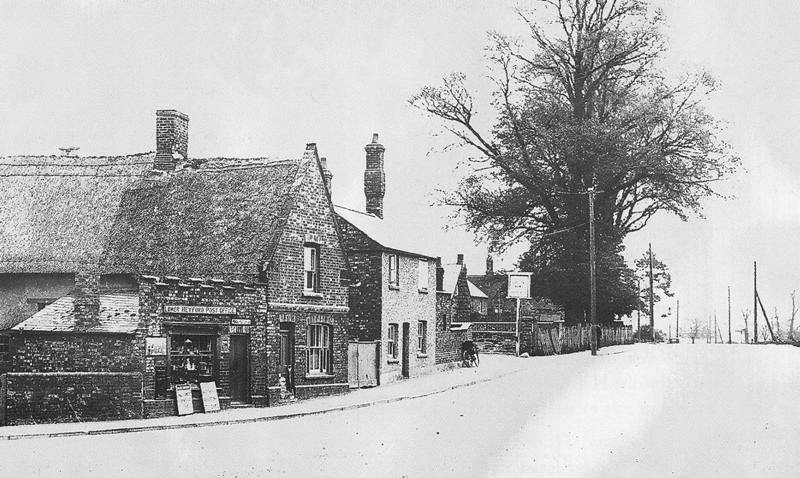
Bob Browning recalled the fair in the village from the early 1900’s. There were swing-boats and roundabouts with wooden horses and most rides charged 1d. All along the road from the Post Office to the schools were stalls: coconut shies, hoopla and darts. Fred Browning remembered the game of Aunt Sally in which you had three balls for one penny and had to throw them through a hole in a door to release ‘Aunt Sally’. There was no prize in succeeding, just the thrill of seeing Aunt Sally appear. Fred even commemorated the fair in verse as part of a poem called “Heyford Green”:

Remember the fairs, wooden horses and wares
would collect to the joy of us all…

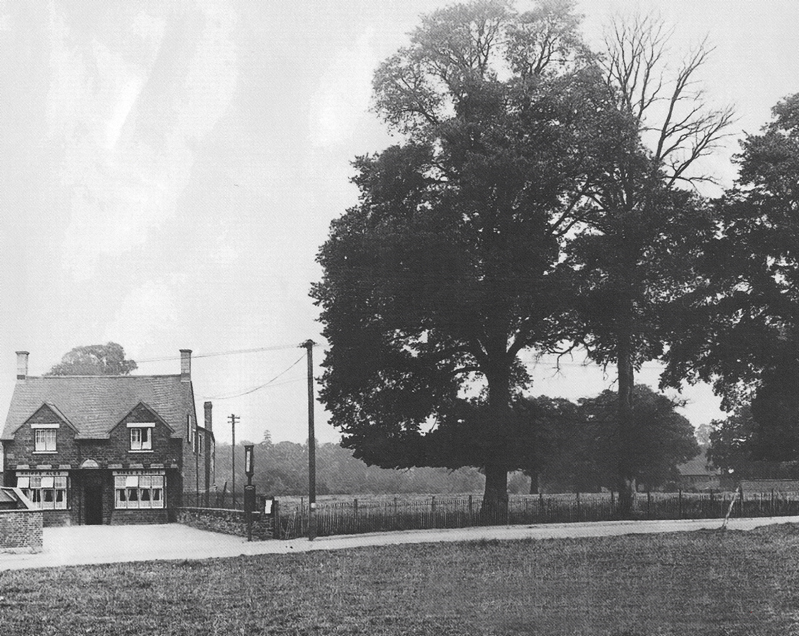
By contrast to such ethereal thinking, The Foresters pub was central to the fair’s activities because of its place on the Green and it wasn’t unusual for there to be fights there.

Great anticipation
Many villagers can still recall the fair from the 1930’s and 40’s. There was great anticipation for its arrival. The children would save up money for weeks beforehand and girls sometimes knit purses to hang around their necks with the three or four pence saved for the rides. They gathered rose hips which they could sell through the school for 3d. per lb. for making rose hip syrup. They would also collect acorns from ‘accern orchard’ which they could sell as pig fodder. Some people would collect eating apples which the fair folk would buy for making toffee apples.

On the day of the fair’s arrival there was great excitement. School children – now no longer allowed out to greet it – would often hear the fair setting up on the Green across the road. This caused them enormous frustration because they were all itching to get out and see it. If the fair happened to arrive out of school hours, the children would go to meet it along what is now the A45. They would put their ears to the ground to try to pick up the vibration from the rumble of the steam engines.

The Steam Engine
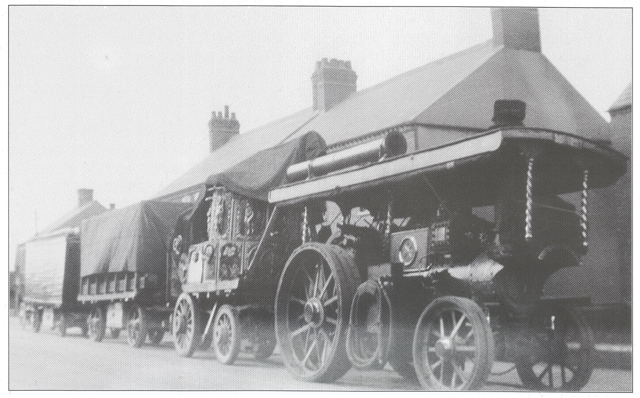
Nether_Heyford_Heyford_Feast_1

This photo, taken in the 1930’s, possibly leaving Finedon, shows George Billing’s Burnell 2625 ‘Lady Pride of England’

Photo lent by Ted Garrett

George Billing
The fair was run at that time by George Billing. He wore a bowler hat and a navy blue suit and his wife collected the money in great heavy bags full of pennies. The fair would set up near the shops and The Foresters and the main attraction was the merry-go-round. It had horses on the outside, cockerels in the middle and smaller horses on the inside. It had its own steam engine to drive it and George Billing stoked up the fire to keep it going. However, sometimes the steam would give out and the children would push the merry—go—round around by hand.

The other main attractions were the big swing boats at 1d. a go. There were many battles to see who could take their boat the highest and the fair people got cross if anyone tried to swing their boat right over! There were stalls for the coconut shies, darts, roll—a—penny and skittles. The skittles were tall and white – four in a line – and the prize for knocking them all down was a packet of nuts or Players cigarettes.

The fair also made its own sticks of rock known as ‘Feast Rock’. It was humbug flavour and striped brown and yellow. The rock stall made it by hand by pulling the sweet mixture out into long strings. By all accounts it was delicious!

Horses and steam
Two traction engines were operated by the fair. The larger one stood up by the Baptist Chapel and generated electricity needed for the lights. As there were still only gas lights in Heyford at the time, the electric light display on the Green was rather a novelty. Hilda Collins remembers how the steam engine would stand on its own beside the chapel, chuffing away: “There were clouds of steam and it would be spitting scalding hot water – quite dangerous really!” She also recalls the organ on the roundabout and how, as children, they would ride round and watch the different instruments ‘play’ in turn in the centre of the ride. The roundabout organ used a pianola device of perforated cards that played the music and – being limited to the number of cards the ride had – the same tunes would start up over and over again.

All the caravans were horse drawn and were set up in a row. At first, water for the fair had to come from a private supply but then the fair people used a public tap that was set up on the Green opposite the Denny’s house. The tap was spring—loaded, i.e. it required you to hold the tap open all the time otherwise it shut itself off again. The fair’s horses were left to graze in a nearby field or in the hollow at the far end of the Green.

When The Foresters closed at 10:30 pm each night, some men came out rather the worse for wear and would head onto the fair site. On occasion, George Masters and Herbert Clarke – both big men — came out of The Foresters and climbed up on one of the horses waving their hats and shouting “giddy-up.” Albert Garrett recalled how once, so many men came out of the pub and clambered onto the merry-go-round that it wouldn’t start. George Billing is remembered for throwing his hat on the floor and pleading with some of the men to get off.

When the fair finally closed around midnight, the last tune played on the steam organ was ‘Christians awake, salute the happy morn’ – Mrs Billing’s favourite tune. When it was all over, the children walked around looking for halfpennies and pennies that had been dropped in the grass. It wasn’t unusual to find threepence or sixpence, which was a lot of money in those days.

The Abbotts and Thurstons
After the Second World War, the Abbots brought the fair and they continued coming for another thirty years. The fairground attractions essentially remained the same, but the Abbots introduced the dodgems. The steam engines were eventually replaced by diesel and by the 50’s, the horses were replaced by vehicles.

The fair continued to be very popular and is remembered for being very crowded during this time. Many families had relatives coming to stay with them for the duration of the fair and Heyford Feast. It was also an attraction to other villages in the locality, for although the fair moved on from Heyford to Bugbrooke for a time, the site in Bugbrooke (a field on the outskirts) was not considered very suitable. Hilda Collins remembers how, on the Green, you could hardly see the stalls for the crowds of people around them. If the fair is quieter today, it is probably to do with easier access to the larger towns and the development of Northampton’s own autumn funfair.

While the fair was at Heyford, the fair children would attend Bliss School. This included old Mr Abbot’s daughter, Norma. In 1971, she married William Thurston from another fairground family and in the following year, the fair began coming under the Thurston name — as it still does today.

Around that time there was debate about the positioning of the fair on the Green. Its site near the shops was considered disruptive because of the noise and there were also complaints about the state of the football pitch on the Green after it had gone. For a time the Thurstons alternated year by year from one end of the Green to the other. Eventually they settled on its present location opposite the school.

Mary Warr, who wrote about the fairground family in her short history of Heyford published in 1970, had a far rosier view of the impact that the fair made on the village. She said, “For as long as we have been here (1953-70) the fair has been in the family. Older villagers have seen the fair people growing up and there is much friendship. I can only speak of my own experiences. We have nearly always had the fair opposite the school and have always known them to be friendly, considerate and peace—loving visitors. At night when the fair closes down, all is quiet and nothing happens to disturb our rest. I hope this wonderful relationship continues. Our places of worship have been visited by them and they have given generously to us on occasions.”

The fair in 1998

Nether_Heyford_Heyford_Feast_2

Photo lent by Stephen Ferneyhough

Nowadays the fair continues to be assembled on the middle section of the Green and it is always tidy and compact. The Thurstons bring only a selection of their total fairground equipment because they do not stay many days and space on the Green is limited. They bring the Waltzer, two or three ‘children’s rides including a helter-skelter, a range of gaming machines in an amusement arcade and a variety of side stalls. The Thurstons are based in Wellingborough with a season that runs from March to November, touring all over the East Midlands and East Anglia. Then during the winter months, they do all their rebuilding and maintenance work. William Thurston’s grandson is the seventh generation in his family to work the fairgrounds.

Sarah Croutear with contributions from Hilda Collins and Ted Garrett

~~

Extract from “The Story of Heyford” – Local book series published in the late 1990’s

Volume 4 of 4 | Chapter 4 of 8 | Page 18 to 21

TheStoryOfHeyford_NetherHeyford_Footer

Heyford’s Historical Heritage  |  How the books were created

Index  |  Covers

The Story of Heyford: Lost Street Names V4C2

Census Returns

There has been a census return once every ten years from 1841 onwards. The only exception was in 1941 because of war time. The details of these census’ are made available to the public when they are 100 years old. Therefore it is currently possible to look up the details for Heyford in 1841, 1851, 1861, 1871, 1881, and 1891. They are held in the Public Record Office at Wootton Park.

Details from the Bryants map of 1837

NetherHeyford_BryantsMap_1837

Census returns are wonderful documents because they list the names of every occupant in the village, giving details of their ages, their occupations, where they were born, and their relationship to the head of the household (eg wife, son, servant, etc). The returns for Heyford during the second half of the nineteenth century show an abundance of agricultural labourers, brickworkers and furnace workers. They show a whole variety of crafts and trades people such as lacemakers, laundresses, beer sellers, coal merchants. bakers etc, and also those employed in domestic service at the Manor House and Rectory.

The census returns also state the address of the householder, but most of the returns for Heyford for this period give only very general descriptions such as “Heyford Village” or “The Green”.  However the Census return of 1871 gives very detailed street names, many of which no longer exist. The following paragraphs takes us through the returns in the order in which they are listed. This may or may not be the same order as the route followed by the enumerator, but if we assume that it is, we can speculate about where these lost street names may have been located.

Brook Farm

NetherHeyford_BrookFarm

Watery Lane

The first four households listed by the enumerator were in Back Lane. Church Lane was at one time called Back Lane, but could the Back Lane listed here have been what is now Watery Lane? The next entries in the returns are Heyford Cottage, occupied by John Smith and Farm House occupied by George Tarry, farmer of 60 acres. Was this one of the former farm houses in Watery Lane? Perhaps Brook Farm?

Middle Street

The enumerator then seems to move through to what we now know as Middle Street because the next five entries are: the School House in Middle Lane, occupied by Thomas Stanton, schoolmaster, the Olde Sun Inn occupied by George Attwood, tailor and innkeeper; and three other houses in Middle Street. From here, he seems to have walked alongside the Green, where there were then no houses, to the Foresters Arms.

Heyford Cottage prior to 1880

NetherHeyford_HeyfordCottage1880

A view of the school site and farmhouse prior to 1880

NetherHeyford_Farmhouse&SchoolSite1880

Church Street

There are then many entries listed in the area that we now know as Church Street. This was obviously the heart of the village as there are eighty households listed in this area. It can only be speculation, but the journey seems to go right down to the Manor House, then on to the Church and Rectory, and all the way back up to the Green. The entries are as follows: The Foresters Arms, occupied by John Wright; the Primitive Methodist Chapel, the sub Post Office, occupied by William Treadwell, bricklayer, and his wife Millicent; seven houses in Billing’s Yard; seven houses in Front Street; the Manor House; ten more houses in Front Street; eleven houses in Masters Row; one house in Church Street; the Rectory; the Church; 15 more houses in Church Street, including Edward Capel, butcher; 2 houses in Robinsons Yard; one more house in Church Street; one more in Front Street; six in School House Lane; and finally seventeen in Grocers Row.

An old stone house on the site of what is now 5 Manor Walk

NetherHeyford_ManorWalk

The Green

The journey then seems to take us around round the Green. The entries are as follows: twenty-eight households listed as The Green; then Farmhouse, occupied by Thomas Starmer,  farmer of 213 acres;  thirteen houses in The Barracks; and four at Crabtree Corner. Where exactly were these places?

Weedon Road

Next he goes out along the Weedon Road towards Stowe Hill: two houses in Stowe Hill Lane; one called Primrose Cottage; one called Field House; two at a place called Pincham; then High House, occupied by William Thompson, boatbuilder; two at Flore Lane, both coal merchants; six at Stowe Hill; the Globe Inn, since renamed the Narrowboat; four at Stowe Hill Yard; the Anchor Inn, possibly the building across the A5 from the Narrowboat; and two more houses in Weedon Road. The enumerator seems to have walked along the A5, taking in one house at Tanborough and two at Aldermans Hill before turning back into the village down Furnace Lane.

Furnace Lane

Finally we come back into the village down Furnace Lane. There are four houses in Furnace Road, one at Heyford Wharf,  one referred to as the Bricklayers Arms, occupied by John Dunkley,  beer seller; and five in Wrights Yard, including George Payne, furnace keeper. Here, the enumerators journey ends.

Stephen Ferneyhough

Two views of the shop and post office as they appeared before the war

NetherHeyford_Shop_PostOffice_PreWar.jpg

This photo lent by Judy Armitage, shows the newsagents and the group of cottages behind since demolished.

NetherHeyford_Shop_OldPostOffice_PreWar

This view shows the old Post Office, demolished in 1950s, Photo also lent by Judy Armitage

~~

Extract from “The Story of Heyford” – Local book series published in the late 1990’s

Volume 4 of 4 | Chapter 2 of 8 | Pages 7 to 11TheStoryOfHeyford_NetherHeyford_Footer

Heyford’s Historical Heritage  |  How the books were created

Index  |  Covers

The Story of Heyford: When We Were Young (Village Lads) V4C8

Many people in the village today remember their childhood days of the 1950’s ‘60’s. The words below record some of the memories of Ken Garrett.

The School
When we were young, Heyford School had a uniform. The blazers had a school badge on the top pocket. It was a blazing torch motif as seen on the road signs for schools.

Sports days were held, as they are now, on the village green, but we also sent representatives to a county sports day which was held at the sports field of Daventry Grammar School. Swimming lessons were also on the agenda and this meant an afternoon out on a Yorks coach to the Midsummer Meadow swimming baths, which sadly disappeared a long time ago, although the water was never that warm. A lot of people owe their swimming prowess to those days.

The headmaster at that time was Mr Woods who was quite strict, and if he found any of his class out on the streets after a certain time he would send them home saying that they needed to be at their best to do justice to their lessons the next day.

Gardening was also part of the school day and the school gardens were found in different places, firstly on the Bugbrooke Road, then in the jitty near to the new school house, and then in the garden behind the school itself.

The Fair
When we were young the fair always set up at the Furnace Lane end of the village green for Heyford Feast. The green was, to say the least, uneven at that time. It was levelled at the time the motorway was built. The dodgems were the main attraction, together with the octopus ride which was added later. The dodgem track had to be set up using large heavy wooden boxes in order that the track was level, and a series of steps up to the track side were to be found at one side. Because of this levelling process there was a big gap under one side of the track which gave us a great hiding place for our games of hide and seek or to read our comics, or dare I say it, to smoke our Woodbine cigarette which could be won on the penny slot machines.

The stallholders would often give out vouchers for free rides on the dodgems in exchange for us fetching water for them. This we did in churns similar to milk churns which were heavy, especially when filled with water obtained from the tap at the bottom of Furnace Lane. The stand where it situated is still there. And it tested our ingenuity to the limit – our home-built ‘go-carts’ were the normal solution. The landlord of the Foresters Arms, Tommy Rolfe, was also known to hand out vouchers although what the reason was, I cannot remember.

When the fair had been dismantled and moved on we would always search the ground where the various stalls had been in case there was the odd stray penny.

Fox and hounds, swimming, and scrumping
When we were young we played ‘fox and hounds’ in the evenings. This usually entailed two or three ‘foxes’ setting off to be chased after a suitable wait by the rest of the group. The boundaries for this pastime were normally the brickyard in Furnace Lane, the river on the other side of the village, ‘Lover Lane’ bridge on the Bugbrooke Road, and the canal bridge on the Weedon Road. Games like this would last for most of the evening and it was not unheard of to run across the river with water up to the knees in order to avoid capture.

We also swam in the river on warm summer days, either by the old Coach Bridge below the manor, or in what we knew as ‘the baths’ situated between the road bridge and Heygates. We did swim in the canal as well. Was it really cleaner that it is now? And this we did at White Bridge, or at Sandbanks which were to be found along the Weedon Road stretch between Swingbridge House and the road bridge.

After swimming and in season we were known to go scrumping in Bens Orchard, and if we weren’t caught we would climb the hay bales in the dutch barn that stood in the orchard and eat our fill. If discovered it was every man for himself!

OH HAPPY DAYS!

Ken Garrett

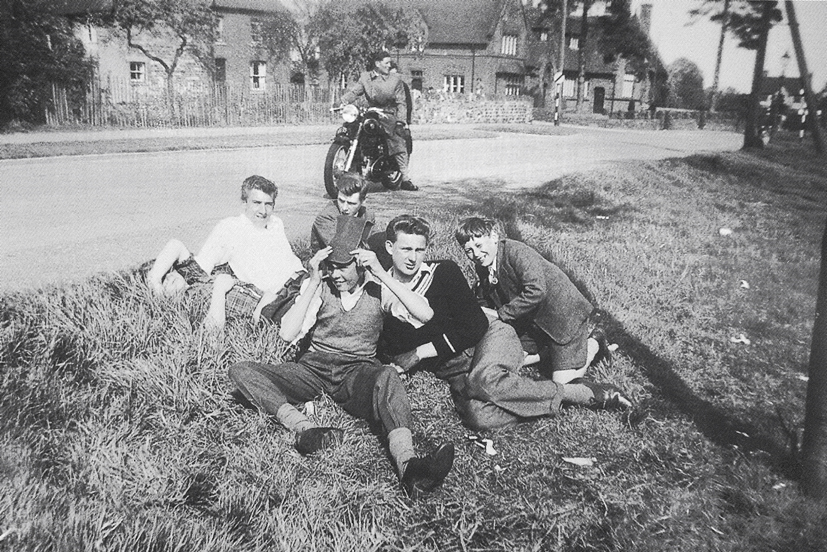
The village lads

NetherHeyford_VillageLads_1950s

This photograph, taken in the early 1950’s, shows some of the village lads, including Tony Nickolls, Colin Haynes, Barry Nickolls and Brian Clements.

~~

Extract from “The Story of Heyford” – Local book series published in the late 1990’s

Volume 4 of 4 | Chapter 8 of 8 | Page 31 & 32

TheStoryOfHeyford_NetherHeyford_Footer

Heyford’s Historical Heritage  |  How the books were created

Index  |  Covers

The Story of Heyford: Life at Heyford Mill V3C8

I was one of a family of three who moved into the mill house in November 1954. My mother had been a housekeeper at East Haddon where she lived in a tied cottage with my sister and myself. Due to ill health she had to give up her job, and of course the cottage. We met some friends of ours, Betty and Bert, who lived in the mill house. They put us up, but when we had been there some weeks they moved with Bert’s job on the railway, so we took over the tenancy of the mill house.

Primitive

It was very primitive to say the least, but at last we were in rented accommodation again. For the £1 per week rent we had a unique dwelling. Having no electricity, mains water, or gas, we used oil lamps and candles for light, and a large black range to cook on, for which we had to collect wood from around the fields. The coalmen Guy and Bob West couldn’t deliver coal to the door because the track was so pot-holed. They thought it would break the axle of their truck, so they left the coal at the second field gate.

In the kitchen we had an earthenware sink. Above it was a pump which you had to ‘prime’ to get the water up from the spring below. To prime it you had to turn the metal pipe (which swivelled) upside down, pour a pint of water down, and then pull a handle, much like a beer pump, and so get your water. The wash-house was a shed opposite the kitchen across the yard. It had a large metal copper which was mounted on bricks, with a space to light a fire beneath it, and so heat the water.

But the greatest delight was the loo! It was in a shed at the far end of the house. It had a wooden seat with a bucket below, which when full had to be emptied and the contents buried in the garden! Home produced manure! When you went after dark you had to go armed with various items — a candle in a jam jar to light your way, and a thick stick and a bucket to bang on to frighten the rats out of the building before you went in! But for all that it was a most happy place to live.

Flooding

We had to go across the fields to get the shopping from Mrs Courts shop, and we bought paraffin, candles and stamps from Mrs Blaney’s store. That was when the weather was fine. When it rained the house did get flooded in the hallway and the main room, but the kitchen was above water level so that wasn’t too bad. When the weather was bad we had to paddle through the mud to the large dutch barn, then past two fields to the top gate (change from wellies to shoes). Then we walked along the main road to Upper Heyford and down the lane to Nether Heyford (Lower Heyford in those days). Sometimes the lane was flooded near Crow Lane so we had to paddle through freezing water.

I married from the mill in 1955 and had my eldest daughter in April 1956. The ambulance taking me to the Barratt got bogged down in mud, but managed to get me to town in time for the birth. Then in September 1956 we were given a council house in Hillside Crescent with all mod cons.

It was a hard life at the mill, but at the same time an experience that my sister and I are pleased to have shared. We were the last people to live there and it is so sad to see the dreadful state it is in now.

Wendy Blackmore

~~

Extract from “The Story of Heyford” – Local book series published in the late 1990’s

Volume 3 of 4 | Chapter 8 of 17 | Page 17

TheStoryOfHeyford_NetherHeyford_Footer

Heyford’s Historical Heritage  |  How the books were created

Index  |  Covers

The Story of Heyford: Heyford Mill V3C7

The Domesday Survey of 1086 includes a record of ‘Haiford with one mill rendering 16s.’ There has presumably always been a mill on this site since those days. The mill buildings are marked (though un-named) on Eyre’s/]effrey’s map of 1771. Bryant’s map of 1827 marks them simply as ‘mill’, but the one inch OS map of 1835 shows it specifically as ‘Heyford Mill’. There were a number of mills along this stretch of the river Nene – at Dodford, Flore, Heyford, Bugbrooke, Harpole, Kislingbury, and Upton. Sadly though, like most of the others, Heyford Mill has fallen into disuse.

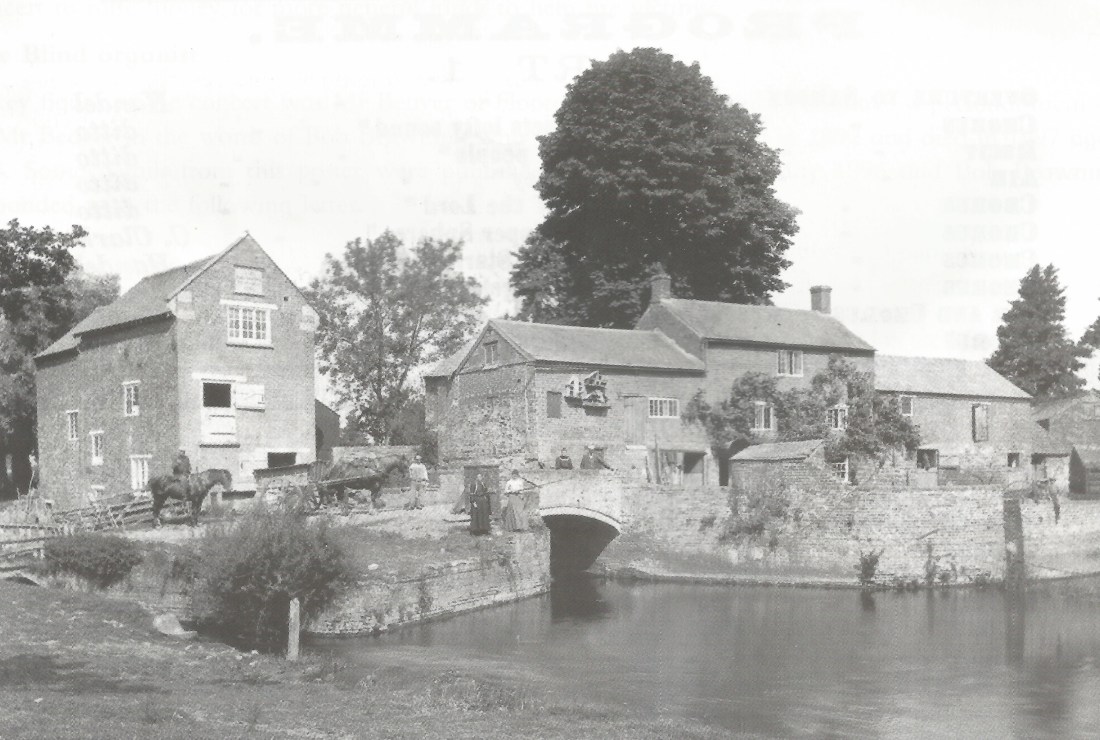
The current buildings, though now derelict, consist of a millhouse, a cottage, and several barns and outbuildings. The building at right angles to the mill stream appears to be the oldest one on site and it is thought to have had an undershot waterwheel. The building on the south side of the stream is considered the most recent, and had an overshot waterwheel. There is a plague built into the front wall of the mill which states: ‘].D. — erected 1821, restored 1881’. The lower part of the buildings are of stone and probably form the original part built in 1821. The upper part which is of brick was probably added
during the 1881 restoration.

The mill in the early 1900s

NetheryHeyford_Mill_1900

This photograph, lent by David Banner, shows the mill buildings as they appeared in the early 1900s. The building on the left is the new mill with an overshot wheel. In the apex above the window is the plaque referred to in the paragraph above. The building on the other side of the bridge is the old mill with an undershot wheel. The slightly taller building in the centre is the mill house, and to its right is the stable block.

The Cosford family

From the late 1700s until the early 1900s the mill was run by the Cosford family. The militia lists of 1777 and 1798 for Upper Heyford both refer to ‘Thomas Cosford, miller, with one water mill capable of grinding 20 quarters per week’. The census returns for 1841 and 1851 show the occupants of the mill as being George Cosford, born around 1804. Also living there were his wife Sarah, their twelve children, and three servants. George Cosford died in 1867. The census return of 1871 shows the occupier as George’s son Edwin George. He was born in 1845. The Kelly’s directories of 1885 and 1914 both list ‘Edwin George Cosford of Upper Heyford’ as ‘miller using water power only’. Edwin’s son, Arthur Thomas, ran the mill with him.

The Banner family

During the first world war, John Banner came to work for Edwin and Arthur Cosford as their miller. He later took over the rent of the mill and continued to run it with his son John. The Banner family continued to run the mill until it eventually closed in the 1960s. Around 1915 John Banner bought a bakehouse in Weedon where his other son James did the baking. They ground the grain at the mill and mixed it with other grades of flour to make bread. James’ wife became known as ‘the bakers lady’ because she took the bread by cart to the villages.

After a lifetime of working in a dusty environment, John Banner developed ‘millers asthma’ and he eventually died in 1933 at the age of 63. His wife continued to live at the cottage until she died in 1943. She was the last member of the family to occupy the cottage.

Around this time, James and John bought the mill (it was originally only rented) and continued trading under the name of Banner Brothers. In addition to growing and grinding their own grain, they provided a milling service to other local farmers. Some of the farmers who came were Charlie North from Upper Heyford, and Billy Whitton, Reg Collins, and Oliver Adams from Lower Heyford. The route from Lower Heyford was along Church Street, through the Manor yard, across North field, and over Coach Bridge. This route from Lower Heyford to the mill is clearly marked on the 1834 ordnance survey map as a track, but on the modern map is shown only as a footpath.

Coach Bridge

Coach bridge was an ancient stone bridge, just wide enough to take a horse and cart across the river. However it had fallen into poor repair and was eventually dismantled in the early 1960s. Now it has been replaced by a simple concrete foot bridge behind Manor Park.

Bob Browning (1892-1997) recalled Coach Bridge with the following words which he wrote for the Prattler several years ago: ‘Take a walk down Church Street, straight on past the Manor House, across the first meadow (I think it is called Manor Park now), and you will find a most unusually built bridge. The two sides are stone built, perpendicular, and it has a flat top and very stout girders of oak with oak railings. This bridge must be  centuries old and possibly was built during the Danish occupation as ‘Hei’ and ‘Forde’ are Danish words. ls this the place from which the village was first called Heiforde?’

Working life at the mill

From 1954 until 1960, the mill continued to be run by James’ sons Jim and Anslem. Jim, who provided much of the information for this article, described to me how the mill worked. The wheat or barley would arrive by horse and cart. It was carried to the top of the mill by a series of chains driven by the mill wheel, and tipped into the garners. It then ran via a spout down to the stones for grinding, and out into the tubs for the farmers to take away.

The wheel was almost certainly the one that had been there since the restoration of 1881. The cogs were made of applewood, and when they wore out, they were replaced by new ones made by a wheelwright called Les Phillips in Flore. The stones, which were of Derbyshire granite, each weighed more than a ton, and would last around twenty to thirty years. The bottom stone remained stationary, and the top one rotated. Both had grooves carved into them to allow the grain to flow. Jim and Anslem both learned the trade of ‘dressing the stones’, that is carving or ‘pecking’ the grooves in such a way as
to ensure that the grain flowed evenly.

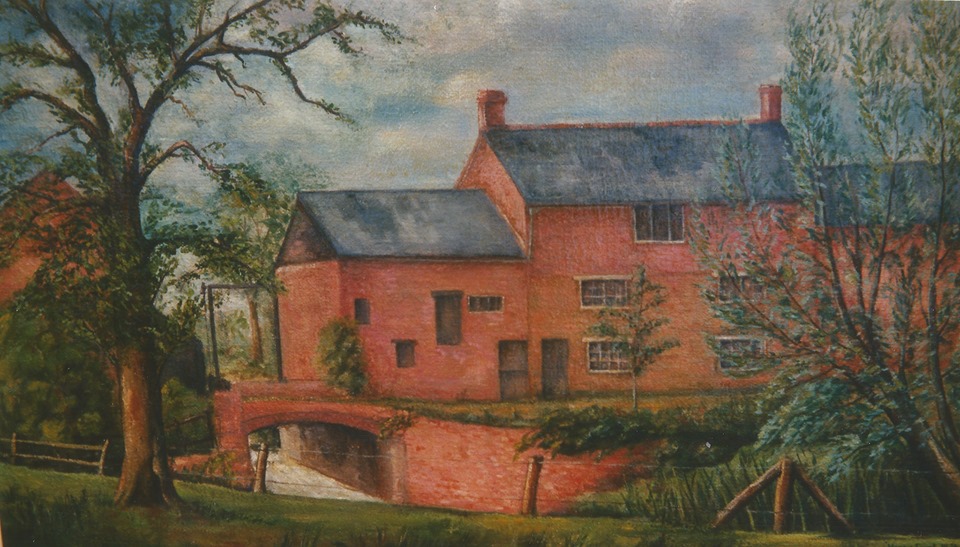
The mill as it appeared in 1976

NetherHeyfordMill_1976_C.jpg

The photograph above is from a painting owned by Jim Banner. It was painted in 1976 by Harry Frost and shows the appearance of the buildings before they became derelict.

The closure 

When the mill was working, the building shook with vibration. This eventually caused it to become potentially dangerous and too expensive to repair. This, together with the development of modern electrically-driven mills such as Heygates at Bugbrooke, made it necessary in 1960 for Jim and Anslem finally to close the mill. It was the last of the mills along this stretch of the Nene to close, and therefore marked the end of an era.

They applied for planning permission to convert the buildings into living accommodation, but it was refused because the area is in a flood plain. When the river rises it occasionally breaks its banks, and it is not uncommon for the ground floor to become flooded with several inches of water. This really made it impractical to do anything with the buildings. Until the 1970s they were in reasonably good repair, but the damage created by vandals, together with the effects of the wind and rain, have caused them gradually to become derelict.

Stephen Ferneyhough

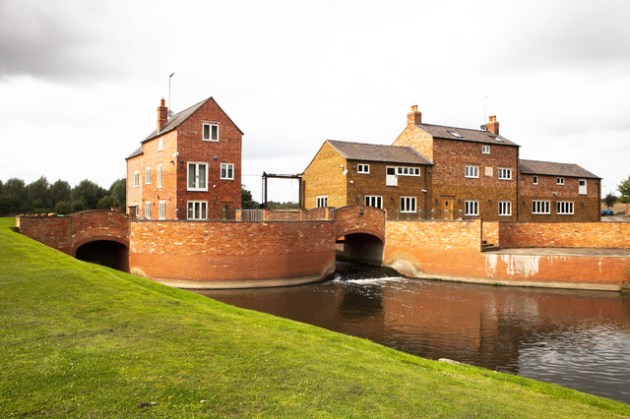
The Mill in 2020

TheStoryofHeyford-HeyfordMill2020_2

Photo by Tactico Photography:
www.tactico-photography.co.uk
www.houzz.co.uk

Jez Wilson

~~

Extract from “The Story of Heyford” – Local book series published in the late 1990’s

Volume 3 of 4 | Chapter 7 of 17 | Pages  14 to 16

TheStoryOfHeyford_NetherHeyford_Footer

Heyford’s Historical Heritage  |  How the books were created

Index  |  Covers

The Story of Heyford: Three Wise Men V3C16

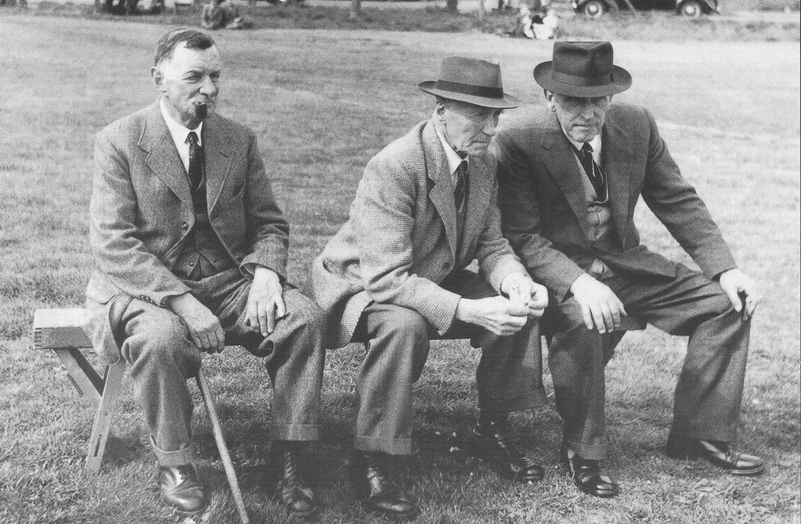
Pictured here around 1950 are Wakefield Whitton, William Denny , and Bernard Kingston. Mr Whitton owned Brook Farm before it was demolished and replaced by the modern houses in Watery Lane and Brookside. Wakefield Way was named after him.

William Denny was of the family of builders. He built the council houses in Furnace Lane. Bernard Kingston as one of the bell ringers. All three were school governors, and they are seen here on the village green judging at one of the school events .

NetherHeyford_ThreeWiseMen_1950

Photo lent by Dorothy (nee Denny) and Bill Kingston

~~

Extract from “The Story of Heyford” – Local book series published in the late 1990’s

Volume 3 of 4 | Chapter 16 of 17 | Page 30

TheStoryOfHeyford_NetherHeyford_Footer

Heyford’s Historical Heritage  |  How the books were created

Index  |  Covers

The Story of Heyford: The Canal Burst of 1939 V3C15

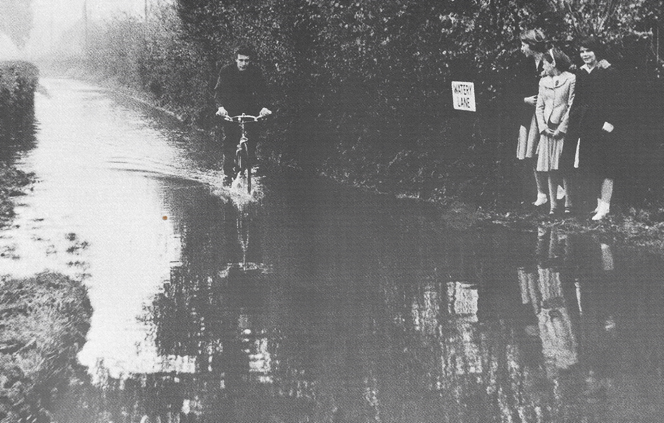
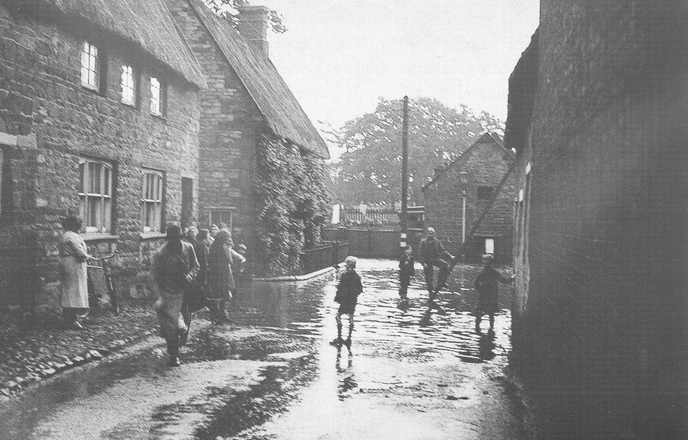
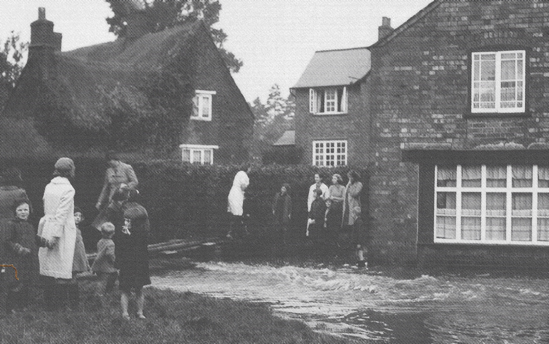
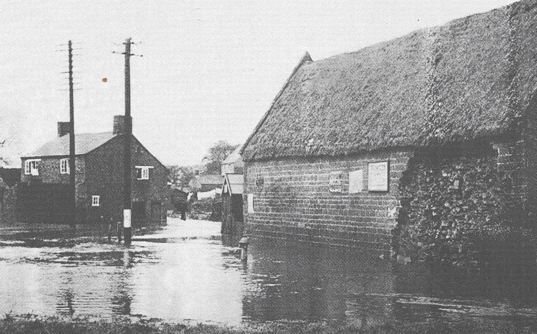
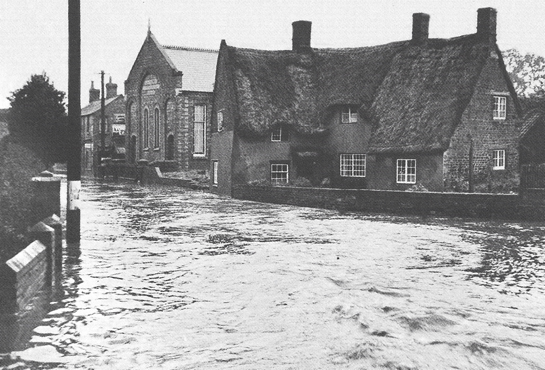
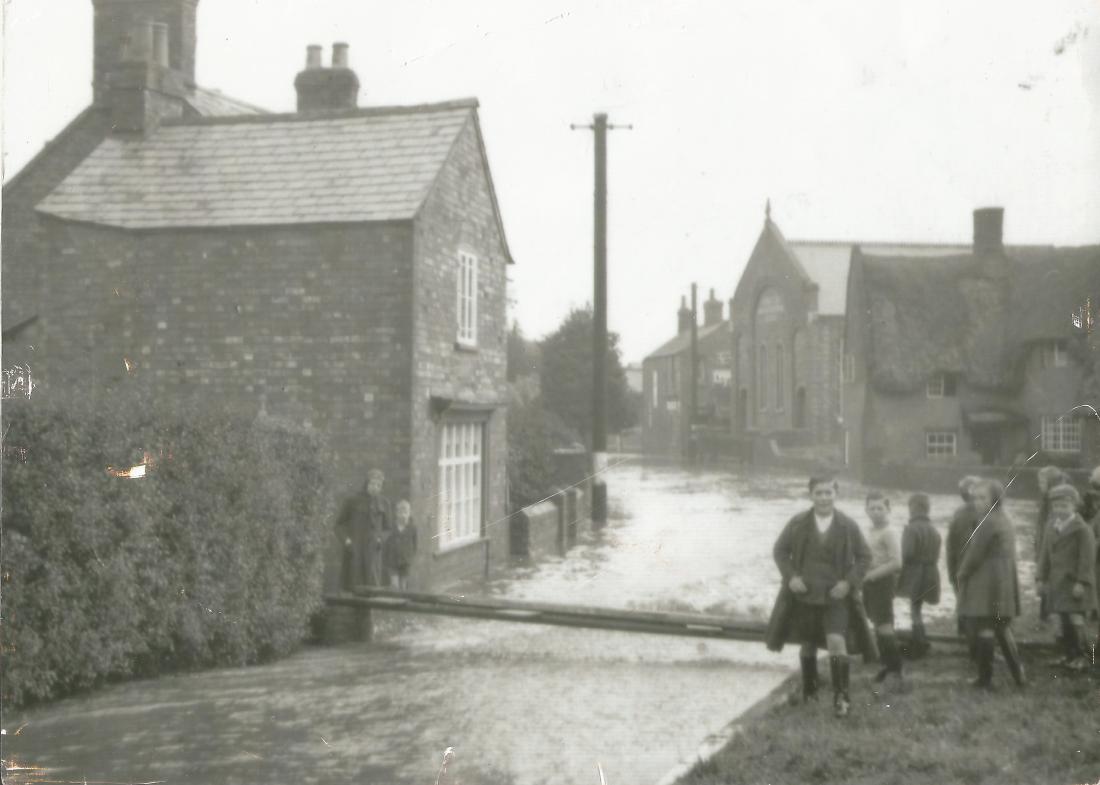
In October 1939, prolonged and heavy rainfall brought the canal level up dangerously high. A break of sixteen feet wide occurred on the Weedon bank, releasing 300 million gallons of water into an already swollen River Nene. The entire Nene valley became flooded and water levels rose into the villages. There has been periodic flooding in the village from time to time, eased to some extent by the culvert inserted in the mid 1980’s. But the recent flooding during the Easter of 1998 showed us again the damage that can he done. On each occasion it was Church Street that bore the brunt of the disaster as is illustrated in these photographs, all taken in 1939.

Watery Lane

NetherHeyford_WateryLane_1939

Church Street / Manor Walk

NetherHeyford_ChurchStreet_ManorWalk_1939

Heyford Antiques (formerly Tops of Heyford)

NetherHeyford_ChurchStreet_1939

The Jubilee Hall

NetherHeyford_JubileeHall_1939

 A view from the top of Church Street

NetherHeyford_ChurchStreet_2_1939

~~

Extra photograph added 2020

NetherHeyfordCanalBurst

Bob Smith January 2020

Extract from “The Story of Heyford” – Local book series published in the late 1990’s

Volume 3 of 4 | Chapter 15 of 17 | Pages 28 & 29

TheStoryOfHeyford_NetherHeyford_Footer

Heyford’s Historical Heritage  |  How the books were created

Index  |  Covers


The Story of Heyford: The Ancient Order of Foresters V3C11

NetherHeyford_ForestersArms_1900

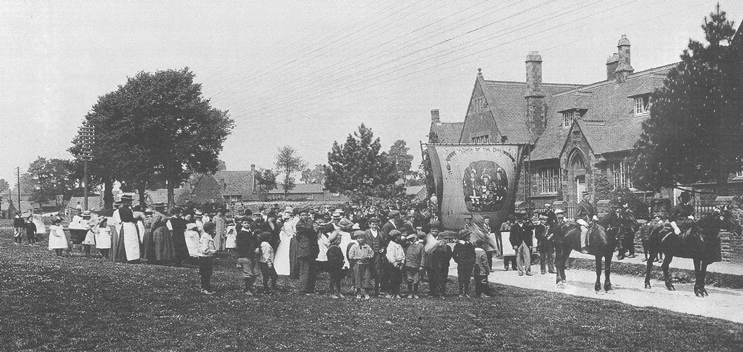
The Ancient Order of Foresters was a co-operative society. This photograph shows their gala day in 1900-1901. Could there have been any link between this and the naming of The Foresters Arms?

~~

Extract from “The Story of Heyford” – Local book series published in the late 1990’s

Volume 3 of 4 | Chapter 11 of 17 | Page 24

TheStoryOfHeyford_NetherHeyford_Footer

Heyford’s Historical Heritage  |  How the books were created

Index  |  Covers

The Story of Heyford: The Tops V3C1

The photograph below was taken in the 1930’s. On the left is the Foresters Arms. There were then no houses between here and the Denny’s house on the corner of Middle Street. In this photograph the view is clear right across the field to Middle Street.

This land was then part of the Manor grounds and was grazed by hunters owned by the occupant of the Manor House. The horses used to stand there, looking over the fence at the passers-by.  Note the old Elm trees at the edge of the field.

The road between this field and the Green was known then as “The Tops” because the children would use the flat area for spinning their tops. The houses which were built alongside the road here by Mr Denny in the 1930’s are sometimes referred to by local people as “the front row”.

The Tops

NetherHeyford_Tops_1930

Photo lent by Judy Armitage 

~~

Extract from “The Story of Heyford” – Local book series published in the late 1990’s

Volume 3 of 4 | Chapter 1 of 17 | Page 2

TheStoryOfHeyford_NetherHeyford_Footer

Heyford’s Historical Heritage  |  How the books were created

Index  |  Covers


The Story of Heyford: The Village Lads in the 1920’s V2C10

NetherHeyford_VillageLads_1920s

This photograph, lent by the Clements family, was taken early 1920’s. It includes Charlie Clements (back,left) and Arthur Parish (front, second from left)

~~

Extract from “The Story of Heyford” – Local book series published in the late 1990’s

Volume 2 of 4 | Chapter 10 of 11 | Page 25

TheStoryOfHeyford_NetherHeyford_Footer

Heyford’s Historical Heritage  |  How the books were created

Index  |  Covers