The Story of Heyford: Heyford’s Bakeries V1C4

There has presumably been baking in Heyford ever since there has been a settlement here. Both Heyford and Heyford Mill are mentioned in the Domesday Book, and the proximity of the mill meant that there was always a local source of flour.

There are several records of baking in the village during the 1700’s and 1800’s:
– The Militia list of 1777 mentions Henry Burch and Robert Burch as Bakers.
– The 1841 Census lists John James, Joseph Claridge and John Cole.
– The Kelly’s directories in the 1800’s show several bakers:

  • Mrs Margaret Jones, baker and shopkeeper, 1854
  • William Claridge, baker and retailer, 1864
  • Isaac Woodhams, baker, 1864, 1869, 1877, 1885, 1890
  • Charles Smith, 1869
  • Daniel Roe, 1877

Until the first world war the building on the corner of Furnace Lane and Weedon Road (now Tops the hairdressers) was the Bakers Arms pub, so called because the landlord Mr Pinnock had a small oven for baking bread. A small oven was also discovered in the old post office building when it was demolished in the early 1950’s.

The Faulkner family 
But from the 1890’s to the 1940’s most of the village’s baking was done by Thomas Faulkner and his family. He had two sons, Walter and Wesley, and five daughters. Much of the following information came from his great grandson Dennis Clarke.

The Faulkner family ran two bakehouses. The first was in the red brick house (now number 19 Church Street) owned by Thomas Faulkner. He ran it with his son-in-law, Fred Furniss. They were from staunch Methodist families well respected in the village. They didn’t drink or smoke. Thomas Faulkner was for many years a lay preacher at the Methodist chapel, and was also the first chairman of the Parish Council.

Then some time during the first world war he established a second bakehouse with a larger oven in the building which is now number 22 Furnace Lane. One of the reasons for needing a larger bakehouse was that he supplied bread to the Weedon Barracks. It was run by his son Wesley. This became the main bakery in the village and was active for more than 30 years. His other son Walter had a bakery in Northampton.

The flour room was upstairs and the flour was fed down to the bakery via a chute. The dough was made up the night before, kneaded into loaves, laid in tins and allowed to rise. The oven was lit between three and four in the morning with faggots of wood. When it was the right temperature, the ashes were removed and the bread put in. The oven, which was well insulated, kept warm for several hours, but even so it was an inaccurate science and it wasn’t unusual for a loaf of bread to be not quite cooked in the middle.

Sunday roasts
Although the oven was used mainly for baking bread, it was also used on Sundays to cook the roasts. The villagers would bring their joints and Yorkshire puddings to be cooked while they were at church or chapel. You would put the joint on a trivet in a baking tray with the yorkshire pudding mix underneath. The fat from the meat dropped into the yorkshire pudding mix as it cooked.  Wesley Faulkner charged 2d for this service. Bill Kingston remembers sitting on the flour bin waiting for the joint to cook. Sometimes it was difficult to recognise your own joint. Mrs Dorothy Kingston remembers as a girl picking up their joint on one occasion only to be told by her mother when she got home that it was somebody else’s! When the joints came out, the cakes went in.

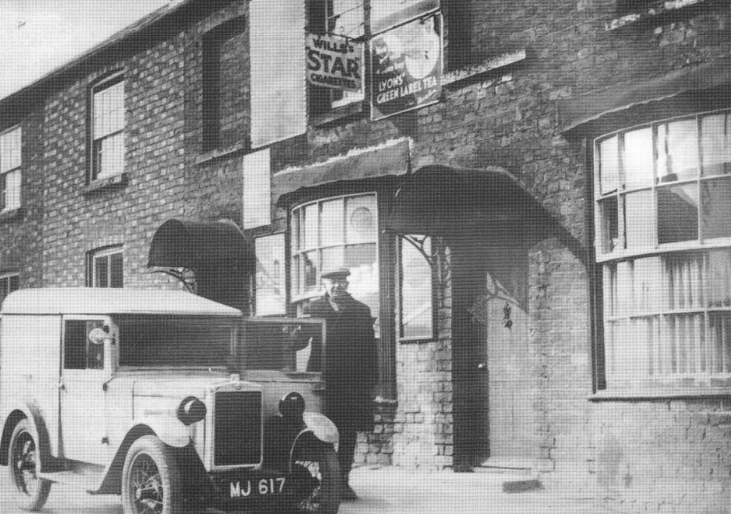
The bakehouse in Furnace Lane also had a little shop which sold not just bread and cakes, but also sweets and cigarettes. In the back yard they kept pigs and chickens as most people did. Outside the back door was a well and a handpump which is still there today. They also kept a pony and trap which Wesley used for making deliveries in the evenings to Stowe, Farthingstone and Litchborough, often not returning until late in the evening. The pony and trap were later replaced by a motorised van.

Wesley Faulkner pictured with his delivery van in the 1930’s
NetherHeyfordBakehouse

Photo lent by Dennis Clarke

Changing times
The bakehouse continued to run until around 1945. However, by this time larger bakeries were being established in town and cheaper mass-produced bread and cakes were becoming readily available through the other village shops.

For some years after this, bread was delivered to the Village by ‘Cooey’ Faulkner, the ‘Midnight Baker’. He was Ruskin, the son of Walter who had a bakery in Abington Avenue in Northampton.  He got his nickname because he delivered bread, often late in the evening and announced his presence by calling “Cooey!” Some people left baskets hanging outside their houses for him to leave the bread if he was very late. Part of the reason for his lateness was that he was always read to accept a cup of tea if offered one! Today the house is occupied by Dennis Clarke,a great nephew of Fred Furniss, and great grandson of Thomas Faulkner. The oven, though no longer used is still in place.

From the 1940’s until the 1980’s no bread baking took place in the village. We had moved into times of mass—production and faster road systems, so most of the bread came from large bakeries outside the village. The installation of gas, and then electricity meant that most families the 1950’s had small ovens in their own modernised kitchen.

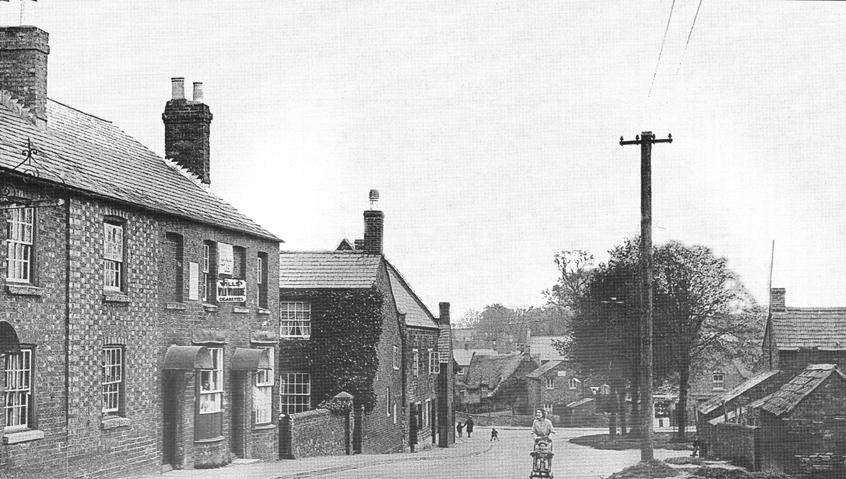
The Bake-house in Furnace Lane
NetherHeyfordBakehouse_FurnaceLane

Photo lent by Judy Armitage

This photograph looks towards the bottom of Furnace Lane and shows the old bake-house on the left hand side. To the left of this on the far left hand side of the picture is the building previously used as the King William pub. You can see here the frame which held the pub sign. Opposite the end of Furnace Lane you can see the little building which was the original Methodist chapel built in 1838 with the plaque above the upstairs windows. To the right of this is the old thatched post office, demolished in the 1950s, and to the left is the thatched cottage occupied by Mrs Anne Clarke, Heyford’s midwife for many years, which was demolished in 1969.

Heyford Patisserie
In 1985 the Heyford Patisserie was opened next to the butchers. The business had been started two years earlier by Wendy Allen who began baking at home. Her first order was from Carol at the Olde Sun to produce pies for bar meals. Then word got around, the number of customers grew, and the business became too big to run from home. At around that time, Malcolm Tarbox (the butcher) acquired the buildings in that block. The old slaughterhouse at the end of the block was renovated and converted into the present patisserie building. On 3rd November 1985 Wendy moved into her new patisserie which gave her not only much better baking facilities, but also a retail outlet. So began a service which was much needed in a village which had doubled in size since the 1950s. Although the bread came from Tees Bakery in Grafton Street, Northampton, all the pies, quiches, and puddings were baked on the premises.

Then after 11 years of long hours, six days a Week, Wendy decided to retire and the business was taken over in 1996 by Lesley Parker who continues to run it in the same way today.

Stephen Ferneyhough

~~

Extract from “The Story of Heyford” – Local book series published in the late 1990’s

Volume 1 of 4 | Chapter 4 of 13 | Pages 9,10 & 11

TheStoryOfHeyford_NetherHeyford_Footer

Heyford’s Historical Heritage  |  How the books were created

Index  |  Covers

The Story of Heyford: Book series – How the books were created (Afterword)

‘The Story of Heyford’ was a series of 4 books published by the Nether Heyford village community as a result of the research work completed during 1996-1997

The Heyford Local History Group

These booklets were born out of a small group of local people meeting together with the aim of recording Heyford’s past. The group became known as the `Heyford Local History Group.’

The first meeting was held at the house of Eiluned Morgan in Church Street in the Spring of 1996. During a series of informal meetings we discussed how we could collect information, photographs and stories, how we could involve other people, and in what form the information could be recorded.

The people involved in these early meetings were Eiluned Morgan, Ken Garrett, Shirley Collins, John Smith, Pam Clements, Stephen Ferneyhough and Steve Young.

Our original aim was to publish a paperback style book with photographs, probably by the end of 1998. We held two open meetings in the school hall, one in October 1996 and one in February 1997. At these meetings we had various information and photographs on display.  At the second meeting Barry Highfield gave a short talk about Mrs Court’s shop and we showed a video of old Heyford photographs. About forty people came to each of these meetings. We served tea and coffee, we made new contacts, we collected more stories, and both occasions were good social events.

By this time however it had become clear that the funds necessary and the time commitment needed to publish a full scale book were beyond our means. All of us in the group were working full time and had various other commitments. So the idea of a series of smaller scale booklets came about and what you see here is the result. There will be several booklets in the series, but with no formal structure. We have worked on the principle that it is better to write down the information as we find it, publish it and then move our efforts on to the next subject. We can always add to it in a later issue as more information becomes available.

By the people, of the people and for the people

Many local villagers have contributed to these booklets by giving information, lending photographs, offering documents, telling stories and exchanging memories. Their names will appear with particular stories as you read through them. It is truly a history prepared by, written about, and published for the people of Heyford.

However we would like to make several particular acknowledgements in relation to the preparation and publishing of these booklets. All the people mentioned below live in the village. Use of school facilities for our open meetings: Alan Watson, headmaster;  Scanning and preparation of photographs: Tim Beard of Manor Park; Typesetting and origination: Bill Nial and Key Composition; Printing:  David Farmer and Heyford Press;  Financial support: The Prattler

Accuracy

Whilst every effort has been made to report these stories accurately, please understand that much of the information has come from memory, recollection and hand-written notes. These booklets have been written to capture the ‘spirit’ of the village rather than to catalogue a series of facts, flames, names and dates. We do hope that you enjoy reading them.

Stephen Ferneyhough, Editor

~~

Extract from “The Story of Heyford” – Local book series published in the late 1990’s

TheStoryOfHeyford_NetherHeyford_Footer

Heyford’s Historical Heritage  |  How the books were created

Index  |  Covers

Heyford Sports 300-Club – Winners

NetherHeyfordSportsClubs

2019 – February 300-Club Winners
1st (£65) Mike Davison (14)
2nd (£30) Wendy Allen (89)

2018 – December 300-Club Winners
1st (£65) D. Dawley (202)
2nd (£30) Tennis Club (151)

2018 – November 300-Club Winners
1st (£65) Mark Smith (30)
2nd (£30) Football Club (51)

2018 – October 300-Club Winners
1st (£65) Ella Adams (62)
2nd (£30) Peter MacIntosh (136)

2018 – September 300-Club Winners
1st (£65) Richard Denny (231)
2nd (£30) Tennis Club (144)


Heyford Singers – March 2019

Netherr_Heyford_Heyford_Singers_March_2019
Let’s begin with a question this month.
When you read the words above, or think of the song Amazing Grace what springs to mind?

Memorial services or funerals? Gospel choirs? Joan Baez?
Barack Obama reciting then singing these words?
American civil rights meetings? Aretha Franklin?

Rewind nearly two hundred and fifty years to the early 1770s and a man called John Newton. He grew up with no particular religious convictions but his life was to take a series of twists and turns that impacted on his beliefs and attitudes to life. He was conscripted into service for several years into the Royal Navy and after leaving this he became involved in the Atlantic slave trade.

A violent storm in 1748, during which he came close to death, caused him to
undergo a spiritual conversion. His slave trading employment continued until 1754 when he left seafaring to study Christian theology, was ordained into the Church of England and became curate of Olney in Buckinghamshire. In co-operation with the poet William Cowper he began to write hymns. Amazing Grace was written to illustrate a sermon on New Years Day 1773, and was then published in 1779. For many years it was sung either unaccompanied or to a wide variety of melodies.

Amazing Grace isn’t a song of theology – it was John Newton’s own heartfelt expression of gratitude to God, who he believed had helped him turn from his former wicked life to fight against the ills he had practiced. Later in life, Newton became a supporter and inspiration to William Wilberforce who lead the fight to pass the British Slave Trade Act in 1807.

For many years the song settled into relative obscurity in England, but in the early 19th century a large religious movement swept the US (known as the Second Great Awakening) marked by the growing popularity of churches and large gatherings of people. In 1835 it was finally linked to the tune “New Britain” to which it is usually sung today.

In the 20th century the song became a regular for gospel and folk artists, but with the popularity of recorded music and radio, “Amazing Grace” crossed over from being essentially a gospel song to secular audiences, thus allowing artists to perform it in thousands of different forms.

Folk singer Judy Collins recorded it in the late 1960s, and the song took on a
political tone, often included in marches and protests against the Vietnam War. Joan Baez claimed that it was the most requested of all her songs, acknowledging that she hadn’t realised that it had started as a hymn, for Amazing Grace had “developed a life of its own”.

Amazing Grace has understandably been sung at some very noteworthy and prestigious venues over the years, as well as numerous protest marches and political gatherings. It has become a song that inspires hope in the wake of tragedy, a “spiritual national anthem”.

It was performed at the famous Woodstock Festival in 1969. In 2015 President Barack Obama famously recited, then sang the hymn at the memorial service for Clementa Pinckney, one of the victims of the Charleston shooting. Opera singer Jessye Norman, performed it at the end of a huge outdoor concert to celebrate Nelson Mandela’s 70th birthday. She stated, “I don’t know whether it’s the text – I don’t know whether we’re talking about the lyrics when we say that it touches so many people – or whether it’s that tune that everybody knows.”

The choir of Heyford Singers will, in their small way add to the history of this unique song, by including it in their forthcoming spring concert, Friday 10th and Saturday 11th May.

We do hope that you can join us then.

____________________________________________________________________________________

If you would like to find out more, visit the Heyford Singers page or our website:

www.heyfordsingers.org

 alternatively come along to one of our rehearsals in Nether Heyford Village Hall.

____________________________________________________________________________________

Jill Langrish

Heyford Singers – February 2019

Nether_Heyford_Singers_Feb_2019
Its that rather gloomy ‘hibernating” time of year, when our indoor companions are memories of Christmas festivities, family gatherings and the long hot summer days of 2018. As I write this, members of Heyford Singers are still enjoying their winter break, but preparing to return to rehearsals for the spring concert (May 10th and 11th). I thought I would therefore take this opportunity to write about another side of Heyford Singers – the incredible amount that has been raised and donated to various charities over the years. Following the recent Christmas concert we sent two cheques of over £225.00 to The Brain Tumour Charity and New Life the Charity for Disabled Children, a not inconsiderable sum!

This is how it works, and has done since the choir was formed seventeen years ago in 2002; during rehearsals choir members put their pennies and pounds into a sealed box which is opened a couple of weeks before the concert, and counted. This money is used to purchase all the raffle prizes for both concert evenings, with the occasional top up from funds if necessary! Meanwhile choir members offer suggestion for charities that are special to them, or that relate to local or national issues. We each vote for our two preferences. The money taken during the concerts from the sale of raffle tickets is divided between the two chosen recipients. The recent Christmas concert charities I have already mentioned above, in 2017 we donated to Medical Detection Dogs and The Carers Trust, in 2016 to Live at Home and Reach For Health, in 2015 to Tommy’s Fund and Dementia UK, and in 2014 to the British Legion and Alzheimer’s Society. Donations in earlier years have gone to such organisations as Special Baby Care unit, Northampton General Hospital, SHAME, East of England Air Ambulance, Meningitis UK, Singing For The Brain, and there are many, many more worthy recipients that I could list! We are understandably very proud of having been able to support so many wonderful charitable causes over the years!

The spring concert is slightly different in that Heyford Singers made a decision, when first formed, to annually support both the local Parish and Baptist church. This as also by way of a thank you for allowing us to perform our concerts in St Peter and St Paul Church (before the choir became too large in numbers), and for the good neighbourliness and use of equipment by the Baptist Church. This has continued to this day and each May we are proud to help and support the churches in our local community.

There are also other instances when Heyford Singers feel privileged to support charities and organisations. Whenever one of our fellow singers dies, or a close family member, we always donate to the family’s chosen charity. David Smith had been so well cared for in his last few months that a donation, in his memory, to the Emergency Assessment Bay of Talbot Butler Ward, was most fitting. Bob Wilson’s tireless commitment (with Alwyne) towards Northampton Live at Home scheme, enabling older people to stay living independently in their own homes for as long as possible, with the best possible quality of life, was a very special recipient from the choir. I could continue ….

As a choir, of mixed ages, lifestyles, experiences, even where we live and work, we delight not only in coming together to sing and enjoy music, but in so doing, raising some pennies to ultimately help those less fortunate than ourselves. To date we have raised and donated over £14,000 !

As the song says ………

Love is something if you give it away,
Give it away, give it away.
Love is something if you give it away,
You end up having more.

____________________________________________________________________________________

If you would like to find out more, visit the Heyford Singers page or our website:

www.heyfordsingers.org

 alternatively come along to one of our rehearsals in Nether Heyford Village Hall.

____________________________________________________________________________________

Jill Langrish