Flood Watch – May 2020

Flood Watch

With the Country’s lock-down due to Coronavirus/Covid-19, the only bright spot has been the improvement in the weather towards the end of March into April which has at least provided the opportunity to catch up with the gardening and take exercise, albeit with spatial restrictions. The increase in footfall on the Nene Way footpath has been noticeable not only with the regular dog walkers but with families enjoying walking or the occasional jogger.

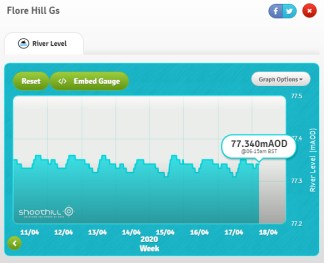
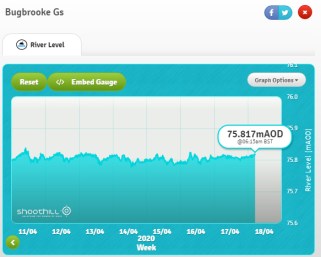
After the excessively wet February March saw a significant reduction in rainfall ending up at 80% of average and the start of a rise in daily temperatures. This continued into April when temperatures rose to 24 degrees with negligible rainfall until overnight rain on 17th April. With the Met Office forecast for the remainder of April when temperatures in the 20’s are anticipated together with low probability of rain it looks as though April will end up with rainfall around 50% of average. River levels have remained exceptionally low with any rainfall being absorbed in drying ground.

The flooding events in the North and West as a result of storms Ciara and Dennis have long disappeared from the news headlines. However a recent article highlighted the plight of those effected as Coved -19 impacts were felt. Families have been forced to return home to live in squalid conditions having to self isolate in the only habitable parts of the house, namely upstairs with limited access to facilities that we all take for granted. In the midst of our current problems let’s hope the Local Authorities / Government / Insurance Companies have not forgotten their promises of help.

In the current situation that the Country is facing the word “RESILIENCE” springs to mind. Like many words they can have multiple meanings and in the case of flooding it means accessing your own risk and providing protection measures appropriate to your property.

“ REMEMBER TO FOLLOW THE GUIDELINES AND KEEP SAFE”

J.Arnold

Flood Watch – April 2020

Flood Watch

The government eventually succumbed to pressure from communities effected by January and February storms and in the recent Budget increased the flood defence funding from £4Bn to £5.2Bn over the period 2021 to 2026.

The Met Office declared February 2020 as the wettest since records began in 1862 with the UK average rainfall exceeding 200mm or 237% of average for February. In areas such as the north and west of the UK with the most severe flooding problems this percentage rose to 350-400% !

Locally February closed with storm Jorge on 28/29th. Why storm Jorge, as storm Ellen was the next in the Met Office named storms after Dennis? As the storm approached the UK from southern Europe the Spanish Met Office designated name was adopted.

Our local rainfall for the month reached 230% of a February average and although the river flooded on 16.02.20 and peaked again on 28/29th it has subsequently remained low. This has been helped by less rainfall to date in March and a welcome rise in temperature allowing the ground to become less saturated-all good news for gardeners. Generally the River Nene has coped well largely due to the work undertaken by the E/A in 2017/2018.

Disappointingly the E/A has failed to meet the target date of August 2019 to resubmit costed plans for further funding for additional flood defence work in the Village. Let’s hope the distraction of staff to support seriously flooded areas does not reduce Nether Heyford’s priority status.

Whilst our local flooding risk is comparatively low we must remain vigilant. Besides local and National weather news forecasts a reminder of the on-line access to real time data for rainfall and river levels is listed below:-

(A) Shoothill GaugeMap:  www.gaugemap.co.uk

Upstream at Flore:

ShoothillGaugeMap-Flore

Downstream at Bugbrooke:

ShoothillGaugeMap-Bugbrooke

(B) River and sea levels  Flood information service for England from Gov.uk

(C) Northamptonshire County Council: www.floodtoolkit.com

Finally don’t forget to register with the Environment Agency  flood warning service on Floodline 03459 881188 to receive telephone and advanced flood warnings for the area.

The overriding message is “BE PREPARED”.

J.Arnold

Flood Watch – March 2020

The Storms
February’s main news headlines have focused on Atlantic storms, Ciara and Dennis which have caused chaos across the country due to prolonged high winds and heavy rain. Some areas have experienced 1 months rainfall in 24 hours (up to 150mm) with the inevitable severe flooding causing evacuation of whole communities from their flooded homes. For some this has been their third flooding in 3 years! Residents effected have said “living through a flood is the most appalling experience. Every time it rains your heart beats faster”.The trouble is todays news becomes tomorrows history and little action follows.

Suddenly the Environment Agency are realising that such events can effect mental health for years after an event with an increase in PTSD stress and depression. It is worth noting that our Flood Alleviation Study in 2017 mentioned health risks but the
Grant-Aid funding procedure did not include such a category. Surely this should be
rated highly in any cost/benefit analysis!

Clearly there is a growing problem with climate change and the increased risk of major flooding events and even the current budget of £4bn to 2026,less than 1% of the infrastructure budget,is woefully inadequate. The E/A claim that a spend of £1bn per year for the next 50 years will barely maintain the current level of risk.

Locally January 2020 had significantly higher rainfall than January 2019 and reached our expected monthly average total. With the ground already saturated and February being dominated by strong winds from storms Ciara and Dennis where wind speeds reached up to 60mph it was inevitable that another flooding event would occur on 16.02.20. Previous storms, Atiyah in Dec 2019 and Brendon in Jan 2020 winds only reached 40 mph. As a result February’s rainfall looks set to exceed its monthly average with the possibility of more flooding.

As 1 in 6 homes across the country are now at risk of flooding,excluding the effect of climate change, it is about time the E/A and local Planners refused all applications for building in areas of flood risk. 10% of new homes were built on zone 3 floodplain and in areas like Lincolnshire this figure rises to 100% where they have already experienced 7 floodings in 20 years!

The Government must now realise that flooding is a National emergency and needs to take immediate action to support those currently effected and make a concerted effort to increase funding for prevention schemes capable of dealing with future long term needs.

J.Arnold

The Story of Heyford: Heyford at the Turn of the Century V4C3

The Census return of 1891

The details from Census Returns are not made available to the public until they are one hundred years old so the one most recently available to us is that of 1891. An analysis of this gives us a pretty good idea of what life in the village was like at the turn of the century.

The houses and people

The details below tell us about the number of houses, people and canal boats.

Lower Heyford

  • 164 houses inhabited, 28 uninhabited
  • 750 people, 365 males and 385 females
  • 7 canal boats with 23 people on board

Upper Heyford

  • 22 houses inhabited, 7 uninhabited
  • 96 people, 41 males and 55 females

The houses listed as uninhabited were either vacant because the occupants were away on the night of the census, or more likely because they were uninhabitable.

A number of the families listed in the 1891 Census have continued to live in the area throughout the century: Names such as Adams, Charville, Clarke, Collins, Denny, Eales, Faulkner, Foster, Furniss, Garrett, Kingston, and Masters are still well known in the village today.

In those days street names were generally not used and there were certainly no house numbers. However several specific buildings are mentioned in the census.
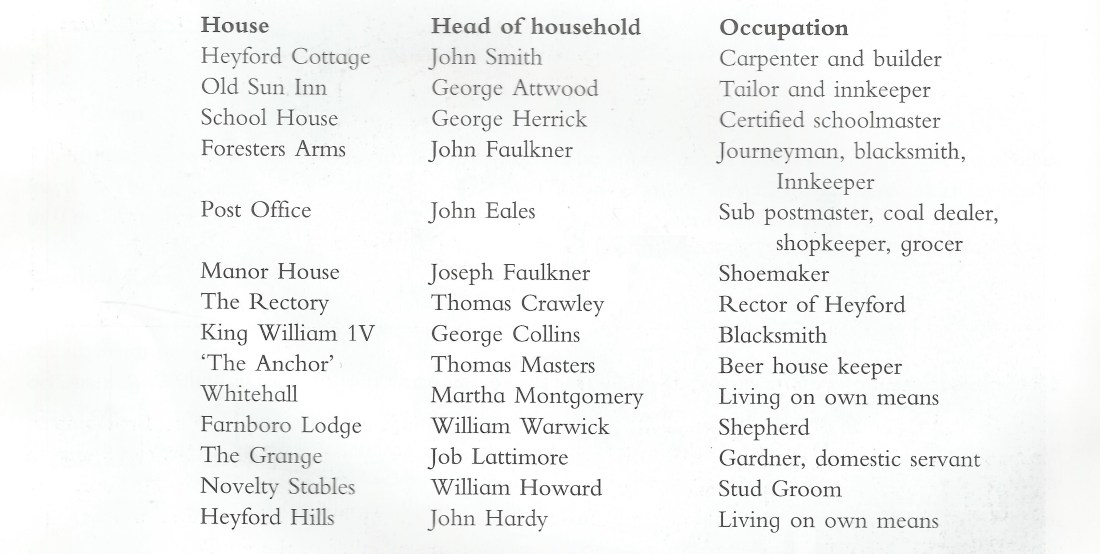
NetherHeyfordTurnofCentury_StoryofHeyford1 copy

Working life

The occupations listed in the census also give some insight into working life in the village. Here is a breakdown into the main types of occupation.

Farming. The census lists 2 farmers, 2 flour millers, 1 milkman, 3 shepherds, 1 tractor engine driver and 26 agricultural labourers.

Building. 1 builder, 1 plasterer, 1 stonemason, 3 bricklayers and 7 carpenters.

Boot and shoe making. 5 shoemakers, 2 shoe rivetters, 1 boot and shoe finisher.

Other trades. 1 tailor, 2 lacemakers, 11 dressmakers, 2 blacksmiths, 1 harness maker, 1 wheelwright, 1 gunmaker, 3 boatbuilders, 1 organ builder.

Dealers. 1 butcher, 2 bakers, 3 coal merchants, 1 timber merchant, 1 corn merchant, 1 draper, 2 carriers, and 5 publicans, beer sellers and innkeepers.

Blast furnaces. These were the biggest single employers in the village with 1 blast furnace foreman, 2 blast furnace engine drivers, 2 stationary drivers, 1 engine fitter, 2 ironstone labourers, 1 weighboy, and 28 labourers.

Brickworks. 16 brickyard labourers.

Railway. 1 railway engine driver, 1 goods shed labourer, 1 engine fitter, 1 telegraph clerk, 3 signalmen and 4 platelayers.

Domestic and educational. 1 schoolmaster, 2 school mistresses, 1 clerk, 1 governess, 14 housemaids and domestic servants, 2 grooms, 1 nurse girl, 3 laundresses, 1 midwife.

Other. 28 general labourers.

The village as it appeared in 1900NetherHeyfordTurnofCentury_StoryofHeyford2

The memories of Bob Browning (1892-1997)

Many of the details in the remainder of this chapter came from information given by Bob Browning to Stephen Ferneyhough on Tuesday 9th April 1996. Bob Browning was born in August 1892 and died in March 1997, aged 104. He was one of two brothers and four sisters all born in Nether Heyford. The story of this family appeared in Volume 2 of this series of booklets. All lived well into their nineties (94, 96, 98, 99, 101, 104) and Bob was the last and oldest surviving member of the family.

I visited him in his room at Bethany Homestead in Northampton. He was smartly dressed in a suit and tie. He greeted me with a handshake and made me feel very welcome by telling the nurse that I was a very good friend of his. He was very lively, interested in anything historical and was very glad to pass on anything he could for the interest of future generations. He lived in the village until he moved to Northampton in 1922, and most of the memories below are from that period.

Everyday life in Heyford

Life for most people was a matter of survival and self-sufficiency. The days were long, money was scarce and life was simple. Most families had an allotment and grew most of their own vegetable needs. After work in the light evenings, this was one of the main activities.

Most families kept hens. At harvest time the children went ‘gleaning’, that is picking up any remaining ears of corn to feed to the chickens. If a hen went broody, you’d put a dozen eggs under her in the spring time and so continue the supply of chickens and eggs.

Most people also kept a pig, usually in the backyard but sometimes on the allotment. The straw from the pigsty Was tipped onto the allotment, and the vegetable waste from the kitchen was fed to the pig. The boys went collecting acorns for the pigs in the autumn which they could sell for a tanner a bagful. The pigs were killed and butchered in the autumn to give a winter supply of meat. This was usually done by the butcher Ted Capel, and later by his son jack. The butcher went to the home or allotment to kill the pig. The meat was salted, and then laid in trays or hung in nets in the living room or hallway.

There were several farmers in the village producing milk. They delivered the milk, which was unpasteurised, each day in large cans. They had pint and half-pint measures which they filled and tipped into the jugs of the housewives who bought it. During the war there were shortages of anything that they couldn’t grow themselves. Sugar was rationed to half a pound a week. Butter was scarce and margarine became more common. However, they made a kind of butter by leaving the milk to stand overnight so that the cream came to the surface. By scooping it off and shaking it up they were able to make a sort of butter to use as a treat at the weekend.

There were two orchards in the village. john Barker had the one owned by the school behind Church Street. There was also Ben’s Orchard in Middle Street. This had a wall all around it, but it didn’t keep the boys out. They went scrumping for apples and pears in the autumn and stored them under the eaves the hayricks which were thatched for protection against the rain. They would always know the right time to retrieve them before the farmer came to dismantle the ricks. Nowadays there are no orchards, but the boys go garden hopping instead… presumably to get the same sense of excitement.

Lack of services

There was no sanitation, just an outside toilet. Some of these still exist in village as tool sheds or stores. but most have gone. The toilet would be emptied around once a week, usually onto the allotment. Sometime before the first world war the cart started coming. Two men employed by the council brought a two-wheeled cart pulled by horse to collect the toilet contents. It was then taken away for disposal. It had only two wheels to allow it to tip for emptying.

There was no gas or electricity. Gas came to the village just before the first world war via the Bugbrooke gasworks. Electricity didn’t come until after the second war. For light there were candles and oil lamps. For cooking there was a range with an open fire. On one side was a boiler for heating water and on the other side a small oven for baking cakes. You could divert the flames and heat to one or the other. On Sundays the wife would cook the vegetables, but the joint and yorkshire puddings were usually taken to one of the bakers for cooking while the family was at church or chapel. The main bakery for this was the one in Furnace Lane run by Wesley Faulkner. Most people had a bath once a week, often on Friday. Each house had a tin bath. The water for the bath was heated in the copper in the kitchen over an open fire. The fires were fuelled mostly by coal. There was a ready supply of coal to the village which came by canal. The Eales family who ran the post office kept a coal yard. Tom Dunkley at the Bricklayers Arms beside the canal also had a coalyard. He made deliveries by cart from which people would buy; enough to last the week.

The water supply consisted of four taps and many wells. There were four public taps in the village. One outside the jubilee Hall, one opposite the school outside Dennys house, one on the wall in Church Lane, and one near the Church rooms. A lot of the houses had wells, all supplied by the many springs in the area. The wells were dug two or three feet wide, five or six feet deep, and brick lined. The water was obtained by means of a bucket and rope. Later after the first war it became common to fit a handpump to the well.

The top of Church Street in 1913NetherHeyfordTurnofCentury_StoryofHeyford3This photograph, lent by Bob Smith, was taken in 1913 and shows a view from the top of Church Street. In the distance can be seen a small group of cottages, since demolished.

The homes

Most of the houses were of stone (either limestone or sandstone) with thatched roofs and stone slabs for flooring. Some of the older ones like the tinsmith forge opposite the war memorial had mud walls. But many of the newer houses built late nineteenth and early twentieth centuries were of brick and slate with red quarry floor tiles. There was a brickworks in Furnace Lane where Wickes now is, but again the canal brought a ready supply of both brick and slate into the village. The owners of Flore Lane Wharf were dealers in brick and slate.

Inside the homes, most walls were plastered. This was made with a mixture of sand and lime. There were two good sandpits in Furnace Lane and there were a number of lime kilns along the canal which supplied slaked lime.

Church Street – the working heart of the village 

In those days there were no street names or numbers. It was just ‘Barkers yard’ or ‘Tandy’s place’. Everybody knew who everybody was and where they lived.

The stone and thatch house behind the war memorial known as ‘the Springs’ was a laundry owned by a family called Smith. Sometime before the first world war the laundry was closed and the house was taken over by the Ward family.

In front of ‘the Springs’ was the Jubilee Hall. An article on this appeared in volume one of this series of booklets.

On the site of the jitty opposite the war memorial was a tinsmith forge. The path of the jitty then ran further to the left and came out beside the house known as ‘the Springs’. The forge was made of mud walls but became derelict and was demolished in 1920 when the New School house was built.

The small building to the right of the jitty which housed ‘Tops the Hairdressers’, and more recently ‘Heyford Antiques’ was built by William Browning, (Bob’s father) as a haberdashery and material business. Bob grandparents, Mr and Mrs Alfred Marsh (maternal side) lived next door.

To the right of this is a small three bedroomed cottage where the six Browning children were born and grew up. Behind these buildings was a saw pit and builders yard.

Next door is the house known as Tandy’s place. There used to be a right of way here through the yard to the jitty. Before Tandy was there it was occupied by a man named Gammage who ran a boot and shoe business. He married into the Faulkner family but later moved his business into Northampton. After he left it was taken over by Mr Tandy who made only heels and soles. He bought scraps from the leather factories and cut them up with special knives, building them up in layers to make heels and soles which were then sold on to shoe factories. After Mr Tandy left, it was occupied by a man named Williams who kept three or four cows and supplied milk to the village.

Further down Church Street, where the road turns sharply to the left, the red brick building on the inside of that corner was a bakehouse. It was owned by Thomas Faulkner who also ran the Methodist chapel for around 50 years until his death in 1940. He lived opposite in the stone and thatch building known as Ash Tree Cottage.

To the right of Ash Tree Cottage are some black doors. Here there used to be a blacksmith. The building belonged to the Faulkner family but the forge was used only once a week by Mr Green who came over from Flore. Later on it was Edward Wright who came (Bob Browning’s father in law). It was closed sometime before the second world war.

To the left of Ash Tree Cottage is Capel Cottage. so called because it was where a butchers business was run by the Capel family for three generations. Firstly by Ted before the first world war, then later by his son Jack. Most of the pigs in the village were slaughtered by the Capels.

Just around the corner was a small wheelwright shop run by Mr Foster. He learned his trade as an apprentice sponsored by the Arnold charity. The main local wheelwright was in Flore.

Further down Church Street, round the corner, almost opposite the Church is a stone, brick and thatch house that was a shop selling sweets, general groceries and beer. It was run by Mrs Oliver. Her husband worked on the roads (building and repairing).

Two views of Church Street

NetherHeyfordTurnofCentury_StoryofHeyford4This view of Church Street at the corner of Manor Walk shows Manor Cottage and Capell Cottage. The lady in the picture is Mrs David Browning.
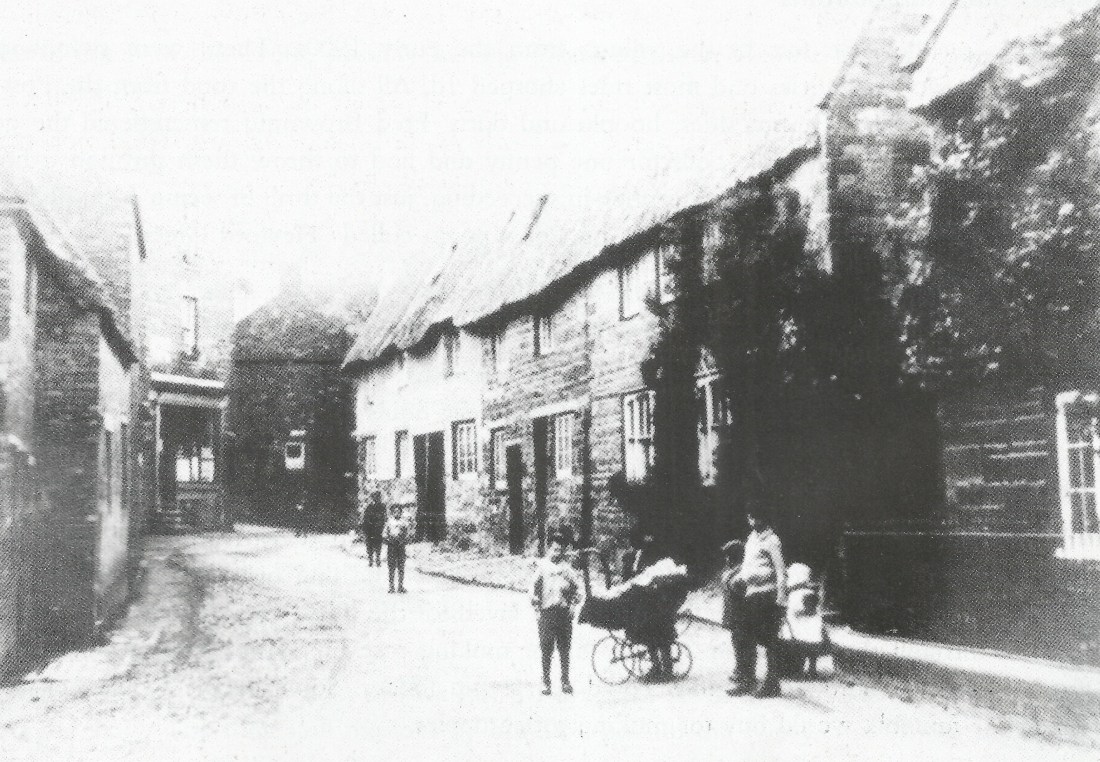
NetherHeyfordTurnofCentury_StoryofHeyford5This picture above shows the row of cottages between the two bends in Church Street. The ones at the far end have since been demolished. 

Stephen Ferneyhough

~~

Extract from “The Story of Heyford” – Local book series published in the late 1990’s

Volume 4 of 4 | Chapter 3 of 8 | Pages 12 to 17

TheStoryOfHeyford_NetherHeyford_Footer

Heyford’s Historical Heritage  |  How the books were created

Index  |  Covers

Letters: Money in your pocket – February 2020

Parking

In a recent Martin Lewis Money programme on ITV he reminded any married couple or partnership in which one partner is a 20% tax payer whilst their partner either does not pay tax or utilise their full personnel allowance,currently at £1250, should apply to transfer the unused tax allowance to their partner. This can be back dated to April 2015 and currently amounts up to a maximum of £250 for the current tax year. Simply contact the Office of Works and Pensions and provide both partners details in order to your claim.

In addition anybody who has taken out a Lasting Power of Attorney, LPA or Enduring Power of Attorney, EPA between 1 April 2013 to 31 March 2017 are entitled to refunds varying from £34 to £54 for each attorney dependent on the date of completion. Separate refunds are available whether cover is for property/financial or health/welfare. Closure date for applications is 1 February 2021. So far over £11M has been paid out. You can claim if you are a donor or attorney. If the donor has died then the executor of the will can claim. Claims can be made to the Office of the Public Guardian by phone 0300 456 0300 selecting option 6 or fill in on-line form. If successful payment will be received within 12 weeks.

I personally have successfully completed claims and received multiple refunds.

James Arnold

Published February Edition 2020

Flood Watch – February 2020

The Weather

2019 ended with a final month of excessive rainfall which resulted in another flood event on 21.12.19 bringing the total for the year to five. An analysis of the years rainfall data at local gauging stations in Daventry, Dodford, Towcester, Pitsford and Nether Heyford showed many similar trends, namely Jan-May below average whilst every month from June to December significantly exceeded the monthly averages. In particular June and October witnessed twice their monthly averages and although there were local variations, Nether Heyford recorded the highest yearly level of 826 mm, ie.18.8% above average. In spite of this Northamptonshire remains one of the lowest rainfall Counties in the Country, possibly due to its central location and surrounding elevated terrain.

These seasonal and now annual variations in weather patterns can clearly be attributed to the erratic behaviour of the jet stream and the effect of global warming. The warming in the polar regions have effected both the northern and southern hemisphere jet streams which coupled with increased El Nino activity have contributed to extreme variations across the UK. 2019 saw record July temperature of 38.7 degrees centigrade in Cambridge whilst Scotland recorded 18.7 degrees centigrade in December. Further evidence of global warming was seen in extreme levels of flooding, forest and bush fires, hurricanes and volcanic activity.

Already January 2020 has started with moderately warm weather interrupted by cold winds from storm Brendon and local flooding on 15.1.20 due to moderate rainfall on 14.1.20 falling on an already saturated catchment area. However the longer term forecast for the remainder of January is generally dry and sunny with overnight frosts. Day time temperatures will be nearer to the January average.

In spite of this let’s hope the World’s 2020 weather settles down!

J.Arnold

PS: My thanks to Tony Clewett for Nether Heyford rainfall data.

Flood Watch – December 2019

Rainfall
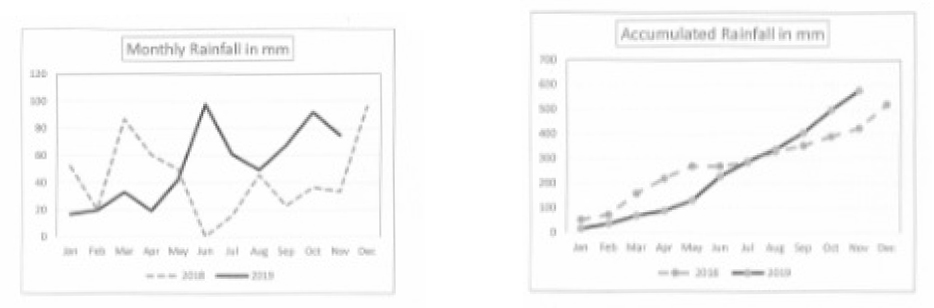
What a difference a year makes is clearly shown in local plots of monthly rainfall and accumulated rainfall. A single flood in March/April 2018 has been superceded by four in 2019, all occurring within one month period,namely 15.10.19, 27.10.19, 10.11.19 and 14/15.11.19. The latter saw extensive coverage of the floodplain and recorded the highest gauge reading of 71.9m.

FloodDecember2019

Prolonged and heavy rainfall has seen extensive flooding across the UK with Yorkshire, Lincolnshire and the East Midlands witnessing flooding of 100’s of homes. Comments from communities effected again highlighted serious problems with the management of flooding in general, namely

(a) E/A warnings too late, clearly a failure of AVM.
(b) delays in activating emergency services.
(c) new flood defences in upstream areas enhancing downstream flooding,creating
sacrificial communities.
(d) E/A misleading residents with claims of “it won’t happen again in your lifetime”.
(e) residents unable to insure properties even though Flood-Re promised affordable cover by adding a levy to everybodies insurance policies.

In this era of high technology it remains incomprehensible why advanced warnings cannot be given well in advance as there is an extensive network of real time rainfall and river level gauges. In addition satellite and ground radar provide forecasters with the ability to make 10 day forecasts and provide updates every 5 minutes.

All of this reminds me of the Bye investigations following the Northampton flooding of 1998 :-

(1) improvements in forecasting and warning systems with the use of local media and sirens to alert communities. Flood wardens with their local knowledge must form a vital link.
(2) improved communication between E/A and emergency services.
(3) in the light of the ever present risk of flooding the E/A recognised the imprudence of inappropriate development in flood risk areas and agreed to defend rigorously their advice to LPA’s to prevent such developments adding to the problems of flooding. It was agreed that the impact of climate change should be factored into any flood defences.

Currently it is forecast that over 10,000 new homes are to be built on the flood plains largely with E/A approval, contrary to their own principles in “Living on Edge”.

Building bigger flood defences is not the answer and more cost effective upstream storage and bypass diverts should be used to ensure the rivers natural capacity is never exceeded.

Clearly lessons have not been learnt, not helped by reductions in staffing levels within the E/A and emergency services.

J.Arnold

Flood Watch – November 2019

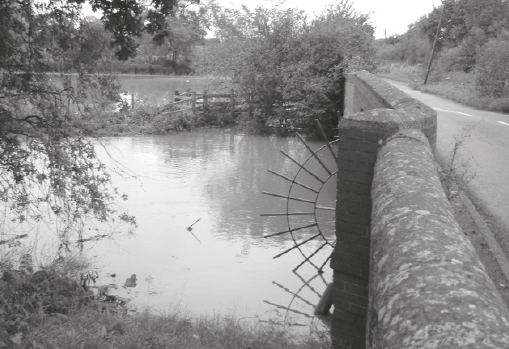
A flooding event is defined as any occasion in which river water encroaches onto the adjacent floodplain. In the case of Nether Heyford this occurs when the monitoring gauge reads 71.55m which has not occurred since March/April 2018. However with the recent changes in the weather pattern as a result of the jet stream being centered to the south of the UK, 2019 has seen increased rainfall totals per month since June .This has resulted in saturated ground and increased run off in the catchment area. This culminated in flooding on 15th October when Broad Meadow opposite Crow Lane and the fields downstream of the Bridge were flooded.

Since Easter floods of 1998 such events have occurred on average 2.5 times a year. Tracing events back to 1947 the trend has been increasing until the latest changes in weather pattern over the last 2 years. Clearly climate change is taking place with weather becoming more unpredictable as evident when comparing rainfall in June 2018 of 1mm to June 2019 of 97mm.

CommunityFloodNov2019

J.Arnold

Flood Watch – September 2019

George Clarke’s recent Channel 4 documentary “Council House Scandal” celebrated 100 years since the Addison Act of 1919 kick started Council Estate building. Sadly since the Right to Buy was introduced properties have not been replaced, hence the current shortage of Council properties for rent. GC has launched a National campaign to encourage Government to build more Council homes and has secured land in Manchester to demonstrate how to build good standard homes at reasonable cost. The programme highlighted a problem with commercial properties being converted to rentable homes under “permitted development” which fail to meet minimum acceptable standards for room sizes. Unfortunately this type of development introduced by Government reduced the power of local Planning Offices to enforce standards and bypass the formal planning processes.

The growth in permitted development could potentially lead to problems during conveyancing on house sale/purchase when the status of each building on site is investigated whether these are new build or change of use. Ideally a Lawful Development Certificate should be produced. To avoid risk to the seller/purchaser the seller can purchase an Indemnity Policy in the name of the purchaser. Not until permitted development is scrapped and the planning process returned to conventional planning application/building control will standards return to normal.

June/July/ August weather has continued to be untypical for this time of the year with short periods of high temperature near 37 centigrade and prolonged periods of heavy rainfall. Surprisingly total annual rainfall to the end of August is only 82% of average resulting from the extremely low rainfall earlier in the year.

Anyone interested in participating in discussions with the E/A over future flood defence requirements and contributing with their own local knowledge of flooding are again invited to contact me directly.

J.Arnold

Flood Watch – July 2019

Flooding issues have hit the headlines with major incidents in Lincolnshire and Tewksbury in a year when climate change has surfaced as a major issue. The E/A’s Emma Howard Boyd and Sir James Bevan have initiated the launch of a review of Flood and Coastal Management Strategy in May 2019 which will form the basis of the Government Statement in October 2019 setting out their long term goals. They claim over 500,000 homes are at risk of regular flooding requiring families to relocate their homes.

Locally 2019 started the year up to the end of May with only 52% of the average rainfall which compares with 106% for 2018. However June has seen almost continuous rainfall currently at 64% above the June average at 88mm compared with 1mm for 2018. The River has coped well rising only 1.1m at its peak on 12/13th May largely as a result of limited run off due to excessively dry land in the catchment area and the effect of the E/A work on the River and Horestone Brook.

In May the Government extended “permitted development” to allow further increase in the size of extensions to properties as part of their policy to improve /increase housing. Many Councils have expressed concerns describing the PD Policy as a planning disaster often causing conflict between neighbours resulting in unsuitable developments over which the Councils have little control. Even more concerning is the lack of protection for the individual through any suitable complaints procedure. Recent experience shows that any so called “Complaints Processes” are ineffective and biased and can only assess following of procedures not change of decisions.

I have recently held several meetings with the E/A to discuss implementation of refusal for permitted development rights under Article 4 to ensure compliance with the legal responsibility of landowners not to impede the flow of flood water as this is a criminal offence under Common Law. Unless this is implemented then building on the floodplain will continue unabated.

As a result of conflict of interest I proposed to close down CFG. However the E/A wished to continue working together especially as a new submission for flood defence funding for the Village is proposed for August/September 2019. Having spent 21 years campaigning for improvements in Nether Heyford I feel its time to step back and invite anyone interested in flooding issues to contact me so that the future of the Village can be secured.

J.Arnold